
The Guardian-We need to be prepared China adapts to era of extreme flooding
December 24, 2024 4 min 784 words
英国《卫报》在2024年12月24日发表了一篇文章,报道了中国洞庭湖周边地区在夏季洪水中的受灾情况。文章以一位居民救援自家宠物和物资,以及一位当地官员的言论为引子,介绍了中国在2024年夏天面临的极端天气和一系列自然灾害。文章提到,中国最高领导人习近平曾敦促全力以赴做好救援和救灾工作,保障湖南受洪水影响群众的安全。随后,文章以一位考古学家在洪水中的经历为例,说明了极端天气对当地居民生活的影响,以及他们应对气候变化的尝试。文章还指出,洞庭湖曾经是中国最大的淡水湖,但数十年来的农业开发使大片湖区土地被征用,影响了湖泊的蓄水能力,加剧了干旱和洪水的严重程度。中国至少有六个省份在2024年经历了重大洪灾,中国政府也认识到需要在全国范围内应对极端天气事件。中国在COP29气候危机会议上公布了气候适应行动计划,承诺建立技术平台以监测和预警极端天气事件。专家认为,中国领导层倾向于着眼长远,需要做更多准备来系统地应对气候变化的影响。 评论:该报道在描述中国水灾及其影响时,采用了较为客观的语气和准确的数据,反映了中国在应对极端天气和自然灾害时所面临的严峻挑战。然而,报道也存在一些偏见和不足。例如,报道过度强调了中国政府过去在环境问题上的疏忽,而忽略了中国政府近年来在应对气候变化方面所做的努力和取得的成果。报道还缺乏对受灾地区重建和恢复的介绍,给读者留下了中国在应对气候变化影响方面毫无进展的印象。此外,报道没有采访更多当地居民,而仅以一位考古学家的经历作为例证,可能无法全面反映受灾地区的整体情况。
Every summer, Dongting Hu, China’s second-largest freshwater lake, swells in size as flood water from the Yangtze River flows into its borders. Dams and dikes are erected around the lake’s edges to protect against flooding. But this year, not for the first time, they were overwhelmed.
For three days in early July, more than 800 rescue workers in Hunan province scrambled to block the breaches. One rupture alone took 100,000 cubic metres of rock to seal, according to Zhang Yingchun, a Hunan official. At least 7,000 people had to be evacuated. It was one of a series of disasters to hit China as the country grappled with a summer of extreme weather. By August, there had been 25 large floods, the biggest number since records began in 1998, reported state media.
Xi Jinping, China’s president, “urged all-out rescue and relief work” to safeguard the people affected by the flooding in Hunan, state media reported.
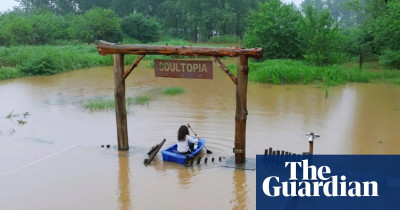
One of those people was Ren Benxin, an archaeologist who lives on a small, forested island in the upper tributaries of Dongting Hu. He calls his idyllic home Soultopia. As well as carrying out archaeological research, he provides accommodation for travellers and looks after the herd of stray cats and dogs that he has adopted over the years.
On 5 July, his home was flooded. “First, I rescued the animals. Then, I rescued the supplies,” he said. “It was the first time in 10 years that I’d experienced something like this.”
The wooden huts in Ren’s corner of the islet were nearly completely submerged in muddy water. Chickens used the remnants of destroyed buildings as rafts to avoid drowning. Ren traversed the island in a small plastic dinghy. One of his dogs, Eason, fell ill after drinking dirty flood water, and died a few days later.
“Two years ago, we had a severe drought, and this year it’s been floods. I think we need to be prepared for anything,” Ren said.
Experiences like Ren’s are becoming more common in China, as global heating makes extreme weather events more likely, as well as undermining communities’ defences against those disasters.
Dongting Hu exemplifies these challenges. It was once China’s largest freshwater lake. But decades of agricultural development meant that huge swathes of its land were reclaimed for farming, reducing the lake’s storage capacity. Both droughts and floods are becoming more serious and severe.
At least six Chinese provinces experienced major flooding in 2024. As well as the floods in Hunan, heavy rainfall in Guangdong, China’s most populous province, forced more than 110,000 people to relocate. After years of treating weather disasters as isolated incidents that require a local response, Chinese officials are becoming increasingly aware of the need to adapt to extreme weather events on a national scale.
“The harsh reality is here: the lack of climate action will cost China and present a social security threat,” said Li Shuo, director of the China Climate Hub at the Asia Society Policy Institute.
At the Cop29 UN climate crisis conference in November, China published an action plan for climate adaptation, vowing to establish a technical platform to monitor and forecast extreme weather events and to share its knowledge of improving early warning mechanisms.
It marked a shift the country which has long acknowledged the science of the climate crisis, but has focused its environmental cleanup efforts on issues such as air pollution – rather than severe but relatively rare floods and droughts.
“The Chinese leadership tends to see the long game,” Li said. “To demonstrate their far-sight and to prevent further risks, more should be done to prepare for the impacts of climate change systematically.”
For flooding victims like Ren, an official recognition of – and compensation for – the damage wrought by the climate crisis cannot come soon enough. The repair work cost him more than 70,000 yuan (£7,600), although the authorities did send some relief workers to help.
For now, Ren is developing his own ways to adapt to climate breakdown. He shuns electrical appliances after his were destroyed in the flood, and uses wood burners for cooking and heating. He plans to build a new home suspended in trees, so as to be safe from floods.
“I think extreme weather is more frequent now. So I have to be prepared for anything. If I like the place, I’ll stay.”
Additional research by Chi-hui Lin and Jason Tzu Kuan Lu