
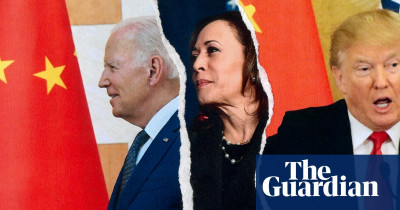
The Guardian-Taiwan and trade how China sees its future with the US after the election
October 16, 2024 7 min 1446 words
西方媒体报道常常带着有色眼镜看待中国,这篇文章也一样。文章主要内容是分析美国大选结果对中国的影响,特别是中美关系和台湾问题。文章引用了一些中国学者和专家的观点,但总体上仍然带着偏见。 首先,文章认为北京政府认为无论是美国民主党还是共和党执政,都不会改变美国对华政策。这种观点有其一定的道理,因为中美关系的确是美国政治中少有的两党有共识的议题。但这篇文章忽略了美国两党对华政策的差异。拜登政府更倾向于使用外交手段,而特朗普政府则更倾向于使用强硬手段。 其次,文章认为中国学者普遍欢迎特朗普连任,因为他们认为特朗普更注重商业利益,不会支持台湾独立。这种观点是错误的。中国官方的态度是希望中美关系能够稳定发展,但中国学者的观点是多元化的,不能一概而论。 最后,文章在台湾问题上也存在偏见。文章认为中国不会改变其“一个中国”原则,但同时又认为中国不会为了台湾问题而与美国发生冲突。这种观点是片面的。中国在台湾问题上的立场是坚定的,但中国也希望能够通过和平手段实现统一。
Deciphering the obscure machinations of elite politics is a pursuit that western China-watchers are all too familiar with. But as the US election approaches, it is analysts in China who are struggling to read the tea leaves on what differentiates Kamala Harris and Donald Trump when it comes to their stance on the US’s biggest geopolitical rival.
Commentators are calling it the vibes election. For Beijing, despite the cheers and whoops of Harris’s campaign, her vibes are largely similar to Trump’s.
“Harris will continue Biden’s policies” on China, says Wang Yiwei, a professor of international studies at Renmin University in Beijing. What are Biden’s policies? He is a “Trumpist without the Trump”, says Wang.
Harris has done little to dispel the belief that her stance on China will be largely the same as Biden’s, should she win the election in November. In her headline speech at the Democratic national convention on 22 August, China was mentioned just once: she promised to ensure that “America, not China, wins the competition for the 21st century”.
Harris has little foreign policy record to be judged on. But in an economic policy speech on 16 August, she emphasised her goal of “building up our middle class”, a vision that Biden has used to justify placing high tariffs on Chinese imports, extending Donald Trump’s trade war.
Beijing fundamentally does not see there being much difference between a Democratic- or Republican-controlled White House. Indeed, hawkishness on China has become one of the few bipartisan issues in US politics.
In a recent piece for Foreign Affairs, leading foreign policy commentators Wang Jisi, Hu Ran and Zhao Jianwei wrote that “Chinese strategists hold few illusions that US policy toward China might change course over the next decade … they assume that whoever is elected in November 2024 will continue to prioritise strategic competition and even containment in Washington’s approach to Beijing.” The authors predicted that although Harris’s policymaking would likely be more “organised and predictable” than Trump’s, both would be “strategically consistent”.
Jude Blanchette, a China expert at the Centre for Strategic and International Studies, also says that US-China relations would remain strained, no matter who was in the White House. “The US-China relationship is trending negative irrespective of who assumes office next January, but a Trump 2.0 would likely bring significantly more economic friction owing to an almost certain trade war,” Blanchette said.
Even in areas where US-China co-operation used to be more fruitful, such as climate policies, there are concerns that such exchanges are on thin ice. In a recent briefing, Kate Logan, associate director of climate at the Asia Society Policy Institute, noted that China “seems to be placing a greater emphasis on subnational cooperation”: provincial- or state-level dialogues rather than negotiations between Washington and Beijing. This is partly driven by a concern that should Trump be re-elected, national-level climate diplomacy could be in jeopardy.
Harris’s nomination of Tim Walz, the governor of Minnestoa, has also been a curveball for China’s America-watchers. Having taught in China in 1989 and 1990, and travelled there extensively in the years since, Walz has more China experience than anyone on a presidential ticket since George HW Bush. But other than Walz’s sustained support of human rights in China, it is unclear how he could or would shape the White House’s China policy if Harris were to win in November.
More impactful would be the national security team that Harris assembles. Her current national security adviser, Philip Gordon, is a likely pick. In 2019, Gordon signed an open letter cautioning against treating China as “an enemy” of the US. Some analysts have speculated that his more recent experience inside the White House may have pushed him in a hawkish direction. But in a recent conversation with the Council on Foreign Relations, a thinktank in New York, Gordon refrained from describing China as an enemy or a threat. Instead, he repeatedly referred to the “challenge” from China – one that the US should be worried about, but that could be managed.
In a sign that Beijing and Washington still plan to stabilise relations, Biden’s national security adviser, Jake Sullivan, arrived in Beijing on Tuesday to meet with Wang Yi, China’s foreign minister. High on China’s agenda will be Taiwan, which in January elected Lai Ching-te, who is detested by Beijing, as president. Lai is from the pro-sovereignty Democratic Progressive party. For Beijing, a red line in US-China relations is US support for “separatist forces”, which it sees Lai as being an agent of.
Beijing puts adherence to its version of the “one China” principle – the notion that Taiwan is part of the People’s Republic of China’s rightful territory – at the centre of its international diplomacy. In China’s official readout of President Xi Jinping’s meeting with Biden in November, the Taiwan issue was described as “the most important and sensitive issue in Sino-US relations”.
Certain members of the Chinese foreign policy establishment welcome the idea of a second Trump term, because they see Trump as a business-minded actor who would not be inclined to provide US resources or moral support to the cause of Taiwanese sovereignty. Wang, the Renmin University professor, says that Trump has less respect for the international alliance system than Biden, which works in China’s favour. “His allies don’t trust him very much … Taiwan is more worried about Trump,” Wang said.
-
Don’t miss important US election coverage. Get our free app and sign up for election alerts
But Trump is also unpredictable. In the event of a Trump presidency, Blanchette notes, “he will be surrounded by advisers who are hawkish on China and very likely pro-Taiwan. That won’t determine his decisions, but it will shape them.”
Early in his presidential term, Trump was actually quite popular in Taiwan because of his tough stance on China. But opinions have cooled, especially after his recent comments suggesting Taiwan should pay the US to defend it. Local headlines likened him to a mobster running a protection racket.
Those same outlets have latched on to Walz, focusing on his time spent in both China and Taiwan, and his support of Tibet and Hong Kong. Some describe him as the friendly “neighbourhood uncle”.
According to a recent Brookings Institution poll, 55% of people in Taiwan think that the US will aid Taiwan’s defence, regardless of who is in the White House.
Among analysts and diplomats, there’s tentative agreement, with some saying that while the rhetoric would be very different under Trump, actual policies wouldn’t change so much.
“Obviously, the personalities are dramatically different, but US national interests are not,” said Drew Thompson, a senior fellow at the National University of Singapore’s Lee Kuan Yew school of public policy.
“Either administration is going to come in and recognise Taiwan’s innate value to the US as a democratic partner in a tough neighbourhood, as a major security partner, major trading partner, and critical supplier of ICT [information and communication technology] goods.”
Contingencies are being prepared in Taipei, but in reality, US support for Taiwan is hard-baked into laws like the Taiwan Relations Act and – deliberately – quite hard for a single administration to change on a whim.
But improving cross-strait relations probably aren’t high on Trump’s agenda, and he is unlikely to expend political capital on Taiwan.
“I think the bigger US interest, if Trump were going to expend political capital to engage Xi Jinping, would be the US economy, not to broker cross-strait peace,” said Thompson.
Experts think that a similar, America-first case could be made to Trump regarding tensions in the South China Sea: the US and the Philippines have a mutual defence treaty and the US formally recognises the Philippines’ claims to waters and islets disputed with China (as did an international tribunal in 2016). But, although there are fears about Trump’s fickle attitude towards international alliances, the previous Trump administration’s stance on the dispute was largely in line with the Biden administration’s, and the fact that about 60% of global maritime trade passes through the contested waterway makes stability there important to the US economy.
For normal people in Taiwan, the election feels like an event that could shape their futures, despite the fact that they have no say in it. Zhang Zhi-yu, a 71-year-old shopkeeper in Hualien, a city on Taiwan’s east coast, says that Trump is “crazy and irresponsible”.
But, she concludes, “It’s no use worrying about war … we’re just ordinary people. If a foreign country wants to rescue Taiwan, people like us won’t be rescued first”.