
英文媒体关于中国的报道汇总 2024-11-08
November 9, 2024 106 min 22376 words
这些媒体报道主要关注了特朗普在美国大选中获胜后中美关系的走向,以及中国为缓解债务问题而采取的经济措施。在特朗普执政的第一次任期内,中美关系一直高度紧张,以贸易战和科技战为代表。特朗普的再次当选可能会延续这一紧张态势,甚至使之升级。中国也面临着地方政府债务高企的问题,以及由此带来的经济下行压力。 对于这些媒体报道,我的评论如下: 首先,这些媒体报道体现了西方媒体对于中国的固有偏见。他们往往过度关注中美关系中的负面因素,而忽视了双方在经贸科技人文等领域的合作成果。此外,他们往往以一种居高临下的态度来评判中国,体现了西方的优越感和意识形态上的偏见。 其次,这些媒体报道缺乏客观性和公正性。他们往往只报道中国政府或民众的负面新闻,而忽视了中国在经济发展社会治理脱贫攻坚等方面取得的巨大成就。他们往往以一种片面的带有偏见的视角来报道中国,而忽视了中国发展的整体面貌。 第三,这些媒体报道体现了西方媒体的狭隘性和短视性。他们往往只关注中美关系中的分歧和冲突,而忽视了双方的共同利益和合作需求。中美关系是当今世界最重要的双边关系之一,其影响已经超越了双边范畴,影响了全球的和平与发展。因此,媒体在报道中美关系时,应该采取更加客观公正的态度,推动两国关系朝着健康稳定的方向发展。 最后,这些媒体报道也从侧面反映了中国的发展进步。中国已经成为世界第二大经济体,其发展成就有目共睹。中国在科技军事等领域也取得了巨大进步,引起了西方国家的焦虑和不安。因此,他们往往采取一种负面的态度来报道中国,以维护他们的霸权地位和意识形态优势。但这并不能阻挡中国前进的步伐,中国将会继续发展壮大,不断提升自己在世界上的影响力。
Mistral点评
- Trump asks Lighthizer, key figure in China tariff war, to be US trade chief, report says
- US lawmakers eye China technology as they target semiconductor equipment makers
- Transactional Trump may well improve US-China ties
- How could a hawkish Donald Trump White House team shape US-China ties?
- China unveils 10tn yuan support for debt-stricken local government
- China warns US there are no winners in trade wars, and unveils £1tn debt swap rescue – business live
- US-China ties in ‘more challenging place’ after Trump win: Singapore’s PM Wong
- China slams Philippines over twin South China Sea laws, vows ‘resolute’ action if provoked
- China unveils debt-relief plan, keeping further stimulus ammo in reserve arsenal
- Is it time for the Philippines and China to resume talks over their maritime row?
- Global businesses bet on China’s market despite Trump win, US trade tensions
- Can another Xi-Biden summit move US-China ties under Trump 2.0?
- South China Athletic Association names outdoor water sports centre after Siobhan Haughey
- China ups special bond quota to 6 trillion yuan in new stimulus salvo
- South China Sea: Beijing’s detention of Vietnamese fishermen sparks tensions, challenges Unclos
- Forum hears economists’ prescriptions for curing China’s property woes
- ‘Money justifies everything’: row as China actor pays fine so daughter can pick fruit
- China to unveil fiscal stimulus plans on Friday, may hold fire until early 2025: analysts
- Swiss university to restrict Chinese applicants, Trump’s victory: SCMP’s 7 highlights
- China to stick with ‘around 5%’ GDP target in 2025 despite Trump tariff threat: economist
- ‘Heroic nation’: how North Korea’s troop deployment to Russia is changing attitudes in China
- China to unveil much-anticipated economic stimulus package
- Chinese scientists propose ram-rotor detonation engine for hypersonic flight
- [Sport] How a Chinese maths 'prodigy' unravelled in cheating storm
- Is Trump’s win the start of a free fall in China-US ties – and is there time to stop it?
- China city offers ‘torturous exile routes’ to visitors to boost tourism, sparking debate
- Fed rate cut gives China room to move as Beijing eyes more economic stimulus
- US-China war diplomacy vital as North Korea complicates Ukraine fray
- China, US officials set to discuss climate change amid fears over Donald Trump’s policies
- If Trump is hostile toward China, Beijing has many ways to respond, US analyst says
- Amid China-US trade ‘conflicts’, Beijing calls for burying the hatchet
Trump asks Lighthizer, key figure in China tariff war, to be US trade chief, report says
https://www.scmp.com/news/us/us-elections/article/3285860/trump-asks-lighthizer-key-figure-china-tariff-war-be-us-trade-chief-report-says?utm_source=rss_feedRobert Lighthizer, a firm supporter of tariffs, has been asked to return as US Trade Representative in US president-elect Donald Trump’s administration, the Financial Times reported on Friday, citing several people familiar with talks in the transition team.
Lighthizer was one of the leading figures in Trump’s trade war with China and the renegotiation of the North American Free Trade Agreement, or Nafta, with Mexico and Canada during his first term.
Trump is beginning to assemble his top team after winning Tuesday’s election. Lighthizer had lobbied for a different role such as commerce secretary, the FT said.
The Trump transition team did not immediately respond to a request for comment. On Thursday, Trump announced he had picked Susie Wiles, one of his two campaign managers, to be White House chief of staff.
Trump aims to kick the aggressive trade agenda from his first term into higher gear with across-the-board 10 per cent tariffs on imported goods and even higher levies on imports from China and elsewhere. If enacted, they would push up consumer prices.
China’s top envoy to the United States warned on Thursday that there are no winners in tariff or trade wars, nor in wars over science and technology or industry.
Mexico’s peso extended losses after news broke of the Lighthizer pick. The peso lost as much as 2.4 per cent to nearly 20.27 per dollar following the report.
“This is just pure fear,” said Gabriela Siller, head of research at Grupo Financiero Base.
“With Lighthizer at the helm of US trade policy, a harsh review of the USMCA is expected,” she said, referring to the countries’ free trade deal that will be reviewed in 2026.
Mexico’s peso was seen as among the most vulnerable currencies to concerns about Trump’s threats to impose tariffs in the run-up to the US election. The currency has whipsawed this week after hitting a more than two-year low amid the US vote count.
Additional reporting by Bloomberg
US lawmakers eye China technology as they target semiconductor equipment makers
https://www.scmp.com/news/china/article/3285863/us-lawmakers-eye-china-technology-they-target-semiconductor-equipment-makers?utm_source=rss_feedWashington lawmakers are going after firms that make equipment for semiconductor manufacturing as the Joe Biden administration mulls more export controls to restrict China’s hi-tech advances.
On Thursday, the Democratic and Republican leaders of the House select committee on China sent letters to five American, Dutch and Japanese companies, requesting detailed information about the companies’ sales volume and customer base on the mainland and highlighting national-security concerns over China’s technological development.
Chinese purchases of chips manufacturing equipment will “not only help the PRC supply chips to Russia’s war machine but also threaten its neighbours, including Taiwan, as the PRC will feel less constrained by the threat of American sanctions”, said John Moolenaar, the Michigan Republican chairing the committee, and Raja Krishnamoorthi of Illinois, the Democratic ranking member.
“It will also allow the PRC to continue to progress in critical fields such as artificial intelligence, which are at the very heart of the strategic competition between the United States and the PRC,” they wrote.
Information from the companies would help the committee understand the flow of chipmaking equipment to China and its role in developing the country’s chip manufacturing base, the lawmakers said.
The targeted firms include three US-based companies – Applied Materials, Lam Research and KLA – as well as Netherlands-based ASML and Japanese firm Tokyo Electron.
The five firms lead the global market for semiconductor manufacturing equipment, which involves some of the world’s most complex technological processes.
The companies were asked to respond to the letters by December 1.
Among other details, they were asked to provide their top 30 customers in China by revenue; total revenue obtained there, including from mainland entities on certain US trade restriction lists; and the number of employees engaged in trade compliance work in the country.
Over the past two years, the US has steadily tightened its hi-tech restrictions on China, including on chips and the technology needed to make them.
US-based companies, including the ones named in the letters this week, have already been subject to controls on exports of their chips and chipmaking machinery.
The Biden administration is considering another update to its rules, which may affect foreign companies that use a certain percentage of American inputs in their products.
The move has intensified a debate among company executives, lawmakers and executive-branch officials over the extent to which the US should restrain its own industry.
According to The New York Times, company executives at major chip firms have been saying that rules that are tougher on American firms than their Dutch or Japanese competitors will hamper US technology leadership.
Some Democratic lawmakers have echoed these concerns.
Krishnamoorthi and Moolenaar made a reference to the concerns in their letters sent this week. “Enhanced export controls simply are not mutually exclusive with a robust and thriving [semiconductor manufacturing equipment] industry,” they wrote.
Transactional Trump may well improve US-China ties
https://www.scmp.com/opinion/world-opinion/article/3285621/transactional-trump-may-well-improve-us-china-ties?utm_source=rss_feedAlthough Donald Trump’s return as president of the United States brings greater uncertainty, his transactional and pragmatic approach may also provide new possibilities for cooperation and stabilising relations with China. For a start, the president-elect is likely to open new trade and investment negotiations with China.
True, during Trump’s first term from 2017-2021, significant changes took place in the US’ economic and trade relationship with China. In 2017, for the first time, the US national security strategy report positioned China as a strategic rival. Months later, the Trump administration started to slap tariffs on Chinese imports, escalating the trade friction into a trade war. During his election campaign, he also said he was considering tariffs of 10-20 per cent on all imports and 60 per cent or higher on Chinese goods.
But Trump, whose administration negotiated the first phase of the Sino-US trade agreement, may also continue to push for Sino-US economic and trade deals in his second term, including on investment. He may well direct his incoming administration to open new negotiations with China on subsidy policies, overcapacity issues and trade imbalances. He could conduct second or third-phase trade deal negotiations based on the first.
Also, Trump holds a relatively open attitude towards Chinese business investment in the US and may encourage or require them to invest and set up factories. Fuyao Glass, for instance, has set up factories and taken root in the US while Contemporary Amperex Technology Limited (CATL) is in discussions with American companies about investing in the US.
Trump has close ties with the business community, including many Fortune 500 companies such as Tesla, Blackstone and Apple. These companies have long-term investments in China and this may prompt some rationality in the new Trump administration, which might even lift some limits on Chinese-owned companies such as TikTok, and sanctions on individuals.
Trump will also need to seek Chinese support to resolve the wars he has promised to. Positioning himself as the president for peace, he has claimed he can end the Russia-Ukraine war before his inauguration, even within 24 hours, and threatened to cut military aid to Ukraine if need be. He also reportedly told Israel to end its war before his presidency starts next January.
Trump’s diplomatic thinking is centred on realism, with a stronger transactional style of seeking trade-offs. China is the largest trading partner of Russia and the Gulf Cooperation Council comprising Bahrain, Kuwait, Oman, Qatar, Saudi Arabia and the United Arab Emirates.
It is playing a growing role diplomatically in the Middle East. China not only helped Saudi Arabia and Iran to reconcile but also got the representatives of 14 rival Palestinian factions to sit down in Beijing for unity talks, showcasing Chinese efforts towards peace and a deft use of soft power. China is also Ukraine’s largest trading partner and can play an active role in helping Kyiv rebuild post-war.
When it comes to the Korean peninsula, Trump had previously sought China’s help on the North Korean nuclear issue. If he continues to work with China, the 1953 Korean war armistice could well be upgraded to four-party talks including China and the United States, with the goal of reaching a lasting peace agreement.
Trump, who has repeatedly accused Taiwan of stealing the US’ chip industry, is also likely to take a more pragmatic attitude towards the island, where the pro-independence Democratic Progressive Party won just 40 per cent of the vote in the presidential election. It is possible that China and the US will work to maintain the status quo on Taiwan, to avoid further escalation of tensions and prevent any accidental conflict.
If Trump can keep to the three Sino-US joint communiques, China and the US could even reach a new consensus or agree on a new communique to promote the peaceful reunification of Taiwan and the Chinese mainland.
There are many other possible areas of cooperation. China and the US can jointly address global challenges such as climate change, fentanyl issues, the governance of artificial intelligence and the debt burdens of Global South countries. Such cooperation would benefit not only both countries but also the world.
China can also promote its inbound tourism, establish a visa-free policy for US citizens, increase the number of resident journalists in both countries and expand access to some platforms to foster more open exchanges of culture and other information to reduce tensions and build trust.
Expanding access to platforms such as Google, Facebook and Twitter in China could also foster a more open exchange of information and culture between the two nations. Similarly, the US could consider pulling back from restrictions on platforms such as TikTok.
Sino-US relations have entered a period of structural competition and long-term confrontation. The competition for global influence has gone beyond the scope of short-term policy adjustments and evolved into a strategic game.
The key to the future of Sino-US relations lies in whether the two sides can reach a new consensus on cooperation and coexistence in the midst of their competition, maintain stable bilateral relations and make this stability a priority.
Although Trump’s policies are highly uncertain, his pragmatic and transaction-oriented style may provide a buffer against Sino-US tensions. When he takes office, Beijing and Washington should work to quickly align and list their points of cooperation, and strive to build a stable and predictable framework.
As the two largest economies in the world, China and the US have an obligation to contribute to global peace and development, which is also the hope of the many countries that would rather not have to take sides.
How could a hawkish Donald Trump White House team shape US-China ties?
https://www.scmp.com/news/china/diplomacy/article/3285848/how-could-hawkish-donald-trump-white-house-team-shape-us-china-ties?utm_source=rss_feedChina and the United States could face a communication breakdown and risk “fierce confrontation” if Donald Trump ushers in a hawkish team of advisers to oversee the country’s China policy.
According to analysts, China does not fear the possibility of an increasingly hardline policy from the new Trump administration and is awaiting the US president-elect’s first move.
The assessment came amid speculation over who would take the top jobs in Trump’s new cabinet following the Republican’s decisive victory in this week’s presidential election.
On Friday, Trump picked Susie Wiles, one of his two campaign managers, to be his White House chief of staff.
According to Reuters, Robert O’Brien, one of Trump’s national security advisers during his first term, is in the running to be the next secretary of state. Mike Pompeo, who was secretary of state and CIA director during Trump’s first presidency, is said to be a top contender for the defence secretary role.
Other reports listed Tesla CEO Elon Musk, who has become one of Trump’s most vocal supporters, and Robert F. Kennedy Jnr, the nephew of former US president John F. Kennedy, as potential Trump cabinet members.
Some of the figures expected to fill top roles are known for their hawkish views on China. O’Brien and Pompeo, in particular, were sanctioned by Beijing in 2021 for what the Chinese government said was interference in the country’s internal affairs and disruption of US-China relations.
An international relations expert who asked not to be named said that while Trump had the full right to appoint his senior officials, placing officials sanctioned by China on his team could “severely restrict” communication between the two rival countries.
“It actually means that there will be much less of a way to deal with China in the future except for Trump himself or those who are not sanctioned,” he said.
“If China and the United States want to resolve disputes or differences through dialogue, it will be very difficult.”
Trump’s cabinet picks will also be an indication of the direction of his administration’s China policy. The expert suggested that if Trump appointed sanctioned officials to key positions, ties between the two countries would move towards “fierce confrontation” as it would be difficult for the sides to cooperate and manage differences.
“The reason why these people are included in the sanctions list is definitely because they have [adopted] some anti-China behaviours … They are likely to take very tough and extreme measures to suppress and contain China, which means that Sino-US relations are likely to deteriorate further,” he said.
Zhu Feng, executive dean of Nanjing University’s school of international studies, said the existing US policy of “strategic suppression and containment” towards China was not likely to change substantially – regardless of who Trump recruited – and he expected the policy to extend into the second Trump term.
But a Trump cabinet consisting of China hawks means there might be a stronger push for such a policy. “So from the Chinese perspective, of course, we must also be prepared,” he said.
China, he said, would approach the new Trump administration in a similar way to how it has done to past governments – with a focus on maintaining dialogue and avoiding an escalation of conflicts. But he stressed this must be “reciprocal”.
James Downes, head of politics and public administration at Hong Kong Metropolitan University, said he expected the new Trump administration’s policy towards China to be “economically confrontational” due to the “right-wing ideologically driven nature” of the likely appointments.
He said Beijing would probably adopt a wait-and-see approach before making any new economic policy moves.
If Trump decided to slap tariffs on China, Downes said China would “no doubt” retaliate with protectionist economic measures to reflect its “growing power at the global level”.
Trump’s first term was marked by a bitter trade war with China, and on the campaign trail, he threatened to impose tariffs of up to 60 per cent on Chinese goods.
According to Chong Ja Ian, professor of political science at the National University of Singapore, Beijing may have to lift some of its restrictions on sanctioned officials to engage with the new administration.
“Or it could refuse to budge to see if the Trump administration caves,” he said.
“In essence, Beijing’s longer term interests would probably be best served by waiting out the Trump administration to see if its energy burns out or gets distracted by other issues. In the interim, it would have to fight whatever fires that come about and bear the cost.”
Wang Yiwei, a professor of international relations at Renmin University, said that in dealing with a more hawkish Trump administration, Beijing might seek to win over Washington allies that had grown increasingly insecure with Trump in office.
China was now “more familiar” with Trump’s tactics, he said, adding that he did not think China was nervous about Trump’s threat of slapping increased tariffs on Chinese goods.
Xin Qiang, deputy director of Fudan University’s centre for American studies, expected Trump to impose trade tariffs and technology curbs, adding that US-China relations would probably “fall into new turmoil … as soon as Trump takes office”.
Noting that Trump’s new administration would probably be made up of politicians with anti-China views, he said Beijing would watch Washington’s next steps after Trump returned to the White House and respond accordingly.
“The most important thing for us now is to see what Trump will do after he takes office,” he said. “China is very likely to wait for [him] to take a step and then we will decide what to do next.”
“If [Trump is] willing to improve Sino-US relations and take some substantive actions to ease Sino-US relations after [he] comes to power, I believe China will be happy to make a goodwill and positive reciprocal response,” Xin added.
Meanwhile, Musk has invested heavily in China during its economic downturn and was among the first US businessmen to visit Beijing after the country lifted pandemic restrictions last year. Could the Tesla CEO be the silver lining of Trump’s new team?
Wang from Renmin University said this was a possibility. Musk, he said, may become a “bridge” for communication between the US and China during Trump’s second term.
Chong from the National University of Singapore said he was doubtful that Musk would have a formal role in Trump’s administration, as a cabinet position could require him to divest his assets or put them in a blind trust. But the tech guru could still play an influential advisory role, he said.
Xin noted that Musk had investments in China and an understanding of the country, “unlike some anti-China politicians who have never been to China and know little about China”.
“Of course it will be great if he can play a positive role or exert a certain influence, but no one can tell now how much influence he will have,” he said.
“And no matter how capable he is, it is extremely hard, if not impossible, to change significantly or even reverse the overall effect of the Trump administration’s [policy] on China.”
Additional reporting by Zhuang Pinghui
China unveils 10tn yuan support for debt-stricken local government
https://www.theguardian.com/business/2024/nov/08/china-unveils-10tn-yuan-support-for-debt-stricken-local-governmentChina has announced 10tn yuan in debt support for local governments and other economic measures, but stopped short of the “bazooka” stimulus package that many analysts had expected.
The fiscal package included raising debt ceilings for local governments by 6tn yuan (£646bn) over three years, so they could replace hidden debt, which authorities said stood at 14.3tn yuan by the end of 2023.
Hidden debt is borrowing for which a government is liable, but which is not disclosed to its citizens or to other creditors, according to the International Monetary Fund.
Authorities said the new measures would cut that debt to 2.3tn yuan by 2028. After the 2008 financial crisis local government in China increasingly used financing vehicles to rack up hidden debt, as many spent big on infrastructure projects, the South China Morning Post reported. But the debts ballooned and with falling revenues local governments cut civil servant pay or held back wages, and amassed debts with the private sector, fanning deflationary pressures.
State broadcaster CCTV described the package as China’s “most powerful debt reduction measure in recent years”, and said it would allow local governments “to better develop the economy and protect people’s livelihood”.
However, Prof Victor Shih, an expert on the politics of Chinese banking policies, fiscal policies, and exchange rate at the University of California in San Diego, US, said the debt relief package “doesn’t come close to resolving the enormous local government debt problem”.
Shih said it was an “accounting exercise” which did not bail out local governments or address the civil servant pay arrears, but instead moved hidden debt on to the books. He said the claim that hidden debt totalled 14.3tn yuan was “a fiction”, and the true number was likely to be about 50tn yuan or more.
The announcement came at the end of a days long meeting of the National People’s Congress standing committee, the highest lawmaking body in China’s Communist party-ruled system. Observers had been expecting bolder measures to promote increased consumer spending and boost China’s ailing economy. GDP growth fell to 4.6% in the third quarter of 2024, short of the 5% target.
Finance minister Lan Fo’an said that more measures were to come, but did not give details.
Beijing had possibly been waiting for the outcome of the US election, as Donald Trump had promised during the campaigns to impose large tariffs on Chinese exports.
“Export has been the main engine of economic growth in China for the past four years. So without additional stimulus from the government, I think growth is going to be under pressure, if the US introduces tariffs.”
Wire agencies contributed to this report
China warns US there are no winners in trade wars, and unveils £1tn debt swap rescue – business live
https://www.theguardian.com/business/live/2024/nov/08/china-us-trade-war-tariffs-no-winners-stock-markets-pound-dollar-business-live-newsUS-China ties in ‘more challenging place’ after Trump win: Singapore’s PM Wong
https://www.scmp.com/news/asia/southeast-asia/article/3285843/us-china-ties-more-challenging-place-after-trump-win-singapores-pm-wong?utm_source=rss_feedThe relationship between the United States and China is in “a more challenging place”, although it remains to be seen where tensions between the superpowers may be headed following Republican Donald Trump’s election victory, Singapore’s Prime Minister Lawrence Wong said on Friday .
Trump, who scored a resounding victory this week to make his return to the White House, has threatened to raise tariffs to 60 per cent for goods imported into the US from China. This is much higher than the levies of 7.5 to 25 per cent he had imposed in his first term.
“Where China is concerned, I think it remains to be seen because we’ve heard what Mr Trump hopes to do in his campaign but what he actually does, we will have to see, including what happens with the key members of his administration and the key members of his Cabinet,” Wong said at a press conference with the local media.
“But I would say taking a step back [and] setting aside the issue of who is in power, the broad dynamics in the US-China relationship is one where we are very concerned about.”
For one thing, while the US remains a pre-eminent power across many dimensions, it has seen China on the rise and it will have to decide whether to “treat this as an existential threat and therefore to contain China, or to embrace China and accept China as a major power in its own right”.
Likewise, China also has decisions to make. Given its rising power and heft in the global economy, it has to consider what responsibilities it will undertake to uphold the international order.
These are “consequential decisions” that the two major powers will have to make with consequences on the future global order, Wong said.
“We hope leaders on both sides will make the wise choices to engage one another, to find a way to coexist with one another (and) have a framework where they compete but at the same time cooperate on issues of shared concerns,” he said.
“Where possible, Singapore will do our part to facilitate such a relationship.”
When asked if there are worries about the possibility of further tariffs being imposed around the world, Wong noted that, beyond the US, Europe and other countries have also been imposing tariffs for fear of Chinese products – notably electric cars – overwhelming their markets.
Given Singapore’s status as an open economy and with trade being three times its gross domestic product, it is naturally concerned about “a world where there are more and more frictions to trade”.
While there may be “a limited role” for tariffs, they “ought to be ideally applied within a proper framework”, he said, adding that a better way to resolve trade disputes is to revamp and strengthen the World Trade Organization (WTO).
Singapore will remain an advocate for stronger multilateral institutions – the United Nations, International Monetary Fund, World Bank, World Health Organization and WTO included – even amid a weakening in multilateralism, he said.
“We think it’s important to keep these institutions strong, to update them where necessary, because many of these were set up decades ago, and they will need to be strengthened and updated in terms of their objectives and functions,” he said.
“We play a constructive role whenever we can in moving in that direction, and I believe there will be like-minded countries who also share those perspectives and we will work together towards these shared outcomes.”
In response to a question from CNA on what Singapore can learn from the conduct and outcome of the recent US presidential election, Wong emphasised that elections held in every country are different.
“It’s not for me to comment on how other countries conduct their elections, or what they do in their campaigns. We have our own elections. We have our own circumstances and context,” he said.
“I think whether it’s the US or any country in the world, I will come back to the simple point that elections are important, and elections are ultimately the people’s opportunity to decide which party forms the government.”
Wong reiterated a point he made in an interview before taking office, that he does not take the mandate from Singaporeans for granted.
“I do not assume that I will continue as prime minister or that the PAP (People’s Action Party) will automatically form the next government,” he said.
When the next general election arrives, the PAP will present to the people its track record and what it has done in this term of government, Wong said.
“We hope that will be sufficient to earn confidence and trust from Singaporeans, and we hope they will give us the chance to govern Singapore,” he said.
He said the government is concerned, because of the recent American elections and contests elsewhere, about election outcomes where “society becomes more divided, more polarised, and then there is no winner”.
“Yes, the election may produce a winner. But in the end, everyone is worse off because it makes it harder to govern, and it makes it harder for countries to move forward,” Wong said.
He said the government has safeguards in place to address this, having put in place measures to counter falsehoods, deepfakes and misinformation while explaining its considerations to Singaporeans.
“We hope at the end of the day that Singaporeans themselves will do their part, because at the end of the day, Singaporeans hopefully will understand what’s at stake is choosing the right party to govern,” Wong said.
This is important for Singapore as it charts its way through a world that is “becoming more dangerous, more turbulent, more volatile, more difficult for small countries like us”, he added.
Ultimately, elections will come and go, but everyone, including the government, the people and all political parties, should ensure that society does not end up divided after that, Wong said.
“We try our best not to go down the path of political populism and opportunism, but find ways to keep our society strong, united, and maintain a high level of trust, because that’s essential for Singapore to stay relevant and to survive in this new world,” he said.
This is the second press conference Wong has held to engage with local media since he took office in May.
At that time, he had pledged to hold more press conferences so that the government could better communicate its “thinking and considerations” to the public.
He said then that “when there are some new developments” or when there is “new thinking”, it would be useful for himself or relevant ministers to meet with the media in press conferences.
In August this year, Wong on his 100th day in office met with the media to elaborate on topics and policies he spoke about at the recently held National Day Rally.
During the session at the National Press Centre, he touched on the core principles and values underpinning the country’s policies, cost-of-living concerns and the importance of creating a family-friendly environment, among other issues.
This story was first published by
China slams Philippines over twin South China Sea laws, vows ‘resolute’ action if provoked
https://www.scmp.com/news/china/diplomacy/article/3285846/china-slams-philippines-over-twin-south-china-sea-laws-vows-resolute-action-if-provoked?utm_source=rss_feedBeijing has condemned two laws enacted by Manila, saying they breach Chinese rights in the South China Sea, while calling on the Philippines to “immediately stop any unilateral actions that could escalate disputes”.
Philippine President Ferdinand Marcos Jnr on Friday enacted the Maritime Zones Act and the Archipelagic Sea Lanes Act, asserting his country’s sea boundaries and rights to maritime resources.
He called them “significant laws that emphasise the importance of our maritime and archipelagic identity”, according to a statement from the presidential communications office.
Beijing had summoned the Philippine ambassador to “lodge stern representations” over the matter, the Chinese foreign ministry said during Friday afternoon’s press briefing.
In a statement issued hours later, the foreign affairs committee of the National People’s Congress (NPC), China’s top legislature, said the Maritime Zones Act “disregards China’s strong opposition and stern representations”, and “seriously infringes China’s territorial sovereignty and maritime rights in the South China Sea”.
The NPC “strongly condemns and firmly opposes this”, the statement said.
It alleged that the act “unlawfully includes China’s Huangyan Island and most islands, reefs and related waters of the Nansha Islands within the Philippine maritime zones,” referring to the contested Scarborough Shoal and Spratly Islands, respectively.
The statement also called the move an attempt by Manila to legitimise the “illegal ruling” of the South China Sea arbitration case through domestic legislation.
A tense stand-off in 2012 over Scarborough Shoal, which Manila claims as Panatag Shoal, led the Philippines to take its case to an international tribunal at The Hague, which ruled in its favour in 2016. But Beijing refused to participate in the proceedings and has never accepted the decision.
“We urge the Philippines to immediately stop any unilateral actions that could escalate disputes or complicate the situation in the South China Sea, and immediately halt any wrongful actions that deliberately undermine the broader China-Philippines relationship and peace and stability in the South China Sea,” the NPC committee statement on Friday said.
The Chinese foreign ministry also issued a statement on Friday condemning Manila, asserting that Beijing’s sovereignty and maritime rights in the South China Sea would “not be affected at all” by the Maritime Zones Act, while warning of “resolute” action if these were breached.
Beijing claims most of the resource-rich, busy South China Sea under what it calls its historic “nine dash-line”. The 2016 tribunal ruling said there was no legal basis for China’s expansive claims but Beijing denounced the verdict as illegitimate.
Frequent clashes between Chinese and Philippine vessels in recent months have sent tensions soaring in the region, with Manila alleging aggressive tactics, including ramming and the use of water cannons and lasers, causing vessel damage and injuries to personnel.
According to Philippine media, the Maritime Zones Act aims to declare the rights and entitlements of the Philippines to establish legal bases for social, economic, commercial, and other activities in the areas.
The Archipelagic Sea Lanes Act, on the other hand, designates the sea and air routes through which foreign vessels and aircraft shall exercise the right of passage, and aims to prevent arbitrary international passage in the Philippine archipelago.
At stake in the region are not only undersea oil and other natural resources, but also fishing rights and possible military outposts.
“With these pieces of legislation, we align our domestic laws with international law, specifically the UN [United Nations] Convention on the Law of the Sea or UNCLOS,” Marcos said after signing the two acts into law in Manila.
“Our people, especially our fisherfolk, should be able to pursue their livelihood free from uncertainty and harassment. We must be able to harness mineral and energy resources in our seabed.”
The arbitration tribunal that ruled in 2016 was set up under the UNCLOS, signed by both China and the Philippines.
The Chinese foreign ministry statement said the arbitration ruling was “illegal and invalid”, and that “China neither accepts nor recognises it, and opposes and rejects any claims or actions based on this ruling”.
“Should the Philippines take any infringing or provocative actions in the South China Sea based on this law [the Maritime Zones Act], China will respond resolutely,” it warned.
Several aspects of the Archipelagic Sea Lanes Act failed to comply with international law and maritime resolutions, the ministry alleged, without offering details.
China unveils debt-relief plan, keeping further stimulus ammo in reserve arsenal
https://www.scmp.com/economy/policy/article/3285854/china-unveils-debt-relief-plan-keeping-further-stimulus-ammo-reserve-arsenal?utm_source=rss_feedBeijing has let loose the first arrow from its closely watched stimulus arsenal, by unveiling an additional 6 trillion yuan (US$837 billion) bond quota to resolve the so-called hidden debt of local governments while pledging more “forceful” fiscal support measures to underpin China’s economic growth.
The debt-swap move, beginning “immediately”, will help the world’s second-largest economy reduce the mountain of debt being held at local levels across the country -widely seen as a fiscal time bomb – by 12 trillion yuan by 2028, and economists say it could help crush a major stumbling block impeding China’s economic growth.
It will relieve local governments’ liquidity pressure and free up resources for economic development, Minister of Finance Lan Foan said on Friday after China’s top legislative body, the National People’s Congress Standing Committee, concluded a week-long session.
While no new fiscal stimulus measures were announced to directly boost the economy, more are on the way, including a “more supportive fiscal policy” for next year, Lan pledged.
“The central government still has a lot of room for borrowing and increasing deficits. At present, we are actively planning the next step of fiscal policy and are stepping up countercyclical adjustments,” he said.
According to the announcement on Friday, raising the quota for local special bonds by 6 trillion yuan will be done over the next three years – 2 trillion yuan per year – to bring high-yielding, off-balance-sheet debt onto the budget that allows for lower interest payments.
The NPC Standing Committee approved the figure when it met.
Meanwhile, a total of 4 trillion yuan has been reallocated from local government budgets to swap out hidden debts over five years, with 800 billion yuan used annually through 2028.
Additionally, the 2 trillion yuan in hidden debt for shantytown reconstructions – previously announced and due in 2029 or later – will still be repaid according to the original contracts.
“The sizeable debt-swap plan can take some immediate debt-servicing pressure off a lot of local governments, and thus lessen their ‘contraction effects’ when it comes to putting Beijing’s stimulus into place,” said economist Huang Yiping, an adviser to China’s central bank.
China’s local governments’ financial positions have worsened over the years as their fiscal revenue declined amid a property crisis and interest-repayment pressure due to the sizeable hidden debt. And this has raised questions of whether they are even capable of faithfully carrying out the support policies that top leaders have called for.
Huang, who is also dean of Peking University’s National School of Development, said the “contraction effects” stem from the fact that many financially strapped localities cannot effectively implement Beijing’s pro-growth measures, and their inability to do more – due to their tight finances – is diluting the effect of Beijing’s growth push.
Gary Ng, a senior economist at French investment bank Natixis, said the move aims to ease the stress from weak land sales on local governments’ income and repayment abilities, which have resulted in a “bottleneck in fiscal policy transmission and confidence”.
Via the above measures, the hidden debts of local governments are expected to decrease from 14.3 trillion yuan as of the end of last year to 2.3 trillion yuan by 2028, according to Lan.
They will also reduce interest-payment burdens for local governments by 600 billion yuan over the next five years, Lan added.
Still, the 600 billion saving is only “modest”, said Larry Hu, chief China economist at Macquarie Group, as it represents less than 0.1 per cent of GDP per year.
“It could reduce the local government debt risk, but doesn’t directly create demand like government subsidies for consumption,” Hu said.
China’s policy goal is to achieve the GDP growth target – which has been set at “around 5 per cent” this year – and to reduce tail risks, not to reflate the economy in any meaningful way, Hu said.
The country’s economy has shown signs of a rebound recently, with the official purchasing managers’ index – a survey of sentiment among factory owners – moving back into expansionary territory in October after five months spent below the 50-point mark.
Hu said he did not expect policymakers to increase stimulus this year, as they need to know more about the new US trade policy after Donald Trump was elected this week as the next president of the United States.
Trump has threatened a 60 per cent tariff on all Chinese imports. If implemented, it could dent China’s export sector and force Beijing to escalate stimulus to the next level.
“But history suggests that Beijing tends to react to the actual situation, not preemptively,” Hu said.
Lan said at Friday’s press conference that China has “ample tools and resources” in its arsenal to maintain fiscal health.
China had 85 trillion yuan (US$11.86 trillion) in total government debt as of the end of 2023, with the debt ratio at 67.5 per cent – much lower than the average among Group of 7 (G7) countries of 123.4 per cent.
And the local government debts in China also formulate massive “effective assets” – including transport and energy infrastructure – that are generating sustained returns, which are an important source for debt repayment and have offered strong support for high-quality economic development, Lan added.
“In general, the Chinese government still has a lot of room to raise debt,” Lan said.
But the room is none for hidden debts. There will be “zero tolerance” for new hidden debts, he added.
Most hidden debt is tied to local government financing vehicles, which are companies that borrow on behalf of local authorities to finance infrastructure investment.
For the next year, China will “actively utilise” the room for a budgeted deficit increase, while enlarging the special bond quota and continuing to issue ultra-long treasury bonds, Lan said.
Zhang Zhiwei, chief economist at Pinpoint Asset Management, said the “forward guidance” was the most important message from the press conference.
It would be unrealistic to expect the government to announce details of the fiscal stimulus for next year now, Zhang said.
“There is a process on how the fiscal budget is prepared, after the government sets a growth target during the central economic work conference in December,” he said.
“But this ‘forward guidance’ indicates that the government likely already made the decision to boost the fiscal deficit next year,” Zhang added. “I think the messages from the press conference are positive for China’s macro outlook.”
China usually sets the tone for economic plans at the year-end work conference and then announces macro targets – such as the annual GDP growth target – during its annual “two sessions” meetings of the National People’s Congress and the Chinese People’s Political Consultative Conference in March. At that time, any additional stimulus measures would also be approved.
China’s targeted fiscal deficit-to-GDP ratio was set at 3 per cent for 2024.
Beijing will also unveil some tax policies to support the healthy development of the real estate market in the near future, Lan said on Friday.
It is also moving forward with the procedure for capital replenishment at major commercial banks via the issuance of special sovereign bonds, and the government is formulating policies of repurchasing idle lands and buying unsold housing via special local government bonds and will accelerate the implementation. The two measures were initially announced by Lan in mid-October.
Lu Ting, chief China economist at Japanese investment bank Nomura, said that while the debt swap does not represent any incremental borrowing, and therefore should not be considered stimulus, Beijing may need to do more work on a much-needed fiscal stimulus.
“It seems Beijing needs more time to come up with more exact numbers for a fiscal stimulus in the coming months,” he said.
Additional reporting by Frank Chen and Sylvia Ma
Is it time for the Philippines and China to resume talks over their maritime row?
https://www.scmp.com/week-asia/politics/article/3285826/it-time-philippines-and-china-resume-talks-over-their-maritime-row?utm_source=rss_feedAs the Philippines confronts an increasingly assertive China in the South China Sea, debate is intensifying over whether renewed diplomacy can strengthen Manila’s sovereignty or if Beijing’s stance makes meaningful dialogue unlikely.
Despite a 2016 international arbitral ruling dismissing China’s expansive claims over the disputed waterway, Beijing has increased its maritime activities there, including inside the Philippines’ exclusive economic zone, triggering repeated confrontations between their vessels. Diplomatic efforts to resolve the issue have made little headway, with the Bilateral Consultation Mechanism (BCM) – a dialogue platform set up by both sides to ease tensions – yielding few concrete results.
Luis Gabriel Estrada, a political science lecturer at the University of the Philippines (UP), said that the Philippines “has not left the discussion table” and that it was in the country’s best interests to continue talks with China on their maritime disputes.
“It’s going to be a question of how productive these discussions are going to be in creating common ground that can be used for peaceful ways forward,” Estrada told This Week in Asia.
Edcel John Ibarra, an assistant professor at the same university, echoed the call for renewed talks. Writing for the ISEAS – Yusof Ishak Institute’s Fulcrum, he suggested that Manila “should seek to convene a new meeting and shift the agenda towards preventing future incidents”, especially after the Sabina Shoal became a new flashpoint in August.
Manila and Beijing established the BCM in May 2017 as an avenue to discuss concerns in the South China Sea and explore areas of cooperation.
But both sides failed to reach a deal in its last BCM on September 11, which came about only after hostilities had peaked, Ibarra said.
Estrada acknowledged that resolving differences through dialogue could also present challenges given each country’s “competing and incompatible views” on their maritime claims.
“The meetings have more or less turned into a reiteration of each country’s talking points on South China Sea issues as well as their narrative of what happened,” Estrada said. Previous talks under the platform touched on joint oil and gas explorations but have stalled because of these “fundamental differences” in both countries’ views on the dispute, he added.
Tensions between China and the Philippines have escalated this year, with several stand-offs between their maritime forces, including a skirmish that led to a Filipino serviceman losing a finger in June.
On Wednesday, two People’s Liberation Army navy vessels and four Chinese research vessels watched on as the Armed Forces of the Philippines conducted its drills at Kota Island, 32km (20 miles) away from the Philippine-occupied Thitu Island, both of which are part of the Spratly Islands in the South China Sea.
Meanwhile, the presence of Chinese ships around disputed waters remained strong, with Philippine authorities monitoring a record 251 vessels in September around the West Philippine Sea, Manila’s term for an area in the South China Sea that includes its exclusive economic zone.
Other observers remained sceptical about a resumption of bilateral talks on the dispute.
Rommel Jude Ong, a retired rear admiral of the Philippine Navy and a professor at the Ateneo School of Government, said that the BCM “is the formal means for diplomatic engagement. We don’t want too many mechanisms at play”.
Attempts at dialogue meant that Beijing appeared to be “willing to enter into genuine negotiations,” said Vincent Kyle Parada, a former defence analyst for the Philippine Navy and a graduate student at the S. Rajaratnam School of International Studies.
“So far, that hasn’t been the case. Beijing has been dragging its feet through the mud with regard to Asean’s efforts to establish a binding code of conduct in the South China Sea,” Parada said.
In October, Philippine President Ferdinand Marcos Jnr called on the Association of Southeast Asian Nations (Asean) and China to expedite the long-stalled code of conduct in the South China Sea and negotiations to prevent further deterioration of the situation.
Parada said Beijing has established itself as a “bad-faith actor, entering negotiations for the sake of being seen as pursuing a diplomatic option”, citing its deployment of forces in areas such as Sabina Shoal and Scarborough Shoal just days after reaching a provisional agreement for resupply missions at the Second Thomas Shoal.
He acknowledged that while crisis management was important, diplomacy was “much easier between peer or near-peer rivals where one presents a relatively equal threat to the other. That’s not the case between China and the Philippines”.
Joshua Espeña, vice-president of the International Development and Security Cooperation think tank, said that there was always room for discussion to “express the Philippines’ clear position that it shall not allow China to misbehave as a great power”.
He added the time was not ripe for the Philippines to resume bilateral talks, given China was “hell-bent position to get what it wants” and Manila’s lack of clout and negotiation power.
Analysts agreed that telling China in advance about the deployment of Philippine maritime assets in a bid to ease tensions was “overly optimistic” considering the decline in trust between both countries.
“Asking permission means we recognise Chinese claims over our own EEZ. That’s not going to happen,” Ong said.
Espeña said that this option was not feasible given Beijing’s lack of transparency on its deployment operations.
“Not allowing others to know your next moves is a consequence of a decades-long neglect of mutual respect and trust among littoral claimants, especially when it comes to neglecting weaker states’ vulnerabilities and worries,” he added.
Observers have stressed the need for the Philippines to strengthen its claims in the South China Sea by adopting comprehensive security measures.
“That means focusing on other key areas like political and economic security. Steps must be taken to safeguard against foreign interference, disinformation campaigns, and cyberattacks, which could potentially undermine the cohesiveness of Manila’s South China Sea response,” Parada said.
The Philippines should lessen its economic dependence on China, especially in the energy and tech sectors, and work with its allies like the US and Japan to draw more investments through initiatives like the Luzon Economic Corridor, Parada added.
Espeña agreed, saying the economic realm was key for Manila to link up with its allies and ultimately sustain its claims and operations in the West Philippine Sea.
“That’s why Manila must gain respect in terms of its convening power to arrange friendly forces into [political and economic] task forces that can be used to tilt the [regional] power balance in the long game,” he said.
Global businesses bet on China’s market despite Trump win, US trade tensions
https://www.scmp.com/tech/tech-war/article/3285808/global-businesses-bet-chinas-market-despite-trump-win-us-trade-tensions?utm_source=rss_feedForeign businesses from the United States, South Korea and Germany pledged commitment to China’s market and supply chains during big import fair in Shanghai, despite the potential of a new trade war between the world’s top two economies after Donald Trump’s victory in the US presidential election.
At a media event tied to the China International Import Expo on Thursday, several companies showed how they are investing in artificial intelligence (AI) and various digital technologies across their mainland supply chains, while stressing the market’s importance in spite of an economic slowdown and geopolitical risks.
3M, the US conglomerate that produces products ranging from industrial to household items, said it is deploying intelligent solutions such as robot arms in its automotive product lines in China to track product parameters and give recommendations to customers based on their requirements. The company established its Chinese business 40 years ago and has seven factories on the mainland.
A localised supply chain provides benefits for both development and manufacturing, according to Jack Xiong, 3M China’s director of research and development operations in Greater China. It helps the company develop products “close to the needs of local customers” and “improves the speed of response in the supply chain”, he said.
Kim Nam-kook, general manager of investment and operations at E-Land Group, the largest fashion and retail company in South Korea, said it has made significant investments to adopt smart technologies in its Chinese supply chain.
“The size of the Chinese market is large enough to make up a 10 to 20 per cent share of total overseas sales of some Korean companies,” Kim said. “Even under market fluctuations, that share is absolute.”
“For some Korean companies that have operated in the Chinese market for more than 10 years, the reason why they do not give up the market is that it is large enough and irreplaceable,” he added.
These reamrks show how foreign businesses have cast a vote of confidence on the mainland market amid rising concerns on a potential decoupling between China and the rest of the world. After Trump’s election win, there are growing worries that multinational firms could further reduce investments in China, once considered the world’s factory.
On Thursday, E-Land showcased various types of robots that are use to improve the efficiency in production and logistics at its E-Innovation Valley, a 350,000 square-metre (3.77 million square-foot) industrial estate in Shanghai’s Minhang district that serves as both the company’s China office and factory.
The company, which entered China in 1994, said that a few years ago it started to adopt robots made by mainland tech companies to help produce, sort and carry clothing. It also uses a smart logistics system to manage production.
Around 300 to 400 people were working for the factory’s logistics and warehousing system between 2015 and 2017, but since the company started using intelligent machines, its manpower investment has been reduced by 30 to 40 per cent, according to Kim.
Voith, a German manufacturer that makes mechanical components for trains and trucks, as well as equipment for the paper-making and hydropower industries, said demand for its niche products remains strong. The company entered China in the early 20th century and earns 20 per cent of its revenue in the country, it said.
“We all see that the entire world pattern has changed a lot after the pandemic … and this has a great impact on international relations and trade,” Chen Hongguo, managing director of Voith Turbo China, a division of Voith dedicated to intelligent-driving solutions and systems, said.
Still, “Voith did not withdraw from China like some companies did, instead we will increase investment”, Chen said, adding that the ongoing industrial upgrade in the country still brings many new opportunities.
Can another Xi-Biden summit move US-China ties under Trump 2.0?
https://www.scmp.com/news/china/diplomacy/article/3285832/can-another-xi-biden-summit-sway-us-china-ties-under-trump-20?utm_source=rss_feedExpectations are high for a China-US summit to manage risks ahead of a change of guard at the White House, with the presidents of both countries headed to South America next week.
Observers see such a summit as part of efforts to stabilise ties before Donald Trump takes office as the 47th US president in January, but some are doubtful of any lasting impact.
Beijing announced on Friday that Chinese President Xi Jinping would be in Lima, capital of Peru, from November 13 to 17 for the Apec summit. He will then travel to Brazil’s Rio de Janeiro for the November 17-21 Group of 20 meetings.
Hours earlier, the White House said that President Joe Biden would attend both bloc summits during visits to Peru and Brazil from November 14 to 19.
According to a Bloomberg report, Biden is expected to meet Xi in Lima, and teams on both sides are still finalising the details.
US national security adviser Jake Sullivan said during his visit to Beijing in August that it was natural for the two leaders to have a sit-down at multilateral talks.
According to Zhiqun Zhu, professor of political science and international relations at Bucknell University in Pennsylvania, the two leaders will aim to maintain stability and avoid any contingencies during the transition period.
He expects the summit to be a significant event even though these are the last weeks of the Biden administration.
“Biden is a lame duck [president], so no surprises or substance will emerge from the meeting. However, it is still significant, showing that the two countries will keep communication channels open and China will work with the US government, regardless of which party the president comes from,” Zhu said.
The potential Xi-Biden summit might also be a message to Trump to create a more predictable environment for bilateral relations, Zhu added.
“It will be an indirect message to Trump, hoping that he will not disrupt this most consequential and complex relationship.”
Xi and Biden last met in person on the sidelines of the Asia-Pacific Economic Cooperation summit in San Francisco last November, after years of tensions over issues ranging from trade, technology and US support for Taiwan, and a serious fallout over Beijing’s alleged spy balloon.
Bilateral ties a hit fresh low in February last year, after the US shot down what it said was a Chinese surveillance balloon in its airspace. Beijing said it was a civilian weather balloon and the US overreacted by shooting it down.
The resultant spat caused US Secretary of State Antony Blinken to shelve a China visit due within days, and 37 Chinese entities were later added to a US Commerce Department’s trade restriction list.
Six months earlier, Beijing suspended several lines of communication with Washington after then US House speaker Nancy Pelosi visited Taiwan and met then Taiwanese leader Tsai Ing-wen despite repeated warnings against such a move.
Beijing sees Taiwan as part of China to be reunited by force if necessary. While the US, like most countries, does not recognise the self-governed island as an independent state, it is opposed to any attempt to take Taiwan by force and is committed to arming it for defence.
But the San Francisco summit appeared to signal a turning of the page in US-China ties, with Biden citing “some of the most constructive and productive discussions” between the two leaders.
Substantive outcomes included the resumption of key communication channels, especially at the military-to-military level. Senior US cabinet members have also since visited China and dialogue has resumed among various working groups.
However, expectations are lower this time around for some observers. Tim Summers, an assistant professor at the Chinese University of Hong Kong’s Centre for China Studies, said such a meeting was not likely to lead to any practical outcomes and would only serve to fortify Biden’s legacy.
“Given the impending change of president in the US, any bilateral meeting with Xi will not be very substantive,” Summers said, adding that Biden would want the meeting to “demonstrate his foreign policy legacy”.
According to Neil Thomas, a fellow of the Asia Society Policy Institute’s Centre for China Analysis, the meeting would have little effect on Trump’s decision-making as president.
“The best reason for Xi to meet Biden would be to signal goodwill toward the US-China relationship but that is unlikely to have much effect on the Trump administration,” he said.
A Xi-Biden meeting might even risk “irritating Trump”, according to Josef Gregory Mahoney, a professor of politics and international relations at East China Normal University.
However, China would be happy to give Biden a farewell meeting, Mahoney said.
“It’s not impossible to imagine a cordial but brief exchange, if Biden is interested, because Beijing is surely happy to say goodbye to him once and for all.”
South China Athletic Association names outdoor water sports centre after Siobhan Haughey
https://www.scmp.com/sport/article/3285815/south-china-athletic-association-names-outdoor-water-sports-centre-after-siobhan-haughey?utm_source=rss_feedThe South China Athletic Association (SCAA) has announced that it will name its new outdoor water sports centre after Siobhan Haughey, Hong Kong’s most decorated athlete.
The South China Athletic Association Siobhan Haughey Aquatic Centre will be unveiled on Wednesday.
Haughey, who has won four Olympic medals and four world championship golds during her career, learned to swim at the SCAA’s swimming pool in Causeway Bay and competed for the association in local competitions in Hong Kong.
“The South China Athletic Association [SCAA] will officially name its newly completed outdoor water sports centre in honour of Ms Siobhan Haughey, recognising her outstanding achievements at the Olympic Games and her significant swimming achievements over her illustrious career,” a spokesman for the association said.
Haughey was the first Hong Kong swimmer to win an Olympic medal when she won silver in the women’s 100 metres and 200m freestyle at the Tokyo Olympics in 2021. At this year’s Paris Games, she won bronze in both events.
China ups special bond quota to 6 trillion yuan in new stimulus salvo
https://www.scmp.com/economy/policy/article/3285764/china-ready-show-stimulus-hand-after-trump-wins-us-presidential-election?utm_source=rss_feedThis live blog has been made freely available as a public service to our readers. Please consider supporting SCMP’s journalism by . Get faster notifications on the latest updates by .
China’s top legislative body, the National People’s Congress Standing Committee, is set to conclude a week-long session days after Donald Trump was confirmed as the next president of the United States. A press conference is being held shortly after the proceedings.
Before the session, expectations for a large fiscal stimulus plan were high, as changes to the national budget or the fiscal deficit ratio require approval from the legislature. But as is typical, news out of the committee has been sparse as its members meet – though it was revealed a bill allowing debt swaps for local governments was under review on Monday, the session’s opening day.
The hotly anticipated stimulus, which would be deployed to help the country reach its target of “around 5 per cent” for gross domestic product growth, may not be as broad or as immediate as initially presumed. After two quarters of weakness, the world’s second-largest economy has shown signs of a rebound, with the official purchasing managers’ index returning to expansionary territory in October.
– China to unveil fiscal stimulus plans on Friday, may hold fire until early 2025: analysts
– In stimulus signal, China’s top legislature mulls debt swap plan on first day
– As China’s top lawmakers gather, what’s in store for the economy?
– Will China’s top legislature give the green light to fiscal stimulus package?
– Investors await China’s NPC meeting for catalysts to sustain US$4 trillion stock rally
– Chinese economists push reform as stimulus takes hold, but Trump win creates uncertainty
South China Sea: Beijing’s detention of Vietnamese fishermen sparks tensions, challenges Unclos
https://www.scmp.com/week-asia/politics/article/3285786/south-china-sea-beijings-detention-vietnamese-fishermen-sparks-tensions-challenges-unclos?utm_source=rss_feedChina’s continued detention of Vietnamese fishermen serves as a warning to Hanoi against persisting with land reclamation activities in the South China Sea, analysts say, noting that while the arrest of fishermen is a common occurrence, Hanoi’s public appeals to Beijing for their release are a new development.
On October 31, Vietnam protested China’s alleged detention of its fishermen and vessels in the disputed Paracel Islands, urging Beijing to “immediately release” them, claiming they were “illegally detained”.
A foreign ministry spokesperson did not specify the number of fishermen or when the detentions occurred.
However, a Chinese think tank, the Beijing-based South China Sea Probing Initiative (SCSPI) said in a social media post on November 1 that Vietnamese fishermen have been detained by China in the Paracel archipelago for six months, having been apprehended in April and May for illegal fishing.
In Beijing, a foreign ministry spokesperson urged Vietnam on Friday to improve its fishermen’s “education and management” to prevent them from entering China’s claimed waters.
Vietnamese authorities, however, insist the fishermen have the right to operate in the waters, as the Paracel Islands belong to Vietnam.
Known as Hoang Sa in Vietnamese, the Paracels have been under Chinese control since a 1974 conflict with Vietnam.
Isaac Kardon, senior fellow at the Carnegie Endowment for International Peace Asia Program, said China is increasingly engaging in aggressive law enforcement and harassment in disputed waters, particularly targeting Vietnamese fishermen.
“[This is] to discourage further Vietnamese land reclamation and to further normalise [Beijing’s] control over Paracel fisheries employing their increasingly capable and competent coastguard forces,” Kardon said.
In May, a Chinese think tank claimed that Vietnam had reclaimed more land in the South China Sea in the past three years than in the previous four decades, warning the activity could “complicate and expand” disputes in the waters.
The Beijing-based Grandview Institution said Hanoi’s expansion had added 3 sq km (741 acres) of new land to the original 0.7 sq km on the features.
Kardon added that Vietnam may be hesitant to disclose the number of fishermen and the duration of their detention, to protect its bilateral relationship, “which is increasingly intimate on internal security matters, from frictions in the South China Sea”.
During Chinese President Xi Jinping’s visit to Vietnam last December, Beijing and Hanoi pledged to step up security cooperation, especially on “regime security”, the first time the two had referred to such a form of security in a joint statement.
They also pledged to strengthen defence cooperation and maintain high-level strategic communication between the two communist parties during Vietnamese President To Lam’s visit to China in August.
Benjamin Blandin, a maritime security expert at the Yokosuka Council on Asia-Pacific Studies, said while China frequently arrests Vietnamese and Filipino fishermen, it is notable that Hanoi has publicly requested their release.
“China has been mistreating Filipino and Vietnamese fishermen for a long time already, ceasing their catch and boats”, detaining and sometimes beating fishermen and confiscating equipment like radios and fishing gear, Blandin added.
Aside from the fishermen issue, Blandin said there are “under the radar” tensions between the countries due to Beijing’s attempt to “delay, slow down or impeach” Vietnam’s effort at reclaiming land on various islands and reefs in the South China Sea.
Last month, Vietnam said Chinese law enforcement personnel boarded a fishing boat and beat the crew with iron bars, seriously injuring four of them, prompting Hanoi to launch a public protest.
On the detention of the fishermen, Gilang Kembara, research fellow at the Singapore-based S. Rajaratnam School of International Studies’ Maritime Security Programme said Vietnam sees China’s act as a violation of the UN Convention on the Law of the Sea (Unclos).
He highlighted that Article 73(2) of Unclos requires the prompt release of arrested vessels and crews upon posting a reasonable bond, and Article 73(3) specifies that penalties for fisheries violations cannot include imprisonment.
Hanoi asserts that without a clear maritime boundary and the rejection of Beijing’s excessive claims in the area, “China’s action is not in line with Unclos or any other international maritime regime as their fishermen were seen to have fished in areas that do not belong to China”, Kembara stated.
In March, Hanoi rejected Beijing’s proposal to redefine its coastal waters in the Gulf of Tonkin, referred to by China as the Beibu Gulf, a waterway at the northern end of the South China Sea between China’s Hainan Island and Vietnam.
Adding that Beijing continues to claim most – if not all – of the South China Sea as its territory, Kembara said China sees itself as having full sovereignty and rights to enforce its laws there.
“Therefore, it does not see itself being tied to Unclos on this particular incident, as they could claim that the Vietnamese fishermen were fishing within its territorial waters, which no one supports,” he added.
Forum hears economists’ prescriptions for curing China’s property woes
https://www.scmp.com/economy/china-economy/article/3285678/forum-hears-economists-prescriptions-curing-chinas-property-woes?utm_source=rss_feedBeijing has been urged to take further action to ensure a soft landing for China’s economically important property sector, as the country focuses on preventing debt shocks, restoring market confidence and meeting its annual economic growth target.
At a forum held by Renmin University on Wednesday, policy advisers and economists joined the chorus of those calling for attention to be paid to weak links such as developers’ tax burdens, the control of home supply, the supply of rural land and concerns about the prospects of a property tax.
“Policy adjustments are needed to mitigate the impact of real estate debt shocks … to prevent a surge in bad debt from squeezing liquidity in the real economy and pushing the overall economy into recession,” Wang Xiaolu, deputy director of the Beijing-based National Economic Research Institute, said at the forum.
In particular, he warned that the market needs to clear out bad debts and see home prices return to a reasonable level, cautioning against a prolonged period of economic stagnation similar to the one seen after Japan’s real estate bubble burst in the 1990s.
Wang’s comments were echoed by other economists at the forum, signalling that property policy must remain high on the government’s agenda if it wants to achieve its targeted gross domestic product growth of “around 5 per cent” this year.
At a news conference last month, China’s housing ministry vowed to add one million units to its urban village reconstruction list and also pledged to double credit to white-listed property projects to around 4 trillion yuan (US$558.33 billion) by the end of the year.
Despite signs of a mild recovery, with housing sales rising in big cities, Mao Zhenhua, co-director of Renmin University’s Institute of Economic Research, expressed concerns about the downward trend in home prices.
Mao called for a freeze on new project launches to “send a clear signal to the market”, and argued for a shift in focus from financing developers to supporting homebuyers, particularly those looking for affordable housing.
“Those who need affordable housing are primarily low- to middle-income groups; the funds should be directed as subsidies to them, encouraging them to find ways to achieve their housing aspirations,” he said.
Feng Jun, former head of the China Real Estate Association, said the key to reviving the property sector lay in “stabilising market expectations to unlock potential demand”.
“Under the influence of price and income expectations, consumers’ risk-averse attitude is unlikely to change as long as the housing price trend remains unaltered,” he said.
He added that the transmission effect of policies is waning, as many regions began lifting restrictions two years ago.
“The policy effects introduced in early October have had limited impact in third- and fourth-tier cities, mainly because the initial policy benefits have already been fully utilised there, leaving little additional incentive,” he said.
Feng suggested cancelling advance tax collection to ease liquidity pressures on developers and adjusting tax incentives for people who trade up to new homes to boost their purchasing power.
He also urged reforms to the presale system, efforts to clarify real estate tax principles, and tighter regulation of developers’ market practices.
Wu Ge, the chief economist at Changjiang Securities, said China’s property woes are “not simply an industry issue but a macroeconomic one”.
Strict control over new commercial housing could reduce local governments’ land revenue, which would have an adverse impact on their capacity to implement countercyclical economic adjustments, he cautioned, adding that boosting demand is more important.
“From a broader perspective, if you aim to flexibly adjust domestic demand, including in real estate, then countercyclical policies – especially interest rate policies – must break free from the constraints of a fixed exchange rate system,” he said.
‘Money justifies everything’: row as China actor pays fine so daughter can pick fruit
https://www.scmp.com/news/people-culture/china-personalities/article/3285427/money-justifies-everything-row-china-actor-pays-fine-so-daughter-can-pick-fruit?utm_source=rss_feedWang Chuanjun, one of China’s most celebrated actors has sparked controversy and debate by paying a fine to park security guard to allow his daughter to pick fruit from a tree.
Having starred in top-rated TV dramas and films, Wang is best known for his portrayal of Sekitani Kamiya in the romantic comedy TV series iPartment, which enjoyed the highest ratings in China during its broadcast.
In 2018, he gained wider acclaim for his role as a leukaemia patient in the blockbuster Dying to Survive, which grossed more than three billion yuan (US$420 million) at the box office.
To authentically depict his character’s frailty and desperation in one significant scene, he reportedly underwent two days and nights without sleep.
However, on November 5, the hashtag “Wang Chuanjun paying a fine for his daughter to pick persimmons” trended on social media, together with a video showing him and his daughter strolling in an undisclosed park.
The video captured the moment when the little girl, captivated by the persimmons hanging from a tree, was lifted onto Wang’s shoulders to reach them.
Despite their efforts, the girl could not reach the fruit, only leading a park security guard to intervene and explain that fruit picking in the park was not allowed.
However, to please his daughter, Wang negotiated with the security guard and agreed to pay a fine.
Afterwards, he jumped to reach the tree and plucked a persimmon for his daughter.
In previous interviews, Wang has shared his parenting philosophy, emphasising the importance of keeping promises to children as they remember everything.
“You cannot lie to children. They remember every single thing you tell them. If you keep your promises, they’ll be very happy. If you don’t, they might suddenly start ignoring you.” he told New Weekly.
Wang’s wife, Qi Xi, 40, is also a celebrated actress in China, renowned for her performances in artistic films.
While the specific amount Wang paid as a “penalty” was not disclosed, the incident sparked a heated debate and divided public opinion on mainland social media.
Some viewed his actions as heartwarming, with one commenter saying.
“That’s how you should raise a girl, satisfy all her needs now so she will not be deceived later! And paying the fine sets an example for the child too.”
Others saw the practicality of his actions.
“I see no problem. If you don’t pick them, they’ll just fall and rot on the ground, which is harder to clean up. Why not eat them instead of letting them go to waste?”
However, many said that fines are meant to maintain public order, not encourage rule-breaking through payment, suggesting that it is also crucial to instil a sense of following public rules among children.
“Wang is sending his daughter the message ‘if you have money, rules do not apply to you’,” one person said.
“Indulging his daughter like this, it is hard to say what her character will be like when she grows up. It simply taught her that money can justify everything,” said another.
China to unveil fiscal stimulus plans on Friday, may hold fire until early 2025: analysts
https://www.scmp.com/economy/policy/article/3285693/china-unveil-fiscal-stimulus-plans-friday-may-hold-fire-until-early-2025-analysts?utm_source=rss_feedWith eyes shifting from Washington as more specifics on China’s “quite a large scale” fiscal stimulus would likely be unveiled on Friday, economists said Beijing is in no position to surprise the market with astronomical figures or a new policy bazooka.
China’s top legislative body, the National People’s Congress (NPC) Standing Committee, is set to conclude its week-long session just days after Donald Trump was confirmed as the next president of the United States.
So far, only one bill covering local debt swap has been officially announced as having been reviewed.
The one-time, large-scale debt ceiling increase for local governments to swap their hidden debts was first announced by Finance Minister Lan Foan during a high-profile press conference last month.
Other policies that have “entered the decision-making stage”, according to Lan, include special sovereign bonds for capital replenishment at major banks and special local government bonds to purchase unsold housing or idle land.
At the end of last month, vice-minister of finance Liao Min had said that “the size of this round of policies will be of quite large scale,” reiterating a sentiment previously expressed by Lan.
Market estimates of the ultimate scale of the existing stimulus package range from 6 trillion yuan (US$838 billion) to over 10 trillion yuan.
“China’s policymakers will likely reserve their firepower for next year as growth risks have decreased,” said Ding Shuang, chief economist for Greater China at Standard Chartered.
“Senior government officials have recently become more confident in achieving the growth target of 5 per cent.”
After two quarters of weakness, the world’s second-largest economy has shown signs of a rebound, with the official purchasing managers’ index returning to expansionary territory in October.
The government may wait until the central economic work conference in December to tackle external risks in a comprehensive way, Ding added.
While Trump’s victory over Vice-President Kamala Harris may add to China’s economic growth pressures amid threats of a 60 per cent tariff on imports from China, Beijing may wait until his policies become clearer before reacting, economists said.
“Policymakers may not increase stimulus immediately as they need to know more about the new US trade policy,” said Larry Hu, chief China economist at Macquarie Group.
The NPC will convene its annual session in March, when the budget for 2025, including any additional stimulus or revision to the fiscal deficit ratio, is expected to be approved.
Swiss university to restrict Chinese applicants, Trump’s victory: SCMP’s 7 highlights
https://www.scmp.com/news/world/article/3285553/swiss-university-restrict-chinese-applicants-trumps-victory-scmps-7-highlights?utm_source=rss_feedWe have selected seven stories from this week’s news across Hong Kong, mainland China, the wider Asia region and beyond that resonated with our readers and shed light on topical issues. If you would like to see more of our reporting, please consider .
Donald Trump’s victory is among the most unconventional, consequential and divisive of US election wins, giving the Republican president-elect a mandate to shape the country’s post-World War II consensus on everything from global trade and foreign affairs to democratic norms, immigration and China policy.
A recent move by Switzerland’s ETH Zurich (Federal Institute of Technology Zurich) to restrict admission of students from countries including China has been heavily criticised, with one Chinese scientist who spent years working in the country labelling the act “discriminatory”.
A new type of high-power microwave weapon, which combines electromagnetic waves with ultra-precise timing technology to boost power output to attack a single target, has been developed by Chinese scientists.
A married man in China managed to maintain relationships with four other women, all residing in the same housing complex. Remarkably, one of these women even lived in the same building as his wife.
The recent disappearances of several girls – including a 17-year-old who vanished during a family meal at a small-town restaurant – have raised alarm among Malaysians, with one child rights group warning of the trafficking and sexual abuse risks affecting girls and young women from vulnerable communities in particular.
Philippine-based fast-food giant Jollibee’s parent company will fully take over Hong Kong’s Michelin-starred restaurant chain Tim Ho Wan by acquiring the remaining 8 per cent stake in the firm for S$20.2 million (US$15.3 million), with a former Singaporean co-owner of the dim sum brand hailing its global success.
China is on track to post its lowest number of marriage registrations since 1980 this year, with an estimate from a leading demographer suggesting as few as 6 million couples would tie the knot, prompting local governments to hand out cash incentives.
China to stick with ‘around 5%’ GDP target in 2025 despite Trump tariff threat: economist
https://www.scmp.com/economy/policy/article/3285676/china-stick-around-5-gdp-target-2025-despite-trump-tariff-threat-economist?utm_source=rss_feedChina is expected to set its economic growth target again at “around 5 per cent” in 2025 despite the looming threat of increased tariffs under Donald Trump’s second term as US president, as Beijing would accelerate stimulus support accordingly, according to a prominent Chinese economist.
The potential trade shock may slow overall growth in early 2025, but China’s economy is expected to pick up momentum later in the year to achieve the annual growth target, said Zhang Ming, deputy director of the Chinese Academy of Social Sciences’ Institute of Finance and Banking.
President-elect Trump – if he stays true to his campaign promises- is set to impose a 60 per cent tariff on Chinese goods, in addition to a 10 per cent blanket tariff on all imports, when he takes office next year.
“The tariff shock brought by Trump’s inauguration will have a significant negative impact on China’s export growth in 2025,” Zhang wrote in an article published on his WeChat social media channel on Wednesday.
Exports account for around 20 per cent of China’s total gross domestic product, with the United States one of its biggest trading partners.
Trump, who started a trade war with China in his first term as president, also campaigned with threats to revoke China’s permanent normal trade relations status, as well as to clamp down on Chinese manufacturers evading US tariffs by setting up factories abroad in countries like Mexico.
Permanent normal trade relations status in the US, known in international trade as most favoured nation status, treats trade partners equally, granting nations advantages such as favourable tariffs as well as fewer barriers like import quotas or being singled out for inspection.
“In this scenario, the Chinese government is expected to intensify its expansionary macroeconomic policies to achieve growth of around 5 per cent,” Zhang added.
Specifically, Beijing may set its fiscal deficit to GDP ratio at between 4 to 5 per cent in 2025, Zhang said, up from its 3 per cent deficit target set in March.
The central government is also likely to issue large-scale special treasury bonds to facilitate the shift, he added.
In terms of monetary policy, Zhang believes the People’s Bank of China has room to further cut the reserve requirement ratio – the amount of cash that commercial banks must hold as reserve – and interest rates, maintaining an expansionary stance until the consumer price index (CPI) reaches around 2 per cent.
China’s CPI has been hovering around zero since March last year, with the key gauge of inflation growing by just 0.4 per cent year on year in September, having last broken 2 per cent in January 2023.
“Under the premise of a worsening external environment, the Chinese government will increase the efforts of local government debt reduction and promote the stabilisation of the real estate market,” Zhang said.
Purchase restrictions on real estate in first-tier cities may be lifted next year to stabilise housing prices in prime areas, he added.
Beginning in late September, Beijing has introduced a range of stimulus measures aimed at the stock and housing markets to boost its sluggish domestic economy, including key rate cuts.
PBOC governor Pan Gongsheng also announced plans last month to further lower the RRR by between a quarter and half a percentage point.
Some market watchers expect special local government bonds to be issued following the ongoing meeting of China’s top legislative body, the National People’s Congress Standing Committee, which is expected to conclude on Friday.
‘Heroic nation’: how North Korea’s troop deployment to Russia is changing attitudes in China
https://www.scmp.com/week-asia/opinion/article/3285597/heroic-nation-how-north-koreas-troop-deployment-russia-changing-attitudes-china?utm_source=rss_feedWithin a few short weeks, the image of North Korea among the Chinese public has turned from a source of derision into an object of admiration, mainly due to Pyongyang’s decision to send troops to assist Russia in its war against Ukraine.
During the 18 years I spent in mainland China, mostly as a Beijing-based correspondent, I had undertaken a number of work and tourist trips to North Korea.
When they learned about my trips, many Chinese would share with me their general impressions – mostly unflattering with some throwing in a few choice words – about their closest neighbour.
The first is the erratic nature of the regime, which is unabashed about taking large amounts of aid from Beijing but yet has no qualms about posing a threat to China and the region by undertaking nuclear proliferation and firing short-range and multiple missiles.
“What a shameless neighbourhood hooligan,” I remember a Chinese bureaucrat once telling me.
Another pervasive impression is the extreme poverty of the secretive country, where the regime is said to have reportedly starved its own people while enriching itself.
“The ordinary people are as poor as church mice and yet think they are living in paradise,” scoffed another Chinese professional.
Then there are the countless Chinese, particularly online netizens, who were contemptuous about the dynastic nature of the North Korean regime, with many describing the country’s leaders by referring to their rotund physiques.
The more sympathetic Chinese, particularly the older generation, would say that North Korea reminds them of China during the fifties and sixties when the country was marked by political campaigns and the fanatical worship of its then top leader Mao Zedong.
But since news of North Korea sending troops to assist Russia in the Ukraine war made the rounds, the Chinese public appears to have viewed its once “contemptuous” neighbour in a different light.
On various social media platforms, many Chinese have praised Pyongyang for sending troops, hailing the country for being “hao yang de” (good job!) and “having the guts to act”.
Several people also expressed support for the Russian-North Korean joint effort, arguing that if America can send troops to South Korea, surely Pyongyang can deploy its soldiers overseas.
“Such combat experience will give them an edge in dealing with Japan and South Korea in future,” quite a few Chinese netizens said.
Others gave the thumbs up to North Korean leader Kim Jong-un, calling him a “strongman” who is “decisive” and “possesses strategic vision” and his country “a heroic nation”.
Two of the most common slogans making the rounds regarding the North Korean troop deployment must surely be “the power of justice, solidarity and mutual assistance” and “civilisation will eventually triumph”.
Are these Chinese public sentiments misplaced? To some it may appear so. But these stem from a popular resentment against what many see as American unilateralism and double standards, as well as Nato’s “provocations” which are viewed as leading to the Russian invasion of Ukraine in the first place.
To be fair, there are Chinese voices arguing that North Korean troops should not be sent to ensure that the Ukraine war does not intensify and to prevent inter-Korean tensions from escalating, but these are few and far between.
It is hard to tell if this new-found “respect” and “regard” that the Chinese public has suddenly developed for its neighbour will persist, especially in light of battlefield defeats, desertions, or poor combat performance.
As Jae Jeok Park, an associate professor at Yonsei University’s Graduate School of International Studies in South Korea, told me, there could be significant North Korean casualties.
“There is also the risk that North Korean soldiers may defect as a result of psychological warfare conducted by Ukraine and South Korea,” Park said.
When that time comes, perhaps the tide of public opinion will swing once again against North Korea. After all, it would be hard to erase the years of impressions formed by the Chinese public of one of its arguably most difficult neighbours.
China to unveil much-anticipated economic stimulus package
https://apnews.com/article/china-economy-stimulus-d3ba981eb1fb9894fa9e8a08ffac40ee2024-11-08T00:56:25Z
BEIJING (AP) — China is expected to announce much-anticipated steps to boost its flagging economy Friday at the end of this week’s meeting of its legislature.
Analysts say bold, multi-trillion yuan measures are needed to reinvigorate the world’s second largest economy, which has yet to bounce back fully from the COVID-19 pandemic.
The central bank loosened restrictions on borrowing in late September, sparking a stock market rally, but economists say the government needs to do more to ignite a sustained recovery. Government officials have indicated that could come at this week’s meeting of the Standing Committee of the National People’s Congress, which must give official approval to any new spending.
The economy has shown signs of life in the last two months. Purchase subsidies offered to people who trade in old cars or appliances for new ones helped auto sales rebound in September. A survey of manufacturers turned positive in October after five straight months of decline, and exports surged 12.7% last month, the largest increase in more than two years.
For most of the year, the ruling Communist Party appeared more focused on addressing long-term structural issues with the economy rather than short-term ones. Previous steps to boost the economy were piecemeal, seemingly aimed at keeping the economy afloat rather than sparking a robust recovery.
In recent weeks, the party has signaled a growing concern about the economy’s sluggishness as it tries to meet its goal of achieving growth of around 5% this year. The central bank’s monetary easing was followed by government pronouncements that it still has ample funds to pump into the economy.
Still, the longer-term goals of transforming China into a high-tech and green energy economy seem likely to remain the chief aims of the Communist Party, which doesn’t face election pressures like the ones that toppled the Democrats and swept Donald Trump’s Republicans to power in America this week.
___
AP Business Writer Zen Soo contributed from Hong Kong.
Chinese scientists propose ram-rotor detonation engine for hypersonic flight
https://www.scmp.com/news/china/science/article/3285368/chinese-scientists-propose-ram-rotor-detonation-engine-hypersonic-flight?utm_source=rss_feedChinese scientists proposing a new concept for a hypersonic engine with improved continuous thrust, lower start-up speeds and enhanced performance have inserted a ramjet into a rotary detonation engine.
Detonation engines use detonation waves instead of traditional combustion to improve thermal cycle efficiency and propulsion performance. Because of their simple structure and high thrust-to-weight ratio, such engines have been used for flight tests in many countries.
Although various types of detonation engines have been proposed, each traditional design has limitations: pulse detonation engines lack continuous thrust; oblique detonation engines require very high start-up speeds; and rotary detonation engines do not achieve ideal total pressure gains.
Inspired by rotary engines, researchers combined a ramjet-based rotor compressor with a detonation engine to propose a new design, termed the Ram-Rotor Detonation Engine (RRDE).
This development, published as a cover article in the 11th issue of the Chinese Journal of Aeronautics by Wen Haocheng and Wang Bing from Tsinghua University, represents a significant advancement in propulsion technology.
The RRDE features a rotating rotor with blades housed within a stationary casing. The engine operates by compressing the combustible mixture, initiating detonation combustion and expanding the gas within variable channels between the blades.
By adjusting the rotor speed, the detonation wave is maintained in a relatively fixed position within the engine, closely approximating the ideal total pressure gain and thermodynamic efficiency of a detonation cycle.
The engine can adapt to varying inlet airspeeds by modifying the rotor speed or adding components, such as compressors and diffusers. Additionally, it shows resilience to fluctuations in air composition.
Theoretical performance analysis shows that with an optimised hydrogen-air mix, the RRDE’s total pressure gain could exceed three times the pressure at the inlet. Numerical simulations confirmed stable operation, with intake speeds reaching Mach 4.2 – or 4.2 times the speed of sound – and combustion gas temperatures around 2,100 Kelvin (1,827 degrees Celsius or 3,320 Fahrenheit).
“The blade profile in this study is only a preliminary design, and an optimised RRDE blade profile should allow for a wider range of inlet parameters,” Wang said in the paper.
However, Wang acknowledged several challenges. Unlike conventional detonation engines, which lack moving parts, this complex structure could increase manufacturing difficulty.
Wang wrote that further research was needed on detonation wave propagation mechanics, high-speed rotor fabrication, thermal protection, and the selection of composite materials for blade manufacturing.
[Sport] How a Chinese maths 'prodigy' unravelled in cheating storm
https://www.bbc.com/news/articles/c87xj8d0131oHow a Chinese maths 'prodigy' unravelled in cheating storm
A 17-year-old girl in China hailed as a genius in a mathematics contest cheated, competition organisers have said - ending months of scepticism over her stellar results.
Jiang Ping, a fashion design student from a rural town in Jiangsu province, made headlines in June when she came 12th in the qualifiers of an international maths contest run by Chinese e-commerce giant Alibaba.
She was the first finalist since the competition began in 2018 to have come from a lowly vocational school, Chinese media reported. The vast majority of the 800 finalists came from elite universities.
Jiang's results turned her into an overnight sensation, and she was labelled a "prodigy" in the press and on social media.
Under China's notoriously cut-throat education system, academic excellence is lauded. Many people online were encouraged by Jiang's results, seeing them as proof that students from vocational institutes could still excel academically.
However, as doubt surrounding her abilities snowballed, competition organisers said last Sunday that Jiang had violated competition rules in the preliminary round, by receiving help from her teacher, who was also a contestant himself.
“This has exposed problems like inadequacies in the competition format and the lack of rigour in supervision. We sincerely apologise,” organisers said in a statement.
According to the final results announced on Sunday, neither Jiang nor her teacher was among 86 winners in the competition.
The rise of a maths sensation
The annual mathematics contest is open to contestants from institutions worldwide and hosted by Damo Academy, Alibaba’s research institute.
This year, Jiang, a student at Jiangsu Lianshui Secondary Vocational School, outperformed other finalists from some of the world’s most prestigious institutions — including Peking University, the Massachusetts Institute of Technology, and the University of Oxford.
She had chosen to study at the vocational school both because she was interested in fashion design, and because her sister and friends were there, said local media outlets.
Jiang's results and unconventional educational background soon grabbed nationwide attention. Her story was featured in a video produced by Damo Academy and she was interviewed by news outlets across the country.
“Learning maths is bumpy, but every time I solve the problems I feel quite happy,” she told the state-run People’s Daily. “No matter what the future holds, I will keep learning.”
Jiang’s teacher, Wang Runqiu, was also thrust into the spotlight, hailed as an educator who noticed and encouraged her passion for maths. Speaking to the media, he described her as an attentive student who had learnt advanced mathematics herself.
"I have encountered many setbacks in the process of learning maths,” he said. “So, I want to do everything I can to help my students and let them know that there are other possibilities in the future.”
But along with an outpouring of praise for Jiang and her teacher, the student’s story also sparked a discussion about whether China’s education system did enough to support gifted students in less academic pathways - especially those who may not have received similar recognition by their teachers.
China's education system focuses much of its resources on those taking the "Gaokao" - the notoriously difficult exam that students need to take in order to get into university. Those in vocational schools had long faced restrictions in taking the gaokao and enrolling in regular universities, until an education reform in 2022 offered vocational school students an alternative university entrance exam.
An earlier op-ed in state-news media outlet Xinhua said that Jiang's results “hint[ed] at an awkward truth: even youths as talented as her may be easily buried without good education credentials”.
'She was not the mastermind'
But as Jiang’s fame burgeoned, criticism and scepticism surrounding her skills also started to bubble.
In June, dozens of other finalists published a joint letter they wrote to the competition organising committee demanding an investigation into Jiang. They also called for her answers to the preliminary test questions to be made public.
The finalists alleged that Jiang had made “several apparent writing mistakes” in an online video and that she “seemed unfamiliar with these mathematical expressions and symbols”.
While the preliminary round of the competition allowed participants to use programming software, the final round was a closed-book exam. The results of the finals, which were initially set to be released in August, were postponed for several months.
When the results were finally made public on Sunday, Jiang was not among the 86 winners of the final round.
Her school also confirmed in a statement on Sunday that Jiang had been helped by her teacher Wang, and that Wang had been given a warning and disqualified from teachers’ awards for the year. The statement also called for leniency and protection for the teenager.
Attempts by the BBC to contact Jiang's family were unsuccessful. A social media account once used by her mother is now defunct, and a phone number linked to her father has been deactivated. Multiple phone calls by the BBC to Jiang's school went unanswered, and a village official declined to discuss Jiang when contacted by the BBC.
While Sunday’s revelation unleashed a wave of criticism of Jiang and her teacher, many social media users also spoke up for the teenager, arguing the bigger responsibility lay with her school and teacher.
“Jiang Ping is not innocent, that’s without question. But who are the worst parties in this?” reads a post on Weibo. “The adults brought this child along to do a bad deed, and let her suffer all the consequences.”
“Even if the whole thing was faked, Jiang Ping was not the mastermind behind it,” another wrote on Weibo. “She should not be burned at the stake.”
Is Trump’s win the start of a free fall in China-US ties – and is there time to stop it?
https://www.scmp.com/news/china/diplomacy/article/3285626/trumps-win-start-free-fall-china-us-ties-and-there-time-stop-it?utm_source=rss_feedChina’s relationship with the United States could be thoroughly tested over trade in the second Trump presidency but the world’s two largest economies can still prevent a free fall in ties, diplomatic observers say.
Even before Donald Trump’s victory over Kamala Harris this week, there had been much speculation about how Trump would engage China if he returned to office.
His previous term was marked by a bitter trade battle, but Trump offered mixed signals on the campaign trail – at times touting his “very strong relations” with Chinese President Xi Jinping and, at others, threatening tariffs of up to 60 per cent on Chinese goods.
Sun Chenghao, a fellow at Tsinghua University’s Centre for International Security and Strategy (CISS), said US-China ties might face “greater challenges” in the first half of the term as parties adjusted to the administration change, before they gradually stabilised.
Sun said that while the trajectory of ties would hinge on who Trump picked for his team, reports suggested that the potential candidates who were likely to shape the new administration’s China policy seemed “relatively tough” on China.
Part of the challenge also stemmed from Trump’s lack of desire to maintain communication with China, he said, noting that the channels left open during the president-elect’s previous administration were mostly linked to the economy and trade.
“Overall, I think there will be challenges for communication between China and the United States,” he said.
“If Harris had won the election, many [current officials] may have been retained and have had some dealings with China. From the personnel perspective, I think it will be more troublesome.”
Sun suggested that Trump’s perception of China may still be “relatively negative”, in part because he believed that the Covid-19 pandemic – for which he blamed China – has led to his loss in the 2020 presidential election.
He said trade frictions would likely dominate US-China tensions but other issues including Taiwan and technology were also “risk points” that could test relations.
Lu Xiang, an expert on US-China relations at the Chinese Academy of Social Sciences, spelled out two possible immediate scenarios.
The first is a resumption of trade negotiations that in 2020 resulted in a phase-one deal – signed by Trump and then Chinese vice-premier Liu He. Under that deal, China agreed to buy an additional US$200 billion worth of American goods and services over the following two years compared with 2017 levels.
The second is that Trump will launch a “surprise attack” early in his term, raising tariffs before pursuing talks with China.
“I don’t rule out this possibility given his personality but from China’s perspective, I believe that in the past six months, China has been preparing for his coming to power,” Lu said. “We are definitely not unprepared for the consequences.”
Trump might also try to divide China and Russia, Lu said.
During his campaign, Trump blamed the Biden administration for strengthening ties between Beijing and Moscow, saying Biden “allowed Russia, China, Iran, North Korea and others to get together in a group”.
“Biden united them. It’s a shame,” he said, adding that he was “going to un-unite them”.
According to Lu, Trump would seek to force China to distance itself from Russia – a “no limits” partner – and likewise push Russia away from China as a “bargaining chip for his support for Putin”.
“At the diplomatic level, this may be a focus but I think the most important areas of bilateral relations would still be in the economic, trade and technological fields,” he said.
Lu said that while China had not been a central to Trump’s campaign this time around – compared to in 2016 – Trump would pay more attention to China after taking office, possibly using Taiwan and the South China Sea to “raise his demands on other issues”.
In an interview with the Wall Street Journal last month, Trump said he would impose more tariffs on China if China were to “go into Taiwan”. “I’m sorry to do this, I’m going to tax you, at 150 per cent to 200 per cent,” Trump was quoted as saying.
Asked for comment on Thursday, Chinese foreign ministry spokeswoman Mao Ning said the US government should handle Taiwan-related issues with care and not seriously undermine bilateral relations or peace and stability in the Taiwan Strait.
A prominent professor of American studies at a Beijing-based university, who asked not to be named, said economic and trade relations between the US and China “will probably be doomed”.
The professor said it was highly likely that Trump would impose the 60 per cent tariffs on Chinese imports as threatened, and Washington’s trade policy towards China would shift from a “small yard, high fence” approach to broad-scale “decoupling”, potentially bringing down an “economic iron curtain”.
The professor expressed concern that much like the limits on Huawei’s access to American technology during his first four-year term, Trump might also halt the supply of aircraft engines to China this time, threatening the production of the country’s C919 passenger jets.
Tim Summers, an assistant professor at the Chinese University of Hong Kong’s Centre for China Studies, suggested that there would not be any “big strategic shift” in relations under a second Trump presidency, noting that the US-China strategic rivalry preceded Trump’s first term and had continued under President Joe Biden.
There may be some tactical differences on things like tariffs or how Washington worked with its allies “but the big picture will not change that much in my view”, he said.
David Arase, resident professor of international politics with the Hopkins-Nanjing Centre, said he expected an early phone or video call between Trump and Xi to open clear lines of communication to prevent a free fall in relations.
“Clearer, direct communication leads to better informed decisions on both sides, and since both sides want to avoid war, this contributes to stability,” he said.
But he also expected higher tariffs on Chinese goods, a refocused US military effort to deal with China’s growing military strength, and tighter US countermeasures against Chinese cyberthreats.
Trump, Arase added, might seek to speed up military innovation and the deployment of new war-fighting capabilities that would shorten the time horizon of China’s strategic advantage in the Western Pacific, which could give “new urgency to Xi’s ambition to solve the Taiwan question by force if necessary”.
“Thus, we could see Chinese military actions just short of armed invasion in coming months,” he warned.
Meanwhile Arase said Trump had shown a willingness to welcome Chinese manufacturing investment in the US, which could give Beijing an incentive to maintain good relations with Washington.
Sun from CISS added that even as there were issues that could detail US-China relations, the two rival countries could seek to resolve them.
In the case of the increased tariffs on Chinese goods, Sun suggested that Trump’s ultimate goal was to “deliver tangible results to the American people and tell them that [he] can negotiate something with China and help the American economy”.
In there, he said, lay an opportunity for the US and China to interact and reach an agreement.
“He must come up with something so it actually provides some opportunities for China-US relations,” he said. “It’s not like the two sides just go back and forth and things get really bad and there’s no end.”
Additional reporting Orange Wang
China city offers ‘torturous exile routes’ to visitors to boost tourism, sparking debate
https://www.scmp.com/news/people-culture/trending-china/article/3285391/china-city-offers-torturous-exile-routes-visitors-boost-tourism-sparking-debate?utm_source=rss_feedA city government in China will offer a unique immersive experience for visitors to retrace ancient, torturous exile routes, complete with prisoner uniforms and handcuffs, igniting debate on mainland social media.
In December, China’s northeastern Heilongjiang province will launch a tourism project allowing visitors to experience an “exile” to Ningguta, as reported by Jiupai News.
It is hoped that this creative package will significantly boost tourism numbers and revenues.
Mudanjiang city, located in the southeast of Heilongjiang, was home to Ningguta, an ancient military town and one of the most renowned locations for exile.
Historical records indicate that over 1.5 million people were banished to Ningguta for serious crimes during the Qing dynasty (1644-1911).
Many prisoners faced long, gruelling journeys, with many perishing along the way, while survivors were often enslaved by local officials.
Ningguta gained modern notoriety through the hit historical drama Empresses in the Palace, in which Emperor Yongzheng exiles his consort’s family there.
Today, visitors to Heilongjiang’s Jingpo Lake scenic area can don pink or blue prisoner uniforms, complete with wooden collars and shackles, to walk the ancient exile route.
There will also be performers dressed as ancient prison guards, providing an immersive experience that allows tourists to feel the weight of their roles.
Tourists may even bungee jump to simulate the desperation felt by exiles who, in their despair, sometimes chose to leap from cliffs.
The cost and total length of the exile route have not yet been disclosed. Admission to the Jingpo Lake scenic site is 49 yuan (US$7) per person.
Scenic area staff indicated that the experience is expected to begin next month, with the government also planning to add winter sports activities along the exile travel route.
This experience of ancient punishment has garnered significant attention on mainland social media.
One online observer on Weibo expressed anticipation, saying: “I cannot wait to go to Ningguta this winter and do a ‘prisoner’ hike. It sounds very stress-relieving.”
Another echoed that sentiment: “It’s a creative way to promote local history and culture that appeals to young people.”
However, there are differing opinions: “Ningguta was a site of tragedy in ancient China, where many intellectuals and patriots were forcibly exiled. This activity is disrespectful to that painful history.”
Historical records show that the wife and son of the literary figure Jin Shengtan, as well as the father of national hero Zheng Chenggong, were among those exiled to Ningguta.
Many ordinary citizens were also wrongfully persecuted under the feudal regime.
The authorities of ancient China employed several notorious torture methods to punish criminals.
The most infamous was lingchi, or “slow slicing”, a brutal method where flesh was gradually cut from the body in multiple pieces until death ensued.
Another method was the needle insertion punishment, where needles were driven under the fingernails, often inflicted on female prisoners.
Fed rate cut gives China room to move as Beijing eyes more economic stimulus
https://www.scmp.com/economy/global-economy/article/3285670/fed-rate-cut-gives-china-room-move-beijing-eyes-more-economic-stimulus?utm_source=rss_feedA quarter of a percentage point interest rate cut by the US Federal Reserve has provided a tailwind for China to manoeuvre its policy stance, and fuelled market speculation that Beijing may double down on economic stimulus as a meeting of its top legislative body draws to a close on Friday.
Speculation has jumped as the world’s second-largest economy could face more pressure after president-elect Donald Trump secured a return to the White House.
On Thursday, the US Federal Reserve lowered its benchmark rate to a range between 4.5 and 4.75 per cent with a second consecutive cut.
It came less than a day ahead of the release of an economic plan by the National People’s Congress Standing Committee, with a proposal to increase the local bond quota having already been reviewed by lawmakers.
“A rate cut in the US also leads to rate cuts in other advanced and emerging markets, including China,” said Dong Jinyue, principal economist at BBVA.
Beijing’s shift of stance to stimulus, following the cuts of policy rates and bank’s reserve requirement ratio by the People’s Bank of China at the end of September, came just after the US Federal Reserve kicked off a rate-cut cycle with a half a percentage point cut.
Ding Shuang, chief economist for Greater China at Standard Chartered Bank, said the US Federal Reserve’s rate cuts could reduce China’s capital outflow risks by narrowing the US-China rate differential.
Beijing is, he added, expected to provide more fiscal support, although “a Trump victory can cause complications”.
Trump, who launched a trade war on China in 2018, has proposed a 60 per cent tariff on all imports from China as a means to protect US industrial capacity from what is commonly termed “unfair” foreign competition.
Matteo Giovannini, senior finance manager at the Industrial and Commercial Bank of China, said that an economic slowdown in the US could affect China’s export growth.
“Lower demand from the US could impact China’s industrial output and the overall trade balance, underscoring the need for China to stimulate domestic demand as a buffer against external shocks,” said Giovannini, who is also a non-resident associate fellow at the Centre for China and Globalisation.
The call for further stimulus came after China’s gross domestic product grew by just 4.6 per cent in the third quarter, the slowest in a year.
Growth between January and September also stood at 4.8 per cent, shy of the annual target of “around 5 per cent”.
Market estimates for a multi-year fiscal stimulus package, including a local debt swap, bond quota increases and a higher fiscal deficit ratio, range from 2 trillion yuan (US$279 billion) to more than 10 trillion yuan.
Giovannini suggested revitalising the private sector, providing small and medium-sized enterprises with tax breaks, relaxing business regulations and improving access to credit could invigorate China’s core business landscape.
“Targeted fiscal support to strategic industries such as green technology, advanced manufacturing, and artificial intelligence could help to attract foreign direct investment and stimulate high-quality growth,” he added.
US-China war diplomacy vital as North Korea complicates Ukraine fray
https://www.scmp.com/opinion/asia-opinion/article/3285331/us-china-war-diplomacy-vital-north-korea-complicates-ukraine-fray?utm_source=rss_feedThe threatening nature of the military cooperation between North Korea and Russia has become clear with the reported deployment of North Korean combat troops to Russia. This development came as a surprise, as few had anticipated troop movements so soon after the North Korea-Russia treaty signed in June.
South Korea’s intelligence agency first detected the movement of North Korean special forces on October 8. Satellite imagery reportedly showed troops being transported aboard multiple Russian warships. At the time, around 3,000 including special forces were thought to have been deployed, with the number expected to reach 10,000 by year’s end.
On October 23, US Secretary of Defence Lloyd Austin publicly confirmed the troop deployment. A week later, on October 31, he warned that 10,000 North Korean soldiers had arrived in Russia, had been outfitted with Russian military uniforms and equipment, and were expected to be moved to battlefields in Ukraine – with around 8,000 in the Kursk border region.
Since then, the troop numbers have continued to rise, with the Pentagon reporting this week of up to 12,000 North Korean soldiers in Russia, including at least 10,000 in Kursk Oblast – where Ukraine says its forces have attacked them.
Russia’s refusal so far to confirm or deny the presence of North Korean soldiers can be interpreted as an implicit admission. That the United States did not immediately publicly acknowledge South Korea’s intelligence, and instead took its time to confirm the findings, must be due in part to the shock of the development. The potential repercussions are profound, and risk an escalation into a global conflict.
North Korea has made a veiled admission of its troop deployment to Russia, framing any military cooperation as legal support under their mutual assistance pact. But given the newness of the pact and the scale and speed of the troop deployment, it is hard not to see premeditation.
The likelihood is that Moscow, feeling the strain of war mobilisation, with more than 600,000 Russians reportedly dead, resorted to enlisting the youth of North Korea, a pariah state, as sacrificial pawns. Russia, facing critical shortages of weapons, equipment and combat personnel, is drifting further away from normal state behaviour. Before the war, it at least fulfilled some of its responsibilities as a permanent UN Security Council member and kept a cautious distance from a rogue state like North Korea.
North Korean leader Kim Jong-un’s reported decision to deploy troops is thought to be driven by two motives: the advancement of his nuclear weapons programme and the generation of foreign currency. North Korean soldiers, suffering from severe food shortages, have little incentive to fight or risk their lives in a conflict far from their own geographic, cultural and political realities. The wages they earn will almost certainly be funnelled back into sustaining Kim’s regime, reducing the soldiers to slaves in uniform.
With South Korean intelligence estimating that Russia is paying US$2,000 per soldier per month, Kim could already be generating US$24 million a month with a deployment of 12,000 men. Given his obsession with securing foreign currency, it seems only a matter of time before the scale of deployment increases. For a garrison state with a standing army of over 1.2 million, with more available for rapid mobilisation, an overseas deployment of 50,000 or more would not be unrealistic.
With their military alliance, Putin and Kim are rapidly positioning themselves as a threat to the civilised world. Drawing North Korea into Russia’s war in Ukraine may well reflect a strategy to widen direct foreign involvement in the conflict to shift it in Putin’s favour – even at the risk of a global escalation.
To avoid being drawn into this dangerous gambit, the international community must act together to contain the conflict while prioritising efforts to prevent or limit the deployment of North Korean troops. South Korea’s demand that North Korea immediately withdraw its forces from Russia highlights the illegitimacy of the deployment and aims to shape global public opinion against it.
At this juncture, attention naturally shifts to China’s role. As long as China remains a stabilising force in global security, the risk of the Ukraine conflict escalating into a world war diminishes. China is likely to also be uneasy about the transfer of North Korean troops to Russia, especially as their base is thought to be in Primorsky Krai, not far from the Chinese border, which could destabilise border security.
If North Korean forces acquire advanced weapons technology and combat experience in Russia, the result would be an alarming increase in tensions on the Korean peninsula and across Northeast Asia – an outcome China is certainly keen to avoid. China’s official response that it was “not aware of the relevant situation” presents an outward show of composure but its discomfort and disapproval are thinly veiled.
Furthermore, with North Korea operating in a wartime posture, China’s involvement is crucial to managing any contingencies or provocative strategies Pyongyang might pursue on the Korean peninsula.
This situation highlights the necessity for fully functional diplomatic and security communication channels between the US and China. US Secretary of State Antony Blinken recently confirmed robust, high-level discussions on this issue with his Chinese counterparts.
As the security of the Korean peninsula becomes increasingly intertwined with the war in Ukraine, it is essential to recognise that a well-functioning global war diplomacy system between the US and China can significantly mitigate the risk of a broader conflict stemming from North Korea’s troop deployment.
China, US officials set to discuss climate change amid fears over Donald Trump’s policies
https://www.scmp.com/news/china/diplomacy/article/3285663/china-us-officials-set-discuss-climate-change-amid-fears-over-donald-trumps-policies?utm_source=rss_feed
State-level and other subnational officials from the US and China are expected to meet in Azerbaijan next week at a key multinational forum to address climate change amid concerns that Donald Trump’s re-election could jeopardise global inroads on the issue.
Senior officials from several American states including California, Maryland and Washington will join their mainland counterparts at the US-China Subnational Climate Leaders Dialogue on the sidelines of the annual United Nations climate summit in Baku, according to people familiar with the event.
The working-level dialogue is hosted by America Is All In and the US Climate Alliance, coalitions formed after Trump withdrew the US from the Paris Agreement, an international treaty on climate change.
The UN summit, also known as Cop29, comes days after Trump’s victory and affords the earliest opportunity for climate-change policymakers and experts from around the world to discuss how their agenda might advance under the coming administration.
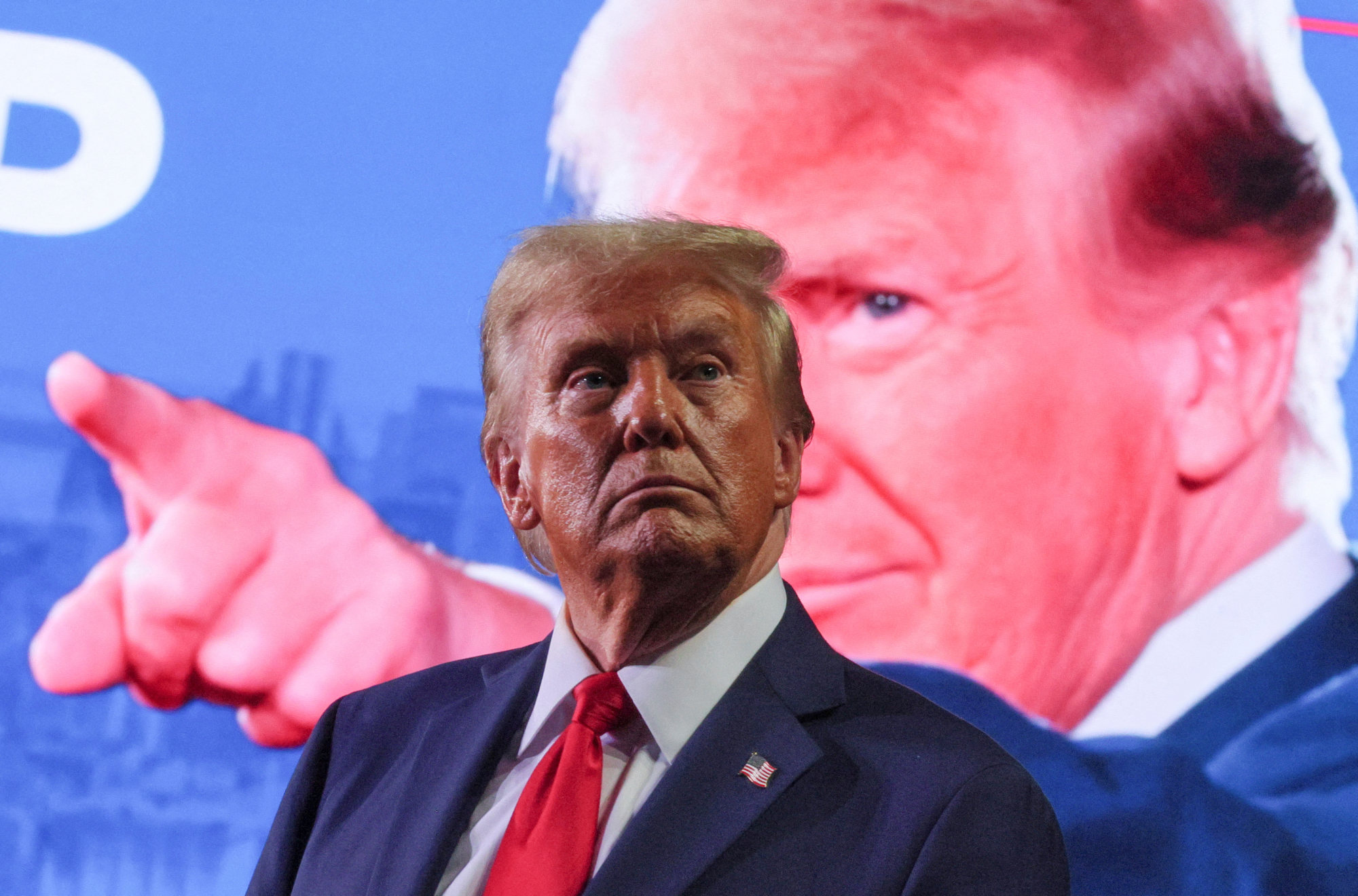
The former US president, who served from 2017 to 2021, has dismissed global warming as a hoax. During his recent campaign for the White House, Trump promised to boost fossil-fuel production if re-elected.
Many climate activists have voiced concern that Trump’s return to power could hinder global negotiations on the issue and stall American efforts to cut greenhouse-gas emissions.
Trump’s second term as US president could also deal a blow to climate cooperation between the US and China, which has been a rare bright spot in their testy relationship in recent years.
In a show of accord in the fight against climate change, China and the US in September announced they would co-host a meeting focusing on methane and other non-carbon dioxide greenhouse gases during the Cop29 summit.
Observers said local-level cooperation between the two countries was expected to play a bigger role in pushing forward the climate-change agenda in the future.
Under the US system, state governments have the authority to set their own climate and air policies, and since the 1990s, much of American energy and climate policy has been led by states. That allows them and cities to advance climate-change cooperation.
“Such partnership is also in the interest of China, which has resisted the notion of decoupling,” said Li Shuo of the Asia Society Policy Institute. “Communication can continue between local authorities even if it’s not at the central-government level.”
In October last year, for example, during high tensions between China and the US, California Governor Gavin Newsom travelled to Beijing, where he met with Chinese President Xi Jinping.
Climate-change cooperation was discussed, according to the Californian government and the Chinese foreign ministry’s read-out. The American state has been a pioneer in subnational cooperation with the mainland.
Subnational cooperation was also identified as an area for cooperation in the so-called Sunnylands agreement signed last November between the US and China ahead of a meeting between Xi and US President Joe Biden in San Francisco.
The two leaders agreed their countries would tackle global warming by ramping up renewable energy with an eye to using it to replace fossil fuels.
In the future, Li added, “there’s greater need for subnational cooperation, which would be one of few core areas of climate cooperation between China and the US”.
Ryna Cui of the University of Maryland School of Public Policy said such engagement could also help build trust.
Indeed, climate-change collaboration at state and city levels has appeared lately to gain traction.
In September, China hosted a meeting in Beijing on subnational cooperation attended by John Podesta, Biden’s top climate enjoy. Earlier, in May, a similar meeting was held in Berkeley, California, joined by Chinese climate-change special envoy Liu Zhenmin.
Regardless of election outcomes, Cui said, “it’s very important to actually collaborate on the subnational level” because sharing about the “implementation experience” is necessary for policy ambitions to materialise.
If Trump is hostile toward China, Beijing has many ways to respond, US analyst says
https://www.scmp.com/news/china/diplomacy/article/3285659/if-trump-hostile-toward-china-beijing-has-many-ways-respond-us-analyst-says?utm_source=rss_feedIf Donald Trump adopts a “hostile” approach toward Beijing in his second term as US president, China has many tools in its toolbox to respond, a former top US official on China policy said this week.
Rick Waters, who until last year served in Joe Biden’s administration as US deputy assistant secretary of state for China and Taiwan, said on Wednesday that Beijing is trying to determine how Trump will deal with China in his second term.
“What is going to happen in the next weeks will be an effort, largely by Beijing, to establish some authoritative channel to figure out whether they’re going to get the transactional administration or the angry one,” Waters said.
He also warned about the risk of escalating tensions regarding Taiwan and the South China Sea during the 10 weeks of transition to a second Trump administration.
Waters, now a managing director of the Eurasia Group’s China practice, led the State Department’s China House from 2022 to 2023, a unit set up under President Biden to address Washington’s growing rivalry with Beijing.
He said that during Trump’s first term, US-China policy split into two periods: the first three years, 2017-19, was more “transactional” as Trump aimed to reach a deal with China to reduce the large trade deficit between them.
Trump imposed tariffs on over US$300 billion worth of Chinese goods and pushed Beijing to sign an agreement requiring it to buy an additional US$200 billion of American goods and services in a two-year period.
The pact, known as the Phase 1 trade deal, was signed on January 15, 2020, just before Covid-19 became a worldwide problem, and Beijing fell well short of the target, at least in part because pandemic-related supply chain disruptions hampered exports.
According to the Peterson Institute for International Economics, China bought only 58 per cent of the total US goods and services exports over 2020-21 it had committed to buy under the agreement, and bought none of the added US$200 billion of US exports.
Waters described 2020, the last year of Trump’s first administration, as an “angry” period, featuring his persistence on blaming China for the Covid-19 pandemic and using language that precipitated attacks on Asian-Americans.
That year, the Trump administration also increased accusations that China was conducting espionage on US soil, and closed the Chinese consulate in Houston, Texas.
“2020 in the Chinese mind was an inflection point of sorts,” Waters said. “I can confirm their long-standing suspicion that the US system is ultimately about exploiting the regime’s vulnerabilities, legitimacy wise, as part of an end state of getting rid of them.”
Concerning tariffs, Waters said that the US still had “a lot more scope” to increase them; Trump campaigned on raising them to 60 per cent on all imports from China. And if China concludes “the US goal is not to reach a new deal” on trade, he said, it could incentivise Beijing officials to “defend their system asymmetrically”, though he added China is still at a “structural disadvantage” in a trade war with the US.
Even so, “the tool box of retaliation has expanded considerably”, he said, citing Beijing’s enactment of its Anti-Foreign sanctions law; export controls on critical minerals that are essential for semiconductor manufacturing for US and its allies; and sanctions against US defence suppliers on military subcomponents.
“What they have done over the past four years is to develop a pretty robust framework of sanctions,” he added. “They could go further if they perceive they need to.”
An immediate concern for both Beijing and Washington, Waters said, was unexpected tensions over Taiwan and the South China Sea flaring during the transition.
For example, if Trump spoke with Taiwan’s leader William Lai Ching-te, it could “create renewed instability” between the US and China. In 2016, Trump, then the president-elect, took a congratulatory phone call from Lai’s predecessor, Tsai Ing-wen. China lodged a protest, saying it opposed any form of official exchanges between the US and Taiwan.
During the Biden administration, China has ramped up military actions around Taiwan since then-US House Speaker Nancy Pelosi’s trip to the island in 2022, often reacting with drills or patrols in response to US exchanges with Taiwan.
During the campaign, Trump has revealed little how he would approach the Taiwan issue. He has dodged questions on whether the US would defend Taiwan, saying that Beijing would not attack the island if he was elected.
He also demanded that Taiwan to pay the US for its defence, and recently accused the island of “stealing” the American chip industry, prompting concerns over the US commitment to the self-ruled island.
In response to Trump’s Taiwan-related comments during his campaign, the Chinese foreign ministry urged the US to handle the issue “prudently”, adding that Taiwan remains “the most important and sensitive issue” in Sino-US relations.
Beijing sees Taiwan as a rogue province, to be eventually reunited with the mainland, by force if necessary.
Most countries, including the US, do not recognise Taiwan as an independent state, but Washington opposes any attempt to take the island by force and remains committed to supplying it with weapons. Both Trump and Biden ramped up arms sales to Taipei during their administrations.
Waters said Trump and his team “have come to realise the sensitivity” of the Taiwan issue.
“While I don’t rule out that there will be a lot of tension over cross-strait issues over the next few years … I don’t know that I would necessarily see Taiwan as an issue where the US will create deliberate instability or uncertainty early on.”
Finally, Waters said that Beijing is closely monitoring who might join Trump’s second administration.
One such hopeful, Elbridge Colby, a former senior Pentagon official who is thought to be a front runner to become Trump’s national security adviser, said in June that “hard military power at the right place at the right time” was needed to deter Beijing from “a determined attack on Taiwan”.
Mike Pompeo, a former secretary of state in Trump’s first term, was also reportedly being considered as the next defence secretary. Pompeo was sanctioned by China after he labelled treatment of Uygurs in Xinjiang as a “genocide” on his last day in office.
Amid China-US trade ‘conflicts’, Beijing calls for burying the hatchet
https://www.scmp.com/economy/global-economy/article/3285623/amid-china-us-trade-conflicts-beijing-calls-burying-hatchet?utm_source=rss_feedChina is looking to “resolve conflicts” in trade with the next US administration while now facing the increased likelihood of more tariffs being put in place, as advocated by US president-elect Donald Trump.
“China is willing to strengthen communication, expand cooperation and resolve conflicts with the United States in accordance with the principles of mutual respect, peaceful coexistence, and win-win cooperation,” Ministry of Commerce (Mofcom) spokeswoman He Yongqian said on Thursday afternoon – a day after the former US president’s return to power became clear following Tuesday’s election.
She added that Beijing looks to “jointly promote the development of China-US economic and trade relations in a stable, healthy and sustainable direction that would benefit both countries, and the world”.
During the same press conference, Mofcom confirmed that European Union officials arrived in Beijing on Saturday for “intensive trade negotiations” regarding EU tariffs on imported Chinese electric vehicles (EVs) that kicked in last week. The two sides had expressed intentions to talk, but it was not confirmed until Thursday.
Beijing could be facing extra pressure in trade following Trump’s election and at a time when it is already seeing tension growing in expanded fronts with some of its other trade partners.
Trump initiated a trade war with China during his first administration, from 2017-21, and the effects rippled through the global supply chain, spurring a shift that saw production lines diversify away from China.
During Trump’s election campaign, he said he would escalate current tariffs to 60 per cent on all Chinese imports, and add a 10 or 20 per cent blanket tariff on all foreign goods entering the US, if granted another term.
Beijing has not directly responded to the possibility of increased tariffs from a new US administration but has condemned Washington for making “unilateralist and protectionist” moves with tariffs, and has retaliated with tariffs on some American imports.
The latest message from Mofcom follows President Xi Jinping’s congratulatory message to Trump on Thursday that included a call for “a stable, healthy and sustainable China-US relationship” as the world’s two largest economies have been engaging in wide-ranging competition in trade, security and tech in recent years.
Jayant Menon, a senior fellow at the ISEAS-Yusof Ishak Institute in Singapore, pointed to the high probability that the incoming Trump administration will raise tariffs on China, but said that Trump’s willingness to subsidise domestic industries, like US President Joe Biden has done through the Chips Act, is “less clear”.
“China may be hoping that these programmes will be replaced by new tariffs, which would essentially mean a less protectionist, and therefore [less] harmful, outcome for China, and the world,” Menon said.
Yet, more tariffs have been imposed on China and are expected to be on the way from American allies and trade partners.
In recent months, the US, Canada and the EU have imposed tariffs on Chinese EVs, after accusing China of unfair competition because of heavy state subsidies in the industry.
While EU tariffs as high as 45.3 per cent kicked in last week, Beijing and Brussels are still exploring the possibility of how individual Chinese carmakers could adjust the price and volume of their imports for the European market, despite failing to reach solutions in previous rounds of talks in the past two months.
The two sides are engaging in a price-undertaking negotiation with a “pragmatic” and “balanced” approach, Mofcom’s He said on Thursday. There was no information about how long the talks would last.
“China wants free trade with no tariffs or restrictions,” said Chen Zhiwu, chair professor of finance at the University of Hong Kong. “But realistically, it knows more are coming, due to the threats to developed economies from China’s intrinsic economic system.
“Officials in Beijing should continue to stress the importance of free trade for world prosperity and be a champion for globalisation even when the global political realities make it hard to restore.”