
英文媒体关于中国的报道汇总 2024-11-07
November 8, 2024 126 min 26712 words
西方媒体的报道内容主要涉及中国的经济科技政治社会等多个方面。在经济方面,有报道称中国的出口额超出预期,达到27个月以来的最高水平,但同时也提到美国特朗普政府对中国商品的关税可能进一步提高,以及欧盟对中国电动汽车的关税,可能会对中国经济造成影响。在科技方面,有报道关注了中国在芯片制造制药等领域取得的进展,但也提到美国对中国科技企业的制裁和限制。在政治方面,有报道关注了特朗普再次当选美国总统可能对中美关系造成的影响,以及中国与其他国家(如马来西亚缅甸印度尼西亚)之间的外交互动。在社会方面,有报道关注了中国女性权益社会风气等话题,但也包含了一些耸人听闻的奇闻轶事。 对于西方媒体的这些报道,我有以下评论: 首先,需要承认西方媒体的报道内容丰富多样,涉及中国的方方面面,体现了一定的客观性和全面性。其次,也需要指出这些报道的偏见和失实之处。例如,在经济方面,报道往往过度强调中国经济面临的困难和挑战,而忽视中国经济的韧性和潜力。在科技方面,报道往往过度关注中国政府对科技企业的支持和干预,而忽视中国企业自身的创新能力和发展潜力。在政治方面,报道往往过度渲染中国与周边国家之间的紧张关系,而忽视中国为维护地区和平稳定所做的努力。在社会方面,报道往往过度放大中国社会存在的负面现象,而忽视中国社会总体上积极向上蓬勃发展的大趋势。 综上所述,西方媒体的这些报道有其客观性和全面性的一面,但同时也存在一定的偏见和失实之处。建议读者在阅读时抱着批判性的思维,客观公正地分析和判断,以全面了解中国的发展现状和未来趋势。
Mistral点评
- Germany arrests US citizen over accusations of spying for China
- China exports surge, but trade war escalation looms: 5 takeaways from October trade data
- China’s Mars rover Zhurong finds evidence of ancient ocean on red planet
- China tariffs on the table, Trump’s ex-Treasury chief says
- [Sport] UK's first Chinese parliamentarian dies at 74
- China and Malaysia should ‘firmly support each other’, Xi Jinping tells Anwar Ibrahim
- Tech war: China’s top chip foundry SMIC posts record revenue despite US sanction warning
- China, US can find common ground in agriculture trade, official says
- 3 remarkable Chinese women whose journeys showcase strength, resilience in face of challenges
- Southeast Asia’s e-commerce gold rush draws Chinese giants from Alibaba to ByteDance
- Chinese premier backs Myanmar’s ‘political transformation’ in talks with junta chief
- Will China’s fiscal bazooka fire as forcefully as investors hope?
- Trump’s comeback no surprise for China – and this time Beijing is prepared
- Extreme anti-China measures under Trump would widen US democratic deficit
- China should learn from Russian ‘resilience’ in sanctions defence: researchers
- Henlius, XtalPi sign deals to expand abroad as Chinese drug companies ‘go out’ for growth
- What Trump 2.0 means for India’s trade with US, China-West balancing act
- Disgust as China mother posts online photo of toddler son urinating over family meal
- Bulgari CEO sees Chinese consumers fuelling luxury growth as economy improves
- Qualcomm chip sales surge thanks to Chinese smartphone makers, but Apple’s shift looms
- Subianto’s China visit to focus on economic cooperation, not maritime issues
- Alibaba Cloud notches big with ‘China’s Instagram’ completing largest data migration
- Shock as China boy grabs girl in lift, drags her away, is arrested, then freed
- Semiconductor firms ASML, AMD, Qualcomm reaffirm China commitment at CIIE trade fair
- Unease over China proves pivotal in US election races in Michigan
- China’s Xi Jinping congratulates president-elect Donald Trump on election victory
- Why Vietnam’s silence on South China Sea dispute with Malaysia is a ‘nuanced diplomatic gesture’
- China’s exports rose 12.7% in October, fastest growth since July 2022
- Why Chinese-American scientists in US are hopeful next Trump era will be better than last
- Chinese economists push reform as stimulus takes hold, but Trump win creates uncertainty
- China is bracing for fresh tensions with Trump over trade, tech and Taiwan
- Donald Trump set to sustain US-Philippines ties to counter China’s clout: analysts
- Trump’s national security jobs will go to loyalists, China hawks: analyst
- World waits to see how triumphant Trump reshapes US approach to trade, China and security
- EU has wish list for Trump, but support for his tough China agenda will be expected
- Trump win makes balancing act between China and US even trickier for developing countries
- Canada plays China card in preparation for Trump trade fight
Germany arrests US citizen over accusations of spying for China
https://www.scmp.com/news/world/europe/article/3285644/germany-arrests-us-citizen-over-accusations-spying-china?utm_source=rss_feedGermany’s federal prosecutor office said it arrested an American citizen on Thursday who allegedly spied for China.
The office said that the suspect, who was only identified as Martin D., was arrested in Frankfurt and that his home was being searched.
The accused, who until recently worked for the US Armed Forces in Germany, is strongly suspected of having agreed to act as an intelligence agent for a foreign secret service, the statement said.
Earlier this year, he contacted Chinese government agencies and offered to send sensitive information from the US military to a Chinese intelligence service, according to an investigation by Germany’s domestic intelligence service.
He had obtained the information in question during his work in the US army, the prosecutor’s statement said, without giving any further information.
German news agency dpa reported it appeared the suspect had not managed to transfer any data to Chinese authorities before the arrest.
German investigators have exposed several people suspected of spying for China this year.
Last month, German authorities arrested a Chinese national accused of passing information on a major air freight hub to a man who is suspected of spying for China.
And in April, a man who worked for a prominent German far-right lawmaker in the European Parliament was arrested on suspicion of spying for China.
News of that arrest came a day after three Germans suspected of spying for China and arranging to transfer information on technology with potential military uses were arrested in a separate case.
China exports surge, but trade war escalation looms: 5 takeaways from October trade data
https://www.scmp.com/economy/economic-indicators/article/3285607/china-exports-surge-trade-war-escalation-looms-5-takeaways-october-trade-data?utm_source=rss_feedChina’s exports beat expectations and hit a 27-month high in October after rising by 12.7 per cent, year on year, to US$309 billion.
“Export values grew, year on year, at the fastest pace in more than two years, and export volumes picked up too,” said Zichun Huang, China economist at Capital Economics.
But Zhang Zhiwei, president and chief economist at Pinpoint Asset Management, said the better-than-expected export growth “may partly be driven by exporters trying to front-load shipments to mitigate the damage” they expect next year from potential trade war repercussions.
US president-elect Donald Trump has hinted at potential tariffs of 60 per cent on shipments from China.
Tariffs from the European Union on Chinese-made electric vehicles also started at the end of October.
“Despite mounting trade barriers, Chinese exports continued to defy gravity,” said Sarah Tan, an economist at Moody’s Analytics in Singapore.
Notably, car and steel are among the products under international fire, but shipments of both still saw year-on-year increases in the double digits, Tan said.
China’s imports fell by 2.3 per cent from a year earlier in October, compared with the 0.3 per cent growth seen in September.
“But this reflects price and base effects. In volume terms, imports appear to have edged up, month on month. And we think they will rise further in the near term,” Huang added.
Crude oil imports fell by 9 per cent in volume terms, while steel imports plunged almost 20 per cent from a year earlier.
“The sixth straight month of decline in steel imports highlights the severity of the property market turmoil,” said Tan at Moody’s Analytics, pointing to the importance of the key construction material.
China posted a trade surplus of US$95.72 billion in October, compared with US$81.71 billion in September.
“China’s foreign trade surplus was US$96 billion in October, compared with US$82 billion in September. The larger surplus came as exports jumped 12.7 per cent, year over year, while imports dropped 2.3 per cent,” said Tan at Moody’s Analytics.
“Rising geopolitical tensions threaten to hamper China’s export performance, while a sluggish domestic economy puts a lid on import growth.”
China saw an increase in exports to its major trading in October, with shipments to the United States increasing by 8.1 per cent.
Shipments to the European Union also rose by 12.72 per cent, while China’s exports to the Association of Southeast Asian Nations rose by 15.78 per cent in October compared with a year earlier.
Exports to Russia, meanwhile, increased by 26.7 per cent, recording their fastest growth since last November.
Huang at Capital Economics expects China’s shipments to stay strong in the coming months, with any drag from potential Trump tariffs unlikely to materialise until the second half of next year.
And import volumes, which ticked up last month, are likely to rise further in the short-run as accelerated fiscal spending shores up demand for industrial commodities, he added.
And Zhang at Pinpoint Asset Management, pointing to potential trade war ramifications in the first quarter of next year, said: “We cannot rely on exports to carry China’s economy. I expect fiscal policy will become more proactive next year as a pillar for growth.”
China’s Mars rover Zhurong finds evidence of ancient ocean on red planet
https://www.scmp.com/news/china/science/article/3285637/chinas-mars-rover-zhurong-finds-evidence-ancient-ocean-red-planet?utm_source=rss_feedChina’s Mars rover Zhurong has found evidence of a coastline from a short-lived ancient ocean, adding to decades of research into the red planet’s watery past.
Data collected during the Tianwen-1 mission shows that an ancient sea might have left rock deposits on the planet’s surface 3½ billion years ago, according to a new study by researchers from Hong Kong Polytechnic University, the China Academy of Space Technology and the Russian Academy of Sciences.
In 2021, the rover started exploring the southern part of Utopia Planitia, a large plain in the northern hemisphere of Mars hypothesised to have been part of an ancient ocean that once covered the planet’s northern lowlands.
The scientists found that southern Utopia Planitia is divided into three parts with different depths, including a shallow marine section and a deep marine section, supporting the theory that the area was once covered by a sea.
The discovery of sedimentary rocks and layering in rocks and sediment are also a sign of “past water activities”, they said in an article published in the peer-reviewed journal Scientific Reports on Friday.
Lead author Wu Bo, a professor in spatial science and director of the planetary remote sensing laboratory at PolyU, said the team was the first to present a probable scenario explaining how the ocean was formed.
Based on analysis of orbital remote sensing data and observations from the Zhurong rover, the team estimated that flooding of Utopia Planitia took place around 3.68 billion years ago, according to Wu.
“The ocean surface was likely frozen in a geologically short period, with liquid water solidified and material deposited by sedimentary load from the water body to form the dry shallow marine unit approximately 3½ billion years ago, and later the dry deep marine unit 3.42 billion years ago,” he said.
In other words, after a short-lived frozen ocean formed a coastline, the ocean surface probably froze and disappeared around 3.42 billion years ago.
Nasa’s Viking 2 mission landed in the Utopia Planitia area in 1976 and mapped the surface of the region.
For decades, scientists have been studying the possible existence of an ocean in the northern lowlands on Mars – a theory that could reveal secrets about the red planet’s early evolution and how the body of water affected its climate and atmosphere.
In the latest study, the researchers identified characteristics consistent with a nearshore zone of an ancient ocean, including volcano-like formations known as pitted cones as well as features on the Martian surface called polygonal troughs and etched flows.
“Existing studies indicate that the pitted cones in the southern Utopia may have originated from mud volcanoes and are often formed in areas with low groundwater or ice content,” Wu said. “Polygonal troughs and etched flows can only form when groundwater or ice is relatively rich.”
Wu said the area studied was divided in two by a 4.2km (2.6-mile) topographic contour line – a feature that usually coincides with the water-level line. Pitted cones are mainly found in the south, while polygonal troughs and etched flows are found in the north.
“Therefore, the study area is considered as a nearshore zone and is further divided into a shallow marine unit with less water or ice content in the south and a deep marine unit with more water or ice content in the north,” he said.
He said the team would try to examine how these water-related features formed and estimate the depths of the marine areas, and comparisons of the shallow and deep areas would help verify their proposed ocean model.
China tariffs on the table, Trump’s ex-Treasury chief says
https://www.scmp.com/news/world/united-states-canada/article/3285648/china-tariffs-table-trumps-ex-treasury-chief-says?utm_source=rss_feedUS President-elect Donald Trump is likely to return to the issue of tariffs in negotiations with China, as well as consider tax cuts and new sanctions, his former Treasury Secretary said in an interview on Thursday.
“I think that tariffs do need to be used to get counterparties back to the table, especially China, which is not living up to all of the agreements they made in the Phase One trade agreement,” Steven Mnuchin told CNBC.
He was referring to a 2020 trade deal that followed a truce in a tariff war between Washington and Beijing.
The agreement saw China pledge to boost purchases of American products and services by at least US$200 billion over 2020 and 2021. But the target was not met amid the pandemic.
Mnuchin added on Thursday that he would recommend Trump use tariffs in a “strategic way” to ensure there is not widespread inflation.
He noted that in his time in the Trump administration, tariffs were accompanied by exemptions for certain products US businesses needed.
Additionally, he said energy prices need to be lowered to keep consumer costs in check.
In his first term, Trump lowered the corporate tax rate to 21 per cent and has since suggested lowering it further to 15 per cent.
“If the corporate tax is going to be lowered, it should be lowered in a way that supports US manufacturing and US jobs as opposed to across the board,” Mnuchin said.
He also suggested that countries such as Iran and Russia could see sanctions intensify.
“In the case of Iran, they’re now selling millions of barrels of oil, which needs to be stopped,” said Mnuchin, who is founder of Liberty Strategic Capital.
[Sport] UK's first Chinese parliamentarian dies at 74
https://www.bbc.com/news/articles/cd9nj8z9329oUK's first Chinese parliamentarian dies at 74
The former Alliance Party assembly member Anna Lo has died at the age of 74.
Ms Lo was the first ethnic-minority politician elected to Stormont, and the first person from the Chinese community to take a seat in a UK parliament.
Born in Hong Kong, she moved to Northern Ireland in 1974.
She became the director of the Chinese Welfare Association in Belfast in 1997.
'Ground breaker'
A decade later she was elected to the Northern Ireland Assembly, representing South Belfast for the Alliance Party.
She was re-elected in 2011 and served until her retirement in 2016.
"Anna will forever be remembered as a ground-breaker in local politics," said Alliance leader Naomi Long.
"Her service to the Chinese community, to good relations and to the city of Belfast, much of which went unseen by most, was transformational."
In a statement, the party confirmed that the 74-year-old died on Wednesday following an illness.
This breaking news story is being updated and more details will be published shortly. Please refresh the page for the fullest version.
You can receive Breaking News on a smartphone or tablet via the BBC News App. You can also follow @BBCBreaking on Twitter to get the latest alerts.
China and Malaysia should ‘firmly support each other’, Xi Jinping tells Anwar Ibrahim
https://www.scmp.com/news/china/diplomacy/article/3285638/china-and-malaysia-should-firmly-support-each-other-xi-jinping-tells-anwar-ibrahim?utm_source=rss_feedChina and Malaysia should “enhance political trust and firmly support each other’s core interests and major concerns”, Chinese President Xi Jinping told Malaysian Prime Minister Anwar Ibrahim in Beijing on Thursday.
China and Malaysia are “key representatives” of developing nations and emerging economies in Asia, Xi said, as he called for a high-level strategic partnership and stronger “coordination on international and regional issues”, according to Chinese state broadcaster CCTV.
The two countries should “firmly support each other, jointly oppose protectionism, and … advocate for an equitable and orderly multipolar world, [and] inclusive and beneficial economic globalisation”, Xi told Anwar.
This came as Anwar wrapped up a four-day working visit to China, which began on Monday with a stop in Shanghai. He visited the 7th China International Import Expo (CIIE) and met his Chinese counterpart, Premier Li Qiang, there before arriving in Beijing on Wednesday evening.
Anwar told Xi Malaysia was “committed to further deepening its comprehensive strategic partnership with China”, and sought closer cooperation in areas including information technology, the digital economy and energy, according to CCTV.
He also cited “similar ideas and close positions on many major international and regional issues”.
“Malaysia upholds strategic autonomy and is willing to work closely with China in multilateral settings to safeguard regional peace, stability and development,” he was quoted as saying.
Xi also called for deeper links with Malaysia in higher education, culture and tourism to “strengthen the bonds of friendship between the two peoples”.
According to Malaysian state news agency Bernama, Anwar’s agenda on Thursday included a meeting with representatives of China International Capital Corp (CICC), a partly state-owned multinational investment and financial services firm.
He then visited Peking University to deliver a public lecture attended by about 200 students, Bernama said.
This is Anwar’s third trip to China since taking office in November 2022, after visits in March and in September last year.
Malaysia under Anwar has sought to ramp up ties with China, its top trade partner for the last 15 years, despite territorial disputes in the South China Sea.
Anwar’s latest visit also comes just five months after Li travelled to Malaysia as the two countries marked 50 years of diplomatic relations. Li’s trip in June concluded with a renewed five-year economic and trade cooperation deal, and various agreements including on manufacturing, the digital economy and logistics.
On Tuesday, Anwar addressed the CIIE opening ceremony in Shanghai. He said Malaysia had invited China to join the annual Asean-Gulf Cooperation Council summit next year, which would “make significant contribution to moving the needle on greater global parity in economic trade, investment and economic advancement”.
“Multi-country cooperation for free trade and sustainability goals must be used as a tool to advance global progress equitably”, he said, “instead of as a weapon to quell competition, promote unfair advantage or create conflict”.
During talks with Li later in the day, Anwar said China had been a good friend and partner to Malaysia, “with frequent high-level exchanges and fruitful cooperation across various fields”, according to the Chinese foreign ministry.
He said Malaysia was willing to deepen cooperation under China’s Belt and Road Initiative, and expand collaboration in trade, investment, the digital economy and education, while boosting people-to-people exchanges.
Malaysia, which takes over the annual rotating chairmanship of the 10-member Association of Southeast Asian Nations next year, will take the opportunity to improve coordination with China on international and regional issues, Anwar told Li.
In Beijing on Thursday, Xi told Anwar of China’s support for Malaysia’s chairmanship of the bloc and for upholding Asean’s centrality and strategic autonomy.
China has been Malaysia’s top trading partner globally since 2009. Among Asean states, Malaysia is China’s second biggest trade partner and biggest source of imports. Bilateral trade volume last year reached US$190.24 billion, of which Chinese imports accounted for close to 55 per cent. China is also the fifth-biggest foreign investor in Malaysia.
But despite a positive tone in official narratives, concerns remain that contested South China Sea claims could complicate relations. Beijing’s expansive claims over the resource-rich waters overlap also with those of Asean members Vietnam, Brunei and the Philippines, a US treaty ally. Clashes between Chinese and Philippine vessels in particular have spiked tensions in the region.
However, criticism from Kuala Lumpur of Beijing’s actions in the South China Sea is rare, with economic ties and diplomacy seen to take precedence.
Last month, China and Malaysia reached a consensus on promoting “pragmatic maritime cooperation”, after the first bilateral dialogue on the management of South China Sea maritime issues.
Malaysia has also sought to balance its ties with rival powers China and the United States, a close economic and strategic partner to Malaysia that has been seeking a bigger footprint in what it calls the “Indo-Pacific”.
Bernama quoted Anwar as saying in June that the resolution of South China Sea disputes should focus on “aggressive” diplomatic engagement and be handled among Asean members and China, without the interference of external parties.
Tech war: China’s top chip foundry SMIC posts record revenue despite US sanction warning
https://www.scmp.com/tech/tech-war/article/3285639/tech-war-chinas-top-foundry-smic-posts-record-revenue-despite-us-sanction-warning?utm_source=rss_feedChina’s top chip foundry, Semiconductor Manufacturing International Corp (SMIC), on Thursday posted record quarterly revenue on the back of strong domestic demand for “legacy chips”.
The Shanghai-based chipmaker said its third-quarter revenue rose 34 per cent from a year earlier to US$2.17 billion.
Net profit for the quarter reached US$148.8 million, up 58.3 per cent from a year earlier.
“The company achieved for the first time more than US$2 billion in quarterly revenue during the third quarter, representing a record high,” SMIC said in a statement on Thursday.
The strong results show how SMIC continues to lead the domestic market in advanced processes for semiconductor production, while also remaining the only fab operator on the mainland that can process 7-nanometre chips.
The chipmaker shipped a total of 2,122,266 eight-inch equivalent wafers last quarter, as its capacity utilisation rate – a measure of semiconductor fabrication activity – rose to 90.4 per cent, the company’s highest reading over the past six quarters. Its monthly capacity increased to 844,250 eight-inch equivalent wafers in the third quarter.
Revenue from Chinese customers also increased steadily over the past few quarters, with 86.6 per cent of revenue generated from mainland-based clients in the past quarter.
SMIC’s Hong Kong-listed shares closed up 4.83 per cent to HK$28.2 on Thursday.
The firm applied so-called multiple-patterning technology to make Huawei Technologies’ Kirin 9000s chipset with its second-generation 7nm process, using existing chipmaking equipment from ASML.
These chipsets inside Huawei’s Mate 60-series smartphones marked a breakthrough for China’s advanced chipmaking efforts, angering the US government and igniting speculation about the effectiveness of Washington’s curbs on the country’s vast technology sector.
Washington added SMIC to the US trade blacklist in December 2020, three months after the US applied a blanket ban on Huawei’s access to global foundry services. Following the US sanctions, SMIC was forced to cut ties with Huawei.
Following Donald Trump’s win in the US presidential elections, most analysts believe his administration will not loosen US tech export controls on China.
“The consensus view is that Trump will step up controls on China’s technology sector,” said Wang Jiping, a vice-president at research firm IDC China. “But this doesn’t rule out possibilities that some cooperation could occur.”
Still, US lawmakers have intensified calls for a further crackdown on SMIC. Michael McCaul, chair of the US House of Representative’s Foreign Affairs Committee, called on the US Department of Commerce to check up on SMIC’s facilities and find out whether the company is illegally producing chips for Huawei, according to a Reuters report on Tuesday.
Over the past few years, SMIC has pivoted its business to domestic customers and suppliers amid US sanctions. It has adopted a test-and-trial strategy in terms of buying equipment, which has allowed domestic semiconductor tools makers such as Naura Technology Group more opportunities to become a supplier for its production lines.
Hua Hong Semiconductor, another Chinese maker of legacy chips, on Thursday said its third-quarter revenue was down 7.4 per cent from a year earlier to US$523.6 million, citing a drop in the average selling price of products. Its net profit, however, shot up 222 per cent to US$44.8 million, according to a company statement.
Hua Hong’s Hong Kong-listed shares closed up 3.3 per cent to HK$23.2 on Thursday.
China’s output of integrated circuits – a broad measure of semiconductor products – expanded 26 per cent to 315.6 billion units in the first three quarters of 2024, according to the National Bureau of Statistics.
China, US can find common ground in agriculture trade, official says
https://www.scmp.com/economy/global-economy/article/3285604/china-us-can-find-common-ground-agriculture-trade-official-says?utm_source=rss_feedChina remains an attractive market for the United States, a high-level US agricultural official said, calling the farming sector a “big success story” despite an uncertain future for the bilateral relationship after the re-election of Donald Trump.
“We think we can double our current level of [agricultural] exports to China, particularly if unjustified barriers are removed to our products,” said Jason Hafemeister, an acting deputy undersecretary of the US Department of Agriculture (USDA), in an interview on Thursday during an ongoing trade fair in Shanghai.
Refusing to “speculate” on the policies the next administration may enact, he called on Chinese authorities to reform tariffs, health certification for imports and registration mandates on US agricultural products to ease the flow of goods.
Trump won a second presidential term on Tuesday after campaigning to, among other trade escalations, impose a 60 per cent tariff on all Chinese goods.
China is foreseeing more economic headwinds in the coming Trump term, which could prompt more retaliatory measures to combat potential tariff increases and tech restrictions from Washington.
Harley Seyedin, president of the Guangzhou-based American Chamber of Commerce in South China, said US businesses still expect dividends from the election outcome.
“American companies operating in China remain optimistic about the future, recognising that the election presents an opportunity for renewed focus on stability, cooperation and sustainable growth in US-China relations,” Seyedin told the Post late on Wednesday.
“Many businesses are hopeful that the next administration will prioritise constructive engagement, balanced trade policies and predictability in global markets.”
Agriculture is one area where Beijing and Washington have had ample room for cooperation, Hafemeister said, and could continue to do so.
“There’s a natural fit between the US and China,” he said. The undersecretary is in China to promote US goods at the China International Import Expo.
“Agriculture has been a very big success story in the US-China relationship,” he said, noting the complementarity of China’s limited arable land, its large population and an excess of US farm produce. “I think we are underperforming in our exports to China.”
US agricultural exports to China have been on the decline in recent years as Beijing attempts to diversify its supply chains as a hedge against geopolitical tensions, turning to countries like Brazil for staple crops like corn and soybeans.
The value of US farm exports is estimated to stand at US$27 billion for the 2024 fiscal year before dropping to US$24 billion in the fiscal year after, according to the quarterly outlook of the USDA published in August. About US$33.7 billion worth of US agricultural products were sold to China in 2023.
Chinese direct investment in the US dropped by 5.2 per cent year on year to US$6.91 billion in 2023, business consultancy Dezan Shira & Associates said.
On the other side, American investment in China fell by about 40 per cent to US$5.4 billion, per data from the US Department of Commerce.
Some analysts said China will find relations with the US easier under Trump than it would have with his defeated rival, current Vice-President Kamala Harris.
“Trump cares mainly about economic ties rather than military or strategic issues in Asia – he cares much more about trade,” said Ker Gibbs, executive-in-residence at the University of San Francisco’s China Business Studies Initiative.
Any talks with Trump’s government would matter, he said, because “they really need external markets to fuel their growth.”
3 remarkable Chinese women whose journeys showcase strength, resilience in face of challenges
https://www.scmp.com/news/people-culture/china-personalities/article/3285446/3-remarkable-chinese-women-whose-journeys-showcase-strength-resilience-face-challenges?utm_source=rss_feedAn increasing number of women in China are breaking free from the constraints of traditional values that dictate they should be obedient and devoted to the family. Instead, they are advocating for their rights to equal education and professional opportunities.
This surge of confidence is being prominently displayed on mainland social media, giving the Chinese public a front-row seat to witness a rapidly growing awareness of women’s rights in recent years.
As a result, we are seeing the emergence of more iconic female figures who embody this feminine empowerment.
The Post highlights three of these extraordinary women, celebrated for their courage, independence, and carefree spirit.
Stand-up comedian, Yang Li, 32, went viral in 2020 with her famous talk show punchline that challenged the male psyche: “How can men be so ordinary yet confident?”
The graphic designer turned comedian used this line to describe the men she dated, resonating with many women who shared their “painful” experiences with patronising men on social media.
Yang’s performance opened doors for fellow female comedians, allowing more women to humorously critique men – traditionally prioritised in families and workplaces – offering a release for their frustration over unfair treatment.
Her punchline also sparked the creation of the internet buzzword “puxinnan”, meaning “ordinary but confident men”.
However, Yang sparked controversy as some offended men accused her of “inciting gender antagonism”.
In October, several male netizens boycotted China’s e-commerce platform JD.com after it announced Yang as its shopping festival endorser. The company quickly removed all posts related to her and denied any future collaboration.
For many women, the more men reacted negatively to Yang’s remarks, the more they felt her message was effective and rallied to support her.
“Yang is a role model who shows us that our experiences are shared, that we can express our feelings, and that we deserve a bigger world,” one woman stated on Weibo.
In 2020, Su Min, a 56-year-old pensioner from central China’s Henan province, decided to embark on a solo cross-country driving tour.
For the previous 30 years, she had fulfilled the roles of a devoted wife and mother, enduring a husband who often physically and emotionally abused her. In 2019, after stumbling upon an influencer’s video showcasing self-driving tours, she realised, “People could live like this.”
Part of her once contemplated returning to her unbearable husband and family after her journey. However, four years later, confronted by her husband’s sarcastic welcome, she opted for a divorce.
Su reached an agreement to pay him 160,000 yuan (US$22,000) in exchange for her freedom.
She has become a symbol of awakening feminism, with some dubbing her the “Chinese Thelma & Louise”, referencing the iconic 1991 US feminist film featuring two women on an adventurous journey.
As she commenced the fifth year of her journey in September, she wrote a letter to herself that read: “I don’t admire those who were born or married into good families. Only the accomplishments I achieve myself are reliable.”
Professional mixed martial arts (MMA) fighter Zhang Weili, 35, from northern China’s Hebei province, has shattered the stereotype that women are inherently weak and delicate.
She rose to fame after becoming Asia’s first female champion in the Ultimate Fighting Championship (UFC) in 2019.
Young women approached Zhang, expressing how much she had inspired them. She felt moved to see her “experiences and hardships help others pursue their own paths.”
Shortly after winning her first UFC title, some men jokingly declared they would not dare date Zhang for fear she might beat them up.
Zhang’s scornful response turned those men into laughing stocks: “We are paid to beat people up. Want to get beaten for free? You wish.”
Southeast Asia’s e-commerce gold rush draws Chinese giants from Alibaba to ByteDance
https://www.scmp.com/tech/big-tech/article/3285600/southeast-asias-e-commerce-gold-rush-draws-chinese-giants-alibaba-bytedance?utm_source=rss_feedThe Southeast Asian e-commerce market is expected to more than double in the next six years to reach US$370 billion by 2030, according to a report from US technology giant Google, Singapore’s sovereign wealth fund Temasek Holdings, and consultancy Bain & Co.
The booming sector has attracted a slew of Chinese players – including Alibaba Group Holding’s Lazada, PDD Holdings’ Temu and ByteDance’s TikTok Shop, as well as regional giant Shopee from Singaporean conglomerate Sea – all vying for Southeast Asia’s 612 million consumers. Alibaba owns the South China Morning Post.
The study, published on Tuesday, covers the digital economies of six major Southeast Asian nations: Indonesia, Malaysia, the Philippines, Singapore, Thailand and Vietnam. Together, their gross merchandise value (GMV) is set to rise 15 per cent this year to reach US$263 billion, while revenues are expected to expand 14 per cent to US$89 billion.
The rapid adoption of live-streaming e-commerce, pioneered and made popular by TikTok’s Chinese sibling Douyin, has helped recharge growth in the region’s online shopping business. The sales method, which lets consumers buy products marketed during live streams, now accounts for around 20 per cent of the sector’s GMV, up from less than 5 per cent two years ago, the report showed.
TikTok Shop, which nearly quadrupled its annual GMV to US$16.3 billion last year, is currently the second-largest e-commerce platform in Southeast Asia, according to a separate report by Singapore-based consultancy Momentum Works. Bargain-shopping platforms Shein and Temu are also expanding their footprints.
The annual Google joint report, in its ninth edition, for the first time examined the profitability of Southeast Asia’s core digital sectors, such as travel booking, online media and financial services. It found that some sectors, including e-commerce, transport and food delivery, have bounced back from the pandemic and introduced innovations that helped them become profitable.
That reflects a broader shift in the region’s industry from focusing on user growth to pursuing bottom-line growth. Some e-commerce firms, for example, have turned a profit through a combination of efforts, such as consistent sales campaigns and optimised seller fees, according to the report.
Meanwhile, the deluge of cheap Chinese imports introduced by e-commerce platforms have drawn the scrutiny of the governments of Indonesia, Vietnam and others, which are under pressure to protect local manufacturers and suppliers.
Temu was recently accused of operating without government approval in Vietnam, shortly after it was banned in Indonesia, Southeast Asia’s biggest e-commerce market. Indonesia last year also briefly suspended the e-commerce business of TikTok Shop, before it resumed local operations by acquiring GoTo Gojek Tokopedia.
Chinese premier backs Myanmar’s ‘political transformation’ in talks with junta chief
https://www.scmp.com/news/china/diplomacy/article/3285622/chinese-premier-backs-myanmars-political-transformation-talks-junta-chief?utm_source=rss_feedChinese Premier Li Qiang told Myanmar’s visiting junta chief Min Aung Hlaing on Wednesday that Beijing supports its political reconciliation and plan to hold an election next year.
Min Aung Hlaing’s trip is being widely watched – it is his first visit to neighbouring China since the military seized power in a 2021 coup and comes soon after the Chinese consulate in Mandalay, Myanmar’s second largest city, was hit with an explosive device in October.
China is an ally of the junta government, which has been losing ground in a civil war against insurgent groups – many of whom also maintain ties with Beijing.
Min Aung Hlaing met Li in the southwestern Chinese city of Kunming, Yunnan province, where he also attended the Greater Mekong Subregion summit on Wednesday and Thursday.
During their talks, Li told Min Aung Hlaing that China supports Myanmar to “push forward political reconciliation and transformation”, according to state news agency Xinhua.
Li also called for efforts to push forward infrastructure projects under the China-Myanmar Economic Corridor – part of Beijing’s Belt and Road Initiative.
Min Aung Hlaing and Li also discussed the military’s battle with rebel groups and the breakdown of a ceasefire brokered by Beijing earlier this year, according to state-run Global New Light of Myanmar (GNLM).
“The door of peace is always open if they genuinely want peace. The armed insurgents should do what needs to be done instead of giving priority to their needs and wishes,” the junta leader was quoted as saying.
He said the rebel groups should “have clear and specific actions for peace so that dialogue can materialise”.
Li said Beijing supported a five-point road map initiated by the junta government to work towards the handover of power to an elected government after a proposed election next year.
The junta’s election plan has been criticised by Western governments and analysts as lacking fairness and political representation, and it is unlikely to be recognised internationally. Opposition groups have also dismissed the proposal as a sham. So far no election date has been confirmed.
Li also called on the junta government to ensure the safety of Chinese projects and personnel in Myanmar, which Min Aung Hlaing pledged to do, according to Xinhua.
The military chief also discussed the Muse-Mandalay-Kyaukpyu railway project that will connect with the Chinese network, saying construction would start in “possible areas”, the GNLM report said.
The railway is part of the China-Myanmar Economic Corridor that aims to link landlocked Kunming to a deep-sea port in Rakhine state on Myanmar’s western coast.
It will run though restive areas including Rakhine and also northern Shan state, which borders China and has been roiled by fighting between the military and rebel groups.
Li said the border posts should remain under the control of the respective governments, and that China reaffirmed the sovereignty and territorial integrity of Myanmar, according to GNLM.
The junta has continued to lose ground to the rebels in the last year, particularly in the border areas.
A coalition of rebel groups known as the Three Brotherhood Alliance reportedly captured 16 townships in northern Shan state between October 2023 and January 2024 after they launched an assault called Operation 1027.
Beijing stepped in and brokered a ceasefire in January this year, but in June the rebels captured a series of strategic cities and towns where the junta’s regional military commands were based.
The loss of Lashio, capital of Shan state, in late July marked one of the biggest victories for the anti-junta forces since the coup.
China’s top diplomat Wang Yi called for “political reconciliation” when he travelled to Myanmar in August and met Min Aung Hlaing – the highest-ranking Chinese official to meet the junta leader since the coup.
Will China’s fiscal bazooka fire as forcefully as investors hope?
https://www.scmp.com/opinion/china-opinion/article/3285586/will-chinas-fiscal-bazooka-fire-forcefully-investors-hope?utm_source=rss_feedThere are plenty of sceptics and critics when it comes to China’s latest stimulus package. But even the naysayers admit Beijing has changed the calculus for the performance of Chinese stocks. Before the bevy of measures were announced in late September, the odds of a durable rally were slim to none.
Fast forward to today and the outlook for Chinese equities is no longer a one-way bet. Morgan Stanley believes a policy pivot has occurred but asks whether it is “sufficient to deliver an exit from deflation”. The company sees a “wide range of potential outcomes” for Chinese and other Asian stock markets.
To be sure, the uncertainty stems from several factors. The stunning victory of Donald Trump in the US presidential election has provided impetus to the rally in the dollar, driven bond yields higher and set the stage for more punitive tariffs on imported goods. With Trump enjoying a much stronger mandate than when he was elected in 2016, more nationalist and protectionist policies that stoke inflation are in store.
The most important determinant of sentiment towards China, however, is the much-anticipated yet contentious fiscal component of the stimulus package.
By announcing a series of aggressive measures to recapitalise banks, refinance local government debt and buy unsold houses to reduce inventory, Beijing unleashed a torrent of speculation over the scale of the fiscal stimulus in the coming years.
The lack of clarity over the size and composition of the package has resulted in a dangerous mismatch between the expectations of investors and Beijing’s priorities.
As markets await the details of the plan, due to be approved at the end of the conclave of the National People’s Congress (NPC) Standing Committee on November 8, magic numbers are being bandied around by Wall Street banks. Morgan Stanley believes a 10 trillion yuan (US$1.4 trillion) fiscal stimulus, amounting to about 5 per cent of China’s economic output, over a two-year period targeting consumers is one of the preconditions for ending deflation.
This is wishful thinking, mainly because Beijing’s objective is stabilisation as opposed to reflation, but also because local government debt restructuring is the main plank of the fiscal expansion. It also shows that the biggest challenge facing Chinese policymakers is managing expectations.
Even before Beijing fires its fiscal bazooka, there are signs the more forceful response is having a positive impact on the real economy. A gauge of private services sector activity experienced its sharpest monthly rise since March last year. Manufacturing output is expanding again while new home sales have risen sharply over the past several weeks, exceeding 2021-23 levels.
This adds to the uncertainty over how aggressive Beijing should be on the fiscal front. It also suggests a bolder and more clearly communicated policy package would have injected more confidence into the economy. By going big at the outset, policymakers would have got more bang for their buck, potentially without having to deploy as much stimulus. It is now more difficult and costly to exceed investors’ expectations.
However, the fundamental reason the dissonance between policymakers and markets is likely to persist is the scale of the structural, economic and geopolitical challenges facing China in the coming years, amplified by Trump’s resounding victory.
First, there are significant constraints on the size and effectiveness of any fiscal stimulus programme. As Goldman Sachs notes, the downturn in the property sector and related industries – which still account for nearly 20 per cent of economic activity – and the weakness of household consumption are likely to result in “policy transmission” being “less efficient than [in] previous easing cycles”.
In addition to weak household income growth, persistent deflationary pressures have depressed corporate revenues, resulting in a sharp decline in tax revenues. This does not only limit the scope for fiscal stimulus, but also keeps the stock market under pressure. Except for the financial sector, corporate earnings fell at a steeper pace last quarter.
Second, Beijing is focused on “high-quality development”, whereby investments in high-end manufacturing plug the demand gap left by property-related sectors. The prioritisation of investment over consumption is something markets are struggling to come to terms with because it prolongs weak domestic demand and fans fears of China turning into 1990s Japan.
China’s bond market warrants close attention. The yield on China’s 30-year bond is on the cusp of converging with Japan’s. That says more about deflationary conditions in China than it does about the return of inflation in Japan. The most reliable gauge of the effectiveness of China’s stimulus package is the benchmark 10-year bond yield which has barely budged since the policy shift in late September.
Third, the approval of the package of fiscal measures by the NPC Standing Committee is not the final word on stimulus. Trump’s victory puts more pressure on Beijing to bolster its defences against the threat of much steeper tariffs. Nomura believes the fiscal stimulus will be 10-20 per cent bigger with Trump back in the White House.
However, this suggests boosting domestic demand will be the main weapon against higher tariffs. Investors banking on more consumption stimulus due to Trump’s victory will be disappointed. Robin Brooks of the Brookings Institution recently tweeted that “China has only one option in response to tariffs: allow the [yuan] to fall hard and fast”. He also tweeted: “Markets should stop chasing China stimulus.”
Beijing is partly to blame for raising expectations. But investors need to reconcile themselves to the geopolitical and economic realities of Chinese policymaking.
Trump’s comeback no surprise for China – and this time Beijing is prepared
https://www.scmp.com/news/china/politics/article/3285629/trumps-comeback-no-surprise-china-and-time-beijing-prepared?utm_source=rss_feedDonald Trump’s imminent return to the White House was not the surprise it was when he won his first term, Chinese officials said, and this time, policy strategy and contingencies have been planned well in advance.
When Trump won the 2016 US presidential election, Beijing, like the rest of world, was caught off guard because attention had focused on Democratic nominee Hillary Clinton, the country’s former top diplomat and a familiar face for Beijing.
After initial difficulties making contact with the Trump camp, the Chinese side eventually connected with the president-elect through his son-in-law Jared Kushner, a channel that would produce various outcomes.
Speaking on condition of anonymity, Chinese officials told the Post that a mix of research and preparation was under way well before election day so that Beijing would be better prepared in the event of a second Trump term.
They also pointed to specific policy uncertainties that a second Trump term would bring.
Discussions on how to prepare for the possibility of a second Trump term began in the spring, according to an official overseeing research.
A source familiar with the situation said advisers wrote reports on how to manage such an outcome.
The person added that he believed Chinese officials were also looking into the prominent role that the world’s richest person – Elon Musk – had played, as well as his ties with China.
The Tesla and SpaceX boss gave more than US$120 million to help fund Trump’s campaign. Musk has also had extensive dealings with top Chinese leaders due to his business in China, but it is unclear what role the billionaire will play in the new administration.
Trump’s victory will not affect China’s general economic direction; it has been set with all kinds of scenarios taken into consideration, according to a contact from a central level economic-related office.
“But when Trump comes back, the US may resume its strategy of pulling back and pushing for manufacturing to return home, escalating the trade war, and this could create barriers to exporting products and affect the real economy in China,” the person added.
Another source familiar with China’s Middle East foreign policy said China may have to adjust its diplomatic strategy in view of Trump’s steadfast support for Israel and his bold moves in his first term to relocate the US embassy from Tel Aviv to Jerusalem.
The possibility of an intensified arms race is also on Beijing’s radar, according to the source.
Trump’s stance on China may not differ much from his first term but “its indirect policies – those affecting areas outside China – and their impact would be very different [when they land on China]”, a contact with a trade-related office said.
According to a Chinese researcher from a top national social science research body in Beijing, over the past several months, all of the nation’s top international relations think tanks have been asked to submit papers to the Communist Party’s leadership with their best educated guesses on prospective cabinet members under both Trump and Harris, as well as their individual positions on China.
“The key is ‘what will they do and how shall we cope’,” he said.
China is better prepared this time due to knowledge and experience amassed from Trump’s first term, according to Zhu Feng, executive dean of Nanjing University’s school of international studies.
“After experiencing his first term, we have a much better understanding of Trump’s style and focus areas, which allows us to be better prepared – the main thing here is that we know US policy towards China isn’t going back to the way it was – China clearly understands and accepts this,” Zhu said.
The US approach to China has seen a major shift, and Trump in 2017 listed China, along with Russia, as America’s primary threats. Under Trump, tensions between the two countries spilled over from trade to technology, and from geopolitics to ideology.
Zhu said China’s approach to US policy was already set and remained consistent. “Even with its pressure on China, Beijing continues to emphasise that both countries should still work together,” he said.
“The entire world will face a new America, which is focused more on prioritising US interests above all,” Zhu said, adding that China would need to understand how a more US-centric Washington would affect global political and economic dynamics.
Sun Yun, co-director of the East Asia programme and director of the China programme at the Stimson Centre in Washington, said China was “traumatised” by Trump’s first term, but this time they had prepared ways to mitigate the expected damage.
“Still, there is no way that you can sufficiently prepare for it. Now with Republicans dominating the White House and the Senate, the Congress could push agendas much further than we have seen under Biden, such as on the removal of [most-favoured nation] status and on diplomatic recognition of Taiwan.”
Neil Thomas, a fellow for Chinese politics at the Asia Society Policy Institute’s Centre for China Analysis, said: “China is better prepared for Trump this time, and [Chinese President Xi Jinping] is likely to target his preference for deal-making to press for strategic advantage in the Indo-Pacific.”
China would look to divide and rule US allies and partners by trumpeting Beijing’s support for economic globalisation and framing Washington as a disruptive force, he added.
The US and China have each built up their respective alliances over the past couple of years in economic, military and diplomatic fields.
China’s top challenge under Trump would be guiding its delicate economy through the bruising tariff war that he wanted to unleash, he said.
“Beijing may contemplate stronger stimulus to support growth in the coming year, while maintaining its long-term focus on industrial upgrading and technological self-reliance,” Thomas said.
Additional reporting by Jun Mai and William Zheng
Extreme anti-China measures under Trump would widen US democratic deficit
https://www.scmp.com/opinion/china-opinion/article/3285533/extreme-anti-china-measures-under-trump-would-widen-us-democratic-deficit?utm_source=rss_feedIn August 2019, amid an escalating trade war with China, then-US president Donald Trump fired off a series of tweets directing American companies to “immediately start looking for an alternative to China” and shift their manufacturing back to the United States. The demand sent stock markets into a tailspin and alarmed US businesses with exposure to China.
While Trump ultimately softened his stance, the threat underscored a disturbing reality that the world must face now that he is returning to the White House: the president has the power to sever ties with the world’s second-largest economy, and can do so on a whim.
With Trump’s resounding victory over Kamala Harris, the spectre of his impulsive, heavy-handed approach to diplomacy looms large. If his past actions are any indication, corporate America might soon be bracing for another round of erratic, high-stakes manoeuvres – or worse – against China.
The US Constitution delegates authority over foreign relations to both the president and Congress, a structure designed to temper executive discretion with legislative oversight. But this balance has shifted dramatically in recent decades.
Foreign policy is now overwhelmingly concentrated in the executive branch and goes largely unchecked, a trend that political scientists attribute to a rise in partisanship and a decline in congressional expertise. With both parties favouring a hardline approach towards China, Trump will have even more freedom to lash out at the country.
Meanwhile, “national security” has proven to be remarkably pliable, extending far beyond traditional concerns such as defence and cybersecurity. It now covers everything from cross-border data flows and supply-chain vulnerabilities to protecting industries deemed too critical to be dominated by foreign competitors.
This broadened definition has enabled presidential actions that would have been unimaginable only a decade ago.
Consider some of the measures taken by Trump and his successor, Joe Biden: sanctioning Huawei and ZTE, banning TikTok, blocking Chinese investment in a dating app, launching the controversial “China Initiative” that disproportionately targeted Chinese scientists working in the US, imposing a semiconductor embargo on China, restricting US investment in Chinese artificial intelligence and quantum computers and, most recently, slapping 100 per cent tariffs on Chinese electric vehicles.
Many of these aggressive policies should be implemented only in emergencies. But what constitutes an emergency has expanded considerably and now includes curbing China’s rise. And when Trump takes office in 2025, the executive branch’s capacity and willingness to declare an emergency and impose extraordinary measures under the banner of national security could increase substantially.
While US courts have the authority to check presidential powers – as they did in blocking Trump’s attempts to ban TikTok and WeChat – they have limited oversight of foreign policy. On matters of national security, in particular, federal courts have historically been very deferential – even more so when Congress and the president are aligned.
The recent passage of the TikTok legislation illustrates how Congress can quickly restore executive power after a judicial ruling constrains it. As a result, TikTok and other Chinese companies are constantly contending with renewed hostility from the executive, like an endless game of whac-a-mole.
Ironically, this concentration of power in the US presidency mirrors the Chinese governance model that American leaders criticise so sharply. The Chinese government’s recent missteps – from mismanaging the Covid-19 pandemic to crackdowns on the tech and property sectors and a sluggish response to mounting deflation risks – should serve as a cautionary tale.
The US is likewise beginning to feel the unintended consequences of its hostile approach towards China. The China Initiative led to an exodus of talented Chinese scientists, many of whom have returned home. Meanwhile, the effectiveness of tough US sanctions and export controls is waning.
Huawei, which initially struggled under these measures, has grown stronger of late, invigorated by state support and a firm resolve to achieve self-sufficiency. In its efforts to contain China, the US risks creating a more resilient rival – one strengthened by the very pressures meant to suppress it.
But instead of reassessing the efficacy of its hardline tactics, US agencies are doubling down on sanctions and restrictions. Even the notorious China Initiative, despite being “discontinued”, persists in a barely concealed form.
Much of the discussion about the Sino-American rivalry has framed China’s rise as the primary catalyst for US policy shifts. But this misses a crucial point: the conflict can also be traced back to a democratic deficit in American foreign policymaking. If the US takes increasingly extreme measures to contain China, as it likely will during Trump’s second administration, it risks widening that deficit – and becoming defined by what it opposes.
China should learn from Russian ‘resilience’ in sanctions defence: researchers
https://www.scmp.com/economy/global-economy/article/3285584/china-should-learn-russian-resilience-sanctions-defence-researchers?utm_source=rss_feedChina should learn from Russia’s struggles with US-led sanctions and take pre-emptive action to boost self-sufficiency in grain and energy, researchers at a government think tank said, while also making its industrial chains more resilient through regional partnerships and diversification.
Their calls have gained urgency following Donald Trump’s victory in Tuesday’s US presidential election, a result likely to intensify tensions between the world’s two largest economies.
“The decoupling, breaking, and choking of industrial chains are likely to become the norm in future great power rivalries,” cautioned Zhang Qizai, deputy director of the Institute of Industrial Economics at the Chinese Academy of Social Sciences. Zhang and fellow researcher Chen Hanxue published their findings in the latest issue of Russian, East European & Central Asian Studies, an academic journal.
They urged China to prepare for risks by learning from Russia, whose industrial chains “demonstrated strong resilience in the face of extreme sanctions” since the onset of the war in Ukraine.
Their research, reposted on the institute’s official WeChat account on Tuesday, came as worries mount in China over the looming threat of US sanctions and the “weaponisation” of the US dollar, with Trump’s return expected to exacerbate geopolitical strife.
“China must further strengthen the stability and supply security of key industries such as food, energy and minerals,” the academics said, calling such a move essential for industrial resilience as well as the functioning of the national economy.
Zhang and Chen also recommended Beijing improve its emergency management systems and increase transparency in food and energy industrial chains, highlighting the critical role of feed and fertilisers in safeguarding the grain supply.
The government can guide enterprises to establish capacity in the country’s north and northwest, they added, and foster partnerships with neighbouring countries like Russia and Kazakhstan to create stable cross-border supply chains.
“While the US used the dollar to impose financial sanctions on Russia, aiming for a ‘financial nuclear bomb’ effect, the impact has been limited,” the researchers said. “[It] could even undermine the dollar’s status as the global reserve currency.”
Following the war’s outbreak in February 2022, the US and its Western allies levied a wave of stringent sanctions against Russia, including unprecedented export curbs, financial restrictions, and caps on oil prices.
Russian banks were cut off from the Society for Worldwide Interbank Financial Telecommunication – the premier international messaging network for cross-border transactions – and about US$300 billion of Moscow’s overseas assets have been frozen.
In response, Russia turned to countries outside the West to continue normal trading, creating an opportunity for greater use of China’s currency.
“[We should] seize the opportunity for the yuan’s internationalisation brought by ‘de-dollarisation,’ strengthen financial infrastructure, and streamline cross-border yuan payment processes,” authors said.
The government researchers also called for the diversification of China’s industrial chains via the country’s international platforms and trade agreements, naming the Belt and Road Initiative and the Regional Comprehensive Economic Partnership as examples.
Mutual international recognition on logistics standards was also encouraged to diversify the country’s transport channels and storage infrastructure.
Leading companies in globally competitive sectors like rail, new energy and power systems should also be supported in their efforts to build brands with independent intellectual property and global influence, the authors said.
“This could serve as a breakthrough to establishing China’s leading position in global supply chains … and enhance our deterrent capacity against potential disruptions.”
Henlius, XtalPi sign deals to expand abroad as Chinese drug companies ‘go out’ for growth
https://www.scmp.com/business/companies/article/3285572/henlius-xtalpi-sign-deals-expand-abroad-chinese-drug-companies-go-out-growth?utm_source=rss_feedTwo Chinese technology firms involved in the development of pharmaceutical drugs have clinched partnership agreements in Southeast Asia and the Middle East, as the industry increasingly looks beyond China’s shores with its cutting edge technology in search of growth opportunities.
Fosun Group’s Shanghai Henlius Biotech subsidiary struck a deal with the Fakeeh family’s Al Tiryaq Al-Khalawi Medical Company (SVAX) to set up two ventures in Saudi Arabia to produce and market pharmaceuticals, according to an announcement at the China International Import Expo in Shanghai.
QuantumPharm, a drug discoverer powered by artificial intelligence (AI) that has been renamed XtalPi, signed a partnership with Sinar Mas Multiartha to use quantum physics, AI and robotics to spur the research and development of drugs in Indonesia.
“The collaboration [with SVAX] is a key part of Henlius’ globalisation blueprint, which will accelerate our business development in key markets and augment our international competitiveness,” said the company’s CEO Zhu Jun.
The ventures underscore the trend by mainland companies across a range of industries that are expanding offshore to survive the grueling competition at home. Pharmaceuticals is the latest industry to look overseas to “go out”, joining e-commerce, AI, and electric vehicle assemblers.
Henlius’ ventures with SVAX will produce and commercialise pharmaceuticals, using the Saudi company’s expertise in drug registration, market entry and marketing to increase the supply of affordable therapies in the region commonly known as Middle East, North Africa and Turkey (Menat).
The ventures will make two drugs available for the Menat region: HLX03 Adalimumab used for treating rheumatoid arthritis and inflamed joints, and HLX04 Bevacizumab for treating cancer. Under the agreement, the two companies will also invest in the joint development of Henlius’ HLX17 Pembrolizumab, which is an antibody used in the treatment of melanoma, lung cancer, Hodgkin lymphoma, and cancers of the stomach, cervix, head and neck.
The Shanghai company, founded in 2010, develops drugs for oncology, autoimmune and ophthalmic diseases. It has so far launched six products in China, with three approved for sale in overseas markets.
Shenzhen-based XtalPi will integrate its AI and robotics research capabilities into the operations of Sinar Mas, one of Indonesia’s largest conglomerates, with a wide array of businesses spanning healthcare, renewable energy, chemicals, logistics, consumer goods and financial services.
“With its robust supply chain and deep market penetration across the Asia-Pacific, [Sinar Mas] is well-positioned to drive industry innovation through advanced AI solutions, reshaping the region’s economic landscape,” said XtalPi’s chairman Wen Shuhao. He added that the venture aims to build a healthier and more sustainable future for consumers in Southeast Asia.
Established in 2015 by three postdoctoral physicists at the Massachusetts Institute of Technology and backed by the world’s largest games publisher Tencent Holdings, XtalPi seeks to transform and speed up new drug discovery and new materials design.
Listed on Hong Kong’s stock exchange in June, it had 187 customers that generated 87.7 million yuan (US$12.2 million) of revenue from drug discovery and 174.4 million yuan from automated chemical synthesis last year.
What Trump 2.0 means for India’s trade with US, China-West balancing act
https://www.scmp.com/week-asia/politics/article/3285478/what-trump-20-means-indias-trade-us-china-west-balancing-act?utm_source=rss_feedIndia is expected to bear less of the brunt of looming import tariffs under a second Trump presidency in the United States because of its regional strategic significance to Washington, but New Delhi’s diplomatic balancing act with the West and other powers such as China may be sorely tested.
Trump, who initiated a trade war with China in his first term, has vowed to impose a 10 per cent tariff on imports from all countries, and 60 per cent duties on imports from China, with the results likely to ripple across global supply chains. He has also previously raised concerns about India’s high import tax.
India’s average import tariff is 17 per cent, but could reach 100 per cent or more on items such as specific types of vehicles and US whiskey.
But observers are optimistic that the returning US president would strike a compromise because of Delhi’s significance in the Indo-Pacific.
“He is likely to focus on China rather than India. With India, he will negotiate and use backchannels to settle any trade issues,” said Vivek Mishra, deputy director with the Observer Research Foundation’s Strategic Studies Programme.
But there are also concerns about what a second Trump term will mean for India since under his previous administration he had initiated a withdrawal of American troops from strife-torn Afghanistan that had raised security fears for Delhi.
Mishra highlighted that Trump was also among the few US presidents who had devised a specific policy for South Asia. “Under him, he may ask India to step up and play a bigger role in stabilising the Indo-Pacific region.”
India and China have been vying for greater influence over the Indo-Pacific, although chances of conflict have receded following a recent border agreement that has eased strained ties. India is part of the informal Quad grouping – along with the US, Australia and Japan – that is committed to a stable and prosperous region.
Many in the small but influential Indian-American community had rooted for Trump over Democrat nominee and US Vice-President Kamala Harris despite her Indian ancestry, which could also influence his approach to India on thorny trade issues, Mishra pointed out.
Indian Americans rallied to support Trump because of his pledge to cut taxes on businesses, he added.
During his campaign, Trump had promised a plethora of tax cuts including tips in the service industry, ending taxes on social security, and lowering the corporate tax rate.
Indian Prime Minister Narendra Modi’s personal friendship with Trump would also have an important bearing on shaping ties between the two countries, analysts say.
“Heartiest congratulations my friend @realDonaldTrump on your historic election victory. As you build on the successes of your previous term, I look forward to renewing our collaboration to further strengthen the India-US Comprehensive Global and Strategic Partnership,” Modi posted on social media X.
His message struck a similar tone to a previous one that he put up following an assassination attempt on the Republican leader in July, when Modi had condemned the attack on “my friend”.
The two leaders have a long history of supporting each other.
Trump likened Modi to Elvis Presley for his star appeal at a massive joint rally in Houston in September 2019. The two leaders more than doubled that crowd about five months later at a cricket stadium in the western Indian state of Ahmedabad, where they lauded each other.
“Trump and Modi will resume their bromance and focus on shared economic gains. It will be interesting to see if India gets tariff exemptions or lower tariffs in this new regime,” said Uday Chandra, an assistant professor of government at Georgetown University.
Analysts say that Modi and Trump’s political campaigning styles are similar, and right-wing Hindus who back India’s ruling Bharatiya Janata Party had openly expressed support for the Republican candidate in the run-up to the presidential election.
At the same time, with the likelihood of greater geopolitical tensions under a Trump regime amid the backdrop of the Russia-Ukraine and Israel-Gaza wars, Delhi will have to be extra vigilant about not stepping on toes over its recent diplomacy to forge ties with all powers.
“It is going to be a fairly exacting time for Indian diplomats. They will have to think on their feet,” said Nilanjan Mukhopadhyay, an independent political commentator.
Ties between India and Canada have come under strain over Ottawa alleging that Delhi had directed the killing of a Sikh separatist leader on its soil. The US had also charged a former Indian intelligence officer with an alleged foiled bid to assassinate a Sikh activist who is an American citizen.
Mukhopadhyay said it remained to be seen how the Trump administration would deal with the issue and whether the personal chemistry between Modi and Trump would be sufficient to resolve the matter, given that US authorities were likely to investigate the episode impartially.
Others said US-India ties were likely to grow despite the uncertainties about what a Trump administration would entail for the world.
“With India, it’s a partnership based on concrete interests, and that is unlikely to be challenged,” said Harsh Pant, an international-relations professor at King’s College London, pointing out that the Indian government had been able to engage with the previous Trump regime effectively.
Disgust as China mother posts online photo of toddler son urinating over family meal
https://www.scmp.com/news/people-culture/trending-china/article/3285406/disgust-china-mother-posts-online-photo-toddler-son-urinating-over-family-meal?utm_source=rss_feedA mother in China has sparked severe online backlash after sharing on social media that her son urinated on a table full of food, and her family continued to eat the meal.
The incident came to light in a recent social media post by a mother from Beijing, who told how her young son, held by his grandmother next to the dining table, suddenly began to urinate.
In the post, the mother “proudly” captured the moment when her toddler’s urine arced onto the table on which appeared to be breakfast, including steamed buns, eggs and vegetables.
Details about the toddler’s age and family background were not disclosed.
The post quickly drew attention on social media, with many netizens expressing disbelief and concern, with one online observer asking: “So, did you guys end up eating that food?”
To the shock of the online community, the mother confirmed: “Yes, we did eat it.”
She then explained that the baby’s grandparents did not mind, so the family continued to eat.
The mother also mentioned that the boy seldom wore disposable nappies at home because they are not ideal for urination.
“During the day, we rarely put disposable diapers on him, usually just using a cloth or letting him go bare. We do not cover it because it is better not to interrupt the child while he is urinating,” she wrote.
She even boasted about her timely photo-taking skills, saying: “Mum’s snapshot skills are quite good.”
In traditional Chinese culture, it is believed that the urine of young boys possesses various “mysterious powers”, from boosting yang energy and reducing fever to spiritual benefits such as warding off evil spirits and enhancing good fortune.
Urine from boys under the age of 10 is considered particularly potent, especially the first morning’s urine collected on the day before a boy turns one month old.
A famous food recipe from southern China, known as “urine eggs”, involves collecting urine from kindergartens or primary schools, cleaning fresh eggs, placing them in a pot, covering them with the urine, then cooking them.
The dish is believed to prevent drowsiness in spring and heatstroke in summer.
However, in this particular case, mainland netizens were only left astounded by the mother’s explanations.
“Is this real? You continued to eat food soaked with urine?” one person asked.
“Wouldn’t the whole house smell like urine? This family has really opened my eyes,” added another.
“As a mother myself, I find this hard to believe,” said a third.
Bulgari CEO sees Chinese consumers fuelling luxury growth as economy improves
https://www.scmp.com/business/china-business/article/3285564/bulgari-ceo-sees-chinese-consumers-fuelling-luxury-growth-economy-improves?utm_source=rss_feedItalian luxury fashion house Bulgari plans to add to its network of stores in mainland China as it bets on “significant” sales via its online channels to fuel growth.
“We have already a very strong position in China, but we believe that we have an opportunity to take the brand to a much bigger level,” CEO Jean-Christophe Babin said at the China International Import Expo (CIIE) in Shanghai.
While the maker of watches, fragrances, jewellery and leather goods has seen a slowdown this year, Babin believes the luxury market may recover in the next 24 months as the country’s economy bounces back.
“The online business is resisting much better because it’s covering a much broader base of clients, and it’s growing,” he added. The LVMH-owned brand’s online stores exist on various Chinese platforms including a luxury ‘pavilion’ on Alibaba Group Holding’s Tmall shopping platform. Alibaba owns the Post.
Rome-based Bulgari celebrated its 140th year this year. It first entered China in a 12-square-metre store in 2004. Today it has more than 100 mainland stores covering 40,000 square metres and employs 1,500 people.
The company is committed to expanding its presence in mainland China, which is one of its most important markets.
Post-Covid-19, consumers engaging in “revenge buying” led to record luxury sales in 2023. However, China’s middle class – long coveted for its purchasing power – has shifted to a more practical mode, boosting savings amid an uncertain economic outlook, a property-market crisis and a punishing loss of stock-market wealth.
Luxury houses are feeling the pinch. LVMH reported that sales in Asia, excluding Japan, dropped 16 per cent year on year in the three months to September 30, following a 14 per cent slide in the preceding quarter.
China’s marriage rate is also dropping, which could indicate trouble for jewellery in particular. Babin is not worried about the long-term outlook, however, as luxury jewellery is “timeless” and “lasts forever”.
“Since the Roman empire mankind has bought jewellery as a token of marital union,” he said. “Even if today fewer people are choosing to get married, there are still growing demographics gifting jewellery to their partners.”
Also, while some luxury sectors have experienced a slowdown in sales due to the economic environment, Chinese consumers still see value in purchasing gold products, Babin said.
A few years ago customers were hesitant to purchase luxury goods online, Babin said. But the market has grown accustomed to it and now trusts that logistics are safe and secure, and also enjoys the convenience of purchasing online, he said.
Chinese consumers have not lost their appetite for luxury goods, but instead have been opting to make purchases outside China, according to a McKinsey study released at the end of September. Savvy Chinese shoppers have been turning to Japan, where they can benefit from favourable currency conditions.
Even so, China remains a key market for Bulgari, and Babin believes China’s economy will remain resilient.
“The West has gone through economic crisis after crisis,” he said. “But we are used to crisis, and we tend to try to focus on fundamentals and to turn the problem into an opportunity.”
Likewise, China will bounce back, he said. “There is a slowdown. But we have totally committed to grow in China further.”
Qualcomm chip sales surge thanks to Chinese smartphone makers, but Apple’s shift looms
https://www.scmp.com/tech/big-tech/article/3285566/qualcomm-chip-sales-surge-thanks-chinese-smartphone-makers-apples-shift-looms?utm_source=rss_feedChip designer Qualcomm on Wednesday forecast sales and profit in the current quarter would exceed Wall Street estimates as the company benefits from a wave of launches of flagship Chinese smartphones.
The company’s shares rose 5.5 per cent in extended trading. They had surged 12 per cent right after it reported results after the company also flagged a new $15 billion stock buy-back.
The San Diego, California-based company is the biggest supplier of smartphone chips and is benefiting from a recovery in smartphone markets as consumers upgrade devices for artificial intelligence applications such as chatbots and image generators.
Qualcomm derived 46 per cent of its revenue in its most recent financial year from customers with headquarters in China.
The company shot down a question on a post-earnings call on whether the surge in China sales were prompted by concerns over possible tariffs that could be put in place by Donald Trump, who was re-elected as US president on Tuesday. Qualcomm executives said they did not believe the prospect of tariffs on Chinese goods played a role in rising sales.
Trump has floated second-term plans for blanket tariffs of 10 per cent to 20 per cent on virtually all imports as well as tariffs of 60 per cent or more on goods from China, in a bid to boost US manufacturing.
“Trump’s policies do pose a risk to the broader semiconductor industry, but it remains to be seen if he allows a [mainland] China takeover of Taiwan and if aggressive tariffs are implemented,” said Angelo Zino, vice-president and senior equity analyst at CFRA Research.
Qualcomm said it expects sales and adjusted profits for its fiscal first quarter – which will cover the holiday shopping season in US and European markets – with a midpoint of US$10.90 billion and US$2.95 per share. Wall Street expected US$10.59 billion and US$2.86 per share, according to data from LSEG.
For the fiscal fourth quarter ended September 29, Qualcomm said sales and adjusted profits were US$10.24 billion and US$2.69 per share, beating analyst expectations of US$9.91 billion and US$2.56 per share.
While Qualcomm’s current outlook topped Wall Street expectations, investors are still trying to gauge how quickly its revenue stream from Apple will fade. Apple is working on its own modem chips, and Qualcomm has warned investors that the iPhone maker will stop using its chips at some point.
While Qualcomm has a deal to keep selling chips to Apple until at least 2026, Wall Street is watching to see whether Qualcomm’s efforts to break into laptops and artificial intelligence in data centres will ramp up quickly enough to offset declines in Apple revenue.
But launches of new flagship phones from Chinese Android brands such as Xiaomi, Oppo and Vivo helped lift Qualcomm’s forecast, said Kevin Cassidy, managing director at Rosenblatt Securities.
Qualcomm on Wednesday also said it had signed a new licensing agreement with Shenzhen Transsion Holdings, a Chinese firm that makes phones for developing markets.
Qualcomm is in a protracted legal dispute with Arm, whose technology Qualcomm uses in almost all its flagship products. Arm last month threatened to cancel a key licence with Qualcomm, and the trial in a case brought by Arm in a licence dispute is set to start in December.
In Qualcomm’s chip segment, the company forecast fiscal first-quarter sales with a midpoint of US$9.3 billion, compared with analyst estimates of US$9.02 billion, according to Visible Alpha data. Qualcomm predicted first-quarter sales with a midpoint of US$1.55 billion in its patent-licensing business, compared with estimates of US$1.51 billion.
Subianto’s China visit to focus on economic cooperation, not maritime issues
https://www.scmp.com/news/china/diplomacy/article/3285569/subiantos-china-visit-focus-economic-cooperation-not-maritime-issues?utm_source=rss_feedDisputes in the South China Sea will not overshadow the top agenda item of economic cooperation during Indonesian President Prabowo Subianto’s state visit to Beijing on Friday – on his first overseas tour since last month’s inauguration.
The 73-year-old ex-general’s visit could serve as an opportunity to push China-Indonesia relations to a new level, according to Beijing. Subianto will be in China until Sunday and will meet his counterpart Xi Jinping and premier Li Qiang.
Foreign ministry spokeswoman Mao Ning said that China is willing to work with Indonesia and “take this visit as an opportunity to consolidate high-level political mutual trust and deepen comprehensive strategic cooperation”.
Speaking at the ministry’s regular press briefing on Tuesday, Mao added that the two sides could “continuously elevate the construction of a China-Indonesia community with a shared future”.
This will be Subianto’s second visit to China since he was confirmed as Indonesia’s president-elect. Days after his sweeping election victory was confirmed in March, Subianto headed to Beijing.
Mao said this reflected the importance the Indonesian leader places on strengthening bilateral relations. She added that the visit also showed the high level of China-Indonesia ties and hailed Indonesia as China’s “good neighbour” and “partner”.
According to Muhammad Zulfikar Rakhmat, director of the China-Indonesia desk at Jakarta think tank the Centre of Economic and Law Studies (Celios), food, energy and transport could be some of the key topics during the bilateral talks.
Subianto has “huge economic promises” to fulfil as president, which were brought up during the election, and these challenges mean that economic cooperation will remain top of the agenda during this week’s visit, he said.
China – Indonesia’s largest trading partner and a major investor in its infrastructure development – is the first stop on a five-nation diplomatic tour that includes the US, Britain, Peru and Brazil, according to Indonesian media reports.
Xue Song, an associate researcher at Fudan University’s Institute of International Studies, noted that compared to his predecessor Joko Widodo’s emphasis on infrastructure cooperation, Subianto is prioritising public welfare and livelihoods.
These include a free lunch initiative, the food estates programme to increase Indonesia’s rice production, affordable housing and healthcare – all potential areas for future cooperation with China, she said.
Subianto was sworn in on October 20 pledging to stick to Jakarta’s traditionally non-aligned foreign policy while making the world’s fourth-most populous nation more active abroad.
His first week in office was marred by maritime friction between Beijing and Jakarta – despite being key economic partners – surrounding the oil and gas-rich Natuna Islands in the South China Sea.
Indonesian coastguard patrol vessels escorted a Chinese counterpart vessel three times from the area – where the countries have overlapping claims – after it “disrupted” Indonesia’s oil and gas exploration activity, according to Jakarta.
The Chinese foreign ministry said its coastguard vessels was on patrol in waters that are under China’s jurisdiction.
Fudan’s Xue said the recent tensions in the South China Sea are unlikely to affect the progress of bilateral cooperation and economic agreements that are expected to be announced during Subianto’s visit.
According to Xue, there has been a consensus between the two sides to keep “a low profile approach” and avoid “megaphone diplomacy” in handling tensions in the contested waters.
The October disputes should be seen predominantly as stemming from domestic political and institutional competition issues faced by the new government in its early stages, she said.
Rakhmat from Celios said that Subianto was known for taking a strong stance on the South China Sea issue during his tenure as defence minister in Widodo’s administration, but he is unlikely to deliver a harsh statement during his visit to China.
Instead, Rakhmat said that he expects Subianto to continue Widodo’s policy of the past decade – avoiding direct discussions of the issue as a major topic and keeping the tone low – given the ambitious economic goals he has promised to fulfil.
Whether Subianto will really soften his stance or maintain a more assertive approach on the South China Sea during his term remains “a big question mark”, Rakhmat added.
The timing of Subianto’s visit – with the US election results revealed just before the trip – was a “very strategic move,” according to Xue, giving him flexibility to adjust his stance and policy.
The second Trump administration’s interest and commitment to the South China Sea issue are likely to be less than Joe Biden’s presidency and Indonesia might take a more cautious approach on this issue as a result, she said.
Xue noted that Subianto’s previous relatively tough stance – as defence minister he said Indonesia should strengthen its defences in the Natuna Sea – was not specifically targeting China.
Instead, Subianto had framed the issue within the context of the China-US rivalry rather than as a conflict between China and its neighbouring countries, she said.
The two countries do not have a formal territorial dispute but China’s sweeping nine-dash line claim in the South China Sea cuts into Indonesia’s exclusive economic zones near the islands.
Chinese vessels occasionally enter what Indonesia designates as the North Natuna Sea, at the southern edge of the South China Sea, drawing protests from Jakarta.
Rakhmat said that during the visit Subianto may also seek China’s help to secure approval for Indonesia’s application to join Brics – the bloc of emerging economies founded by Brazil, Russia, India, China and South Africa.
Jakarta has expressed its desire to join the expanded Brics and is waiting to be approved for full membership. According to Rakhmat, the decision is not only about expanding economic ties but also “a political posture towards the West”.
Brics membership is a way for Jakarta to tell the US and its Western allies that “Indonesia actually has other partners”, said Rakhmat. He added that a balanced approach will also be applied to Subianto’s visit to Washington after the China trip.
Rakhmat observed that there is essentially a “necessity” of showing Indonesians that Jakarta is “keeping its foreign policy independent” after Widodo was widely criticised for being “pro-China” during his presidential term.
“Despite the fact that [Subianto] wants to strengthen Indonesia’s partnership with China … and whether in reality he’s striking the balance … he needs to demonstrate the image that he’s keeping an independent foreign policy,” he said.
Alibaba Cloud notches big with ‘China’s Instagram’ completing largest data migration
https://www.scmp.com/tech/big-tech/article/3285540/alibaba-cloud-notches-big-chinas-instagram-completing-largest-data-migration?utm_source=rss_feedAlibaba Group Holding’s cloud computing arm is now home to 500,000 terabytes worth of data from Chinese lifestyle platform Xiaohongshu after what the companies called the largest data migration ever, a case that could enhance the leading position of one of the country’s largest tech firms in the domestic cloud market.
The migration of the 500-petabyte “data lake” – a repository that stores, processes and secures large amounts of structured and unstructured data – started last November, taking a year of 1,500 staff members from Xiaohongshu working with teams at Alibaba to complete, according to a statement from Alibaba Cloud. Alibaba owns the South China Morning Post.
The data lake contains all the raw and critical data that Xiaohongshu has accumulated since it started operating 11 years ago. For context, one petabyte of data can hold around 11,000 4K high-definition movies, which would require more than two-and-a-half years of non-stop binge watching to get through – assuming an average size of 90 gigabytes and length of two hours per film.
The case marks a big win for Alibaba as cloud providers are racing to upgrade their data centres amid rising demand for artificial intelligence services. Alibaba is the largest cloud provider in China with 36 per cent of the market in the second quarter, according to Canalys. It is also the largest cloud provider in Asia-Pacific and third-largest in the world by revenue.
Shanghai-based Xiaohongshu is the largest lifestyle social media platform in China, boasting a monthly active user base of more than 300 million and growing rapidly in recent years. The vast amount of data it generates daily added to migration challenges that were “beyond one’s imagination”, Alibaba Cloud said in its statement posted to WeChat.
The scale of this project could bolster confidence in Alibaba Cloud after outages in recent years have dented its image. Outages in December 2022 and November 2023 took websites offline in Hong Kong and Macau, and suspended service on Taobao, Alibaba’s flagship shopping platform.
Alibaba Cloud said close collaboration, fast response times from teams and agreed-upon development standards contributed to the smooth migration, calling it a milestone for Xiaohongshu that allowed the social media firm to get a tally of all of its digital assets for the first time.
Shock as China boy grabs girl in lift, drags her away, is arrested, then freed
https://www.scmp.com/news/people-culture/trending-china/article/3285389/shock-china-boy-grabs-girl-lift-drags-her-away-arrested-then-freed?utm_source=rss_feedMainland social media has been appalled by surveillance footage of a 14-year-old boy assaulting a 7-year-old girl in the lift of their residential building.
The boy was put under administrative detention by the police in eastern China’s Jiangxi province after the footage was published online and triggered public fury.
The teenager, surnamed Liu, followed the seven-year-old girl, surnamed Wang, into the lift on the evening of November 2.
Liu immediately placed his hand over Wang’s mouth and nose as the lift door closed behind them, choking her.
He dragged her out of the lift after it reached the first floor. Wang’s mother, surnamed Li, said her daughter passed out for a few seconds and began to cry after she awoke.
Startled by Wang’s crying and a resident passing by, Wang released the girl.
Li said her daughter suffered nightmares after that and had to skip school.
The Beijing News reported that the police seized the boy and released him within 24 hours, because the age of criminal liability is 16 in China.
As a neighbour released the footage online and sparked public outrage, the police announced on November 4 that they had arrested the teenager for assault, and held him under administrative detention, which according to the law would not be longer than 15 days.
China’s criminal law stipulated that juveniles aged 14 to 16 face criminal punishment for serious offences, such as intentional homicide and injury.
Lawyer Zhang Yonghui from Zhejiang Tiequan Law Firm told mainland media outlet Dahe Daily that Liu committed the crime of child molestation, which usually leads to the punishment of up to five years in jail, but Liu would not face legal consequences because he was younger than 16.
Zhang said Liu might be sent to reformatory after being released.
The neighbour who published the video said the offender’s family apologised in the residential compound’s social media group two days after the assault.
They said the boy had been well-behaved and was only “bewitched”.
They also sent in the group chat a video of the boy being beaten up by his family, and promised to send him away to another city after he is released.
“His family was irresponsible in justifying his wrongdoing as ‘bewitched’, and was even more wrong planning to send him away rather than educating him,” an online observer said.
“The law should keep pace with the times as minors are getting exposed to unfiltered information on the internet at a younger age. A crime without consequences would lead to more serious problems in the future,” another said.
China amended its criminal law in 2021, lowering the age of criminal responsibility for intentional homicide and injury by extremely cruel means from 14 to 12.
Semiconductor firms ASML, AMD, Qualcomm reaffirm China commitment at CIIE trade fair
https://www.scmp.com/tech/tech-war/article/3285473/semiconductor-firms-asml-amd-qualcomm-reaffirm-china-commitment-ciie-trade-fair?utm_source=rss_feedInternational semiconductor firms – including ASML, Advanced Micro Devices (AMD) and Qualcomm – have put the spotlight on some of their latest products at a major trade fair in Shanghai this week, in a fresh sign of their commitment to China in spite of mounting US sanctions on the country.
They joined about 400 other companies at the Intelligent Industry & Information Technology exhibition, as part of this year’s China International Import Expo (CIIE) event. The six-day trade show will conclude on Sunday.
Taking part in the CIIE reflects how these foreign semiconductor technology vendors see the world’s second-largest economy as a vast market for their products and services, according to participants, despite tensions between Washington and Beijing.
“This marks our sixth participation in CIIE,” ASML executive vice-president Shen Bo, who serves as the Dutch chipmaking equipment vendor’s country manager for China, said on Monday. “This annual event continuously demonstrates China’s commitment to openness and collaboration, aligning perfectly with ASML’s corporate culture.”
ASML, which dominates the global market for advanced lithography systems used to make chips, did not display any of its large machines at the exhibition area. But that did not prevent a large number of people to crowd its booth on Wednesday.
The Dutch firm, instead, provided various product information for its lithography solutions, including three deep ultraviolet systems – the NXT:1470, NXT:870 and XT:260. The NXT:1470 was highlighted as ASML’s first “dry NXT system”, capable of producing more than 300 wafers per hour.
Meanwhile, AMD – Nvidia’s rival in the global market for graphics processing units used in video gaming and artificial intelligence (AI) development projects – is taking part in the CIIE trade show for the fourth time. The US company exhibited various AI infrastructure products and solutions, while Nvidia skipped the event.
“CIIE provides a high-level international platform for us to showcase our broad range of end-to-end AI solutions and applications with our ecosystem partners,” said AMD senior vice-president Spencer Pan, who serves as the firm’s president for Greater China. “Through expanded cooperation with Chinese partners, we are accelerating digital transformation and industrial upgrade [on the mainland].”
San Diego, California-based chip designer Qualcomm featured its recently launched SnapDragon8 Elite mobile platform at the CIIE. This chip, which support generative AI applications, has been installed in various Chinese Android smartphone models, including the Xiaomi 15, Honor’s Magic 7 and Vivo’s iQOO.
New US sanctions, however, could make it difficult for more major foreign tech companies to take part in the CIIE. From January 2, the US will ban outbound investments in China’s semiconductors, quantum computing and AI sectors if they are deemed a threat to American national security, according to a US Treasury announcement last month.
When asked about the potential impact of Donald Trump’s triumph in the US presidential election, several employees at the semiconductor booths in the CIIE exhibition area said it remains to be seen what measures he will pursue. But they expressed hope that trade sanctions on China could be relaxed, allowing for the sustainable development of the country’s semiconductor industry.
Unease over China proves pivotal in US election races in Michigan
https://www.scmp.com/news/china/article/3285510/unease-over-china-proves-pivotal-us-election-races-michigan?utm_source=rss_feedDemocratic US Senate candidate Elissa Slotkin narrowly won a fiercely contested race in Michigan, edging out her Republican opponent Mike Rogers on Wednesday in a contest where depicting China as a threat to the state proved pivotal.
While Slotkin managed to prevail by a mere 18,000 votes, Democrats lost the US House seat she vacated. Republican candidate Tom Barrett, who hammered Democrat Curtis Hertel over alleged ties to China, flipped the seat by nearly 17,000 votes.
Political observers in Michigan highlighted Republicans’ strategy of stressing potential Chinese threats to boost their party in the rust-belt swing state, particularly a US$2.4 billion electric-vehicle battery plant by Shanghai-based Gotion High-Tech, which has drawn stiff local opposition over fears it is an instrument of China’s Communist Party.
Despite Rogers’ loss, experts said the former US congressman outperformed expectations in mounting a sterner challenge to Slotkin than anticipated.
Rogers repeatedly accused Slotkin of signing a non-disclosure agreement with Gotion, the Chinese company building a battery plant in rural Michigan – an allegation she has strongly denied.
He also ran ads accusing his opponent of trying to force electric vehicles on people, prompting Slotkin to counter with TV spots in which she declared: “In Michigan, we don’t care what kind of car you want to drive.”
Slotkin’s campaign ads suggested that Rogers, as AT&T’s chief security adviser from 2016 to 2017, worked to bring mainland telecoms giant Huawei Technologies into the US market. He rejected the accusation.
“Gotion, green energy and his attacks on China – all those TV ads and millions spent – I think they helped [Rogers],” said Bill Ballenger, a former state lawmaker and founder of the publication Inside Michigan Politics, who noted Slotkin held a three-to-five percentage point lead in the run-up to the election.
Barrett, meanwhile, accused Hertel of entering secret deals with Gotion, “a CCP-backed company”. His campaign claimed Hertel worked as a Gotion “agent” in 2023 as a legislative director for Michigan Governor Gretchen Whitmer, a Democrat.
In another sign of Michigan’s public mood holding firm against Beijing, John Moolenaar, a conservative Republican member of the US House and chair of the US House select committee on China won too.
The congressman has been vocal opposing Gotion, introducing legislation last year intended to block mainland firms from obtaining American government subsidies.
With Republicans poised to regain the US House of Representatives and take control of the US Senate in the new term, the bill is expected to pass and become law under the coming Donald Trump administration.
Moolenaar this election cycle regularly accompanied Trump, J.D. Vance, the US vice-president-elect, and Rogers to their campaign rallies around Michigan.
He blasted US Vice-President Kamala Harris, the Democratic presidential candidate, for playing into the “hands of the CCP” to “make our auto industry dependent on supply chains controlled by China”.
As the state’s highest-profile Democrat, Whitmer, in her second term as governor, has supported the Gotion battery plant, saying it could create more than 2,000 local jobs.
Last April, the Democratic-controlled state legislature approved more than US$170 million in subsidies for the project, overcoming Republican opposition. Since 2022, Democrats have controlled both legislative chambers and held the governorship.
But after Tuesday’s elections, Democrats appeared likely to lose their historic three-way stranglehold. As of Wednesday evening, Republicans were projected to win or lead in 58 of Michigan’s 110 state House races.
Ballenger said Republicans’ central message was clear: “We shouldn’t have cosy ties with China”. In a related vein, they argued the Gotion plant had deep links to Beijing and stoked a debate about electric vehicles in a state dominated by the American car industry and long reliant on fossil fuels.
With Michigan’s Republicans ready to control the state’s House of Representatives for the next two years, he added, “they can block anything that Governor Whitmer and the Democratic Senate try to do”.
The narrative around the Gotion project took shape in August, when Trump and Vance slammed the battery plant. Trump stated he was “100 per cent opposed to Gotion”, which would “put Michiganders under the thumb of the Chinese Communist Party”.
Vance held a rally near Gotion’s plant site, accusing Harris of allowing the CCP to build factories on US soil and fund them with American taxpayers’ dollars.
Jundai Liu, a University of Michigan sociologist who attended the Vance rally in August, said the Gotion project and push for EVs sparked statewide concerns about the environment and geopolitics, yet the issue did not split neatly along party lines.
“It is not a clear-cut, Democrats-versus-Republicans division in which Democrats are all for Gotion [and] Republicans are all against Gotion. That’s not the story,” Liu added.
Republicans’ decision to connect the China threat, EV push and Gotion plant was a “smart move”, Ballenger said, given Harris had been vague about how she would differ from US President Joe Biden on the issues and never addressed the Gotion controversy.
In contrast, Slotkin distanced herself from her party, despite Harris’ endorsement of her candidacy. The Michigan Democrat took to calling herself a “China hawk” who opposed Gotion and Chinese ownership of farmland and manufacturing facilities.
Polly Diven of Michigan’s Grand Valley State University believed Michiganders welcomed international investment but Gotion was different. “It is from China,” she said. “And it is gigantic, so I guess there’s a fear that maybe it’s overly influential”.
On Wednesday, as the nation focused on Trump’s election victory enabled by his winning Michigan after losing the state in 2020, Green Charter Township where Gotion is expected to build its plant reelected an anti-Gotion supervisor for its board.
Jason Kruse, who was first elected in November last year when local residents ousted five of the township’s seven officials in a recall vote over their approval of the project, has promised to get rid of Gotion. Kruse won 65 per cent of the vote.
Earlier this year, Gotion sued the township over its decision to halt the project and won a temporary ruling in a US federal court that authorised it to keep building as the case against it continues.
China’s Xi Jinping congratulates president-elect Donald Trump on election victory
https://www.scmp.com/news/china/diplomacy/article/3285526/chinas-xi-congratulates-president-elect-donald-trump-us-election-victory?utm_source=rss_feedChinese President Xi Jinping has sent a congratulatory message to Donald Trump, following the former US president’s election as the next occupant of the White House, according to state news agency Xinhua.
Xi told Trump that China and the US would “benefit from cooperation and lose from confrontation”, the Xinhua report said.
“A stable, healthy and sustainable China-US relationship is in the common interests of the two countries and the expectations of the international community,” he said.
“It is hoped that the two sides will uphold the principles of mutual respect, peaceful coexistence and win-win cooperation, strengthen dialogue and communication, properly manage differences, expand mutually beneficial cooperation, and find a correct way for China and the United States to get along.”
Xi’s message, delivered on Thursday, followed similar messages to the successful Republican nominee from lower-level officials, including the foreign ministry spokesman’s office and Xie Feng, China’s ambassador to the US.
Also on Thursday, Chinese Vice-President Han Zheng congratulated J.D. Vance, Trump’s running mate.
More to follow...
Why Vietnam’s silence on South China Sea dispute with Malaysia is a ‘nuanced diplomatic gesture’
https://www.scmp.com/week-asia/politics/article/3285503/why-vietnams-silence-south-china-sea-dispute-malaysia-nuanced-diplomatic-gesture?utm_source=rss_feedVietnam’s continued silence on a complaint from Malaysia over a disputed reef expansion in the South China Sea reflects a careful diplomatic strategy to avoid “jeopardising” its relationship with its neighbour, analysts say, as divisions within Asean give China an advantage in stalling regional agreements.
On Tuesday, reports emerged that Malaysia had sent a complaint letter to Vietnam over its alleged expansion of a South China Sea reef that both countries claim as their own, in a rare bilateral escalation not involving China.
Malaysia’s letter was sent to Vietnam’s foreign ministry in early October but had so far received no reply, two officials told Reuters.
In May, a Chinese think tank claimed that Vietnam had reclaimed more land in the South China Sea in the past three years than in the previous four decades, warning that the activity could “complicate and expand” disputes in the waters.
The Beijing-based Grandview Institution said Hanoi’s expansion had added 3 sq km (741 acres) of new land to the original 0.7 sq km on the features.
Abdul Rahman Yaacob, a research fellow at the Lowy Institute’s Southeast Asia programme, said there could be many factors for Vietnam’s delay in replying, as it might want to wait until the outcome of Malaysian Prime Minister Anwar Ibrahim’s visit to China this week.
“Or it could be due to bureaucratic process in Hanoi in carefully crafting a response given that Malaysia is a member of Asean, and Vietnam may not want to jeopardise its bilateral relationship with Putrajaya,” Rahman said, referring to the 10-member Association of Southeast Asian Nations bloc.
Anwar’s four-day visit to China this week is aimed primarily at meeting potential investors to boost the country’s economy.
While Malaysia’s protest to Vietnam might appear to be in line with Beijing’s position, Rahman noted that Anwar had already stated that Malaysia would continue its oil and gas exploration in the contested water despite China’s protest.
“Therefore, the protest to Vietnam could be Malaysia’s strategy to signal to China that Malaysia is even-handed when dealing with issues related to the contested waters in the South China Sea,” Rahman said.
Last month, Anwar reiterated that state energy firm Petronas would continue to conduct oil and gas exploration activities in Malaysia’s exclusive economic zone (EEZ) in the South China Sea, despite objections from China.
This included exploration activities in Petronas’ Kasawari gas development off Sarawak state on Borneo, he said, adding that Malaysia would, however, “not close the door on discussions with any country”.
Oh Ei Sun, Malaysian political analyst and a senior fellow at Singapore’s Institute of International Affairs, called Vietnam’s silence so far a “nuanced diplomatic gesture” and said a formal reply – likely to strongly reiterate Hanoi’s position on the dispute – could “temporarily sour” ties with a fellow Asean member.
“So a no reply or perhaps an indefinitely delayed reply while on-site activities are ongoing is likely to be a considered move,” said Oh, who is also principal adviser at the Pacific Research Center of Malaysia.
The timing of the complaint letter was unlikely to be an indication of Malaysia’s attempt to “ingratiate” itself with China given Anwar’s trip this week, Oh said, noting that doing so could be “a double-edged sword” as both Putrajaya and Beijing had bilateral sovereignty disputes over parts of the South China Sea.
China claims sovereignty over almost the entire South China Sea and has deployed a fleet of coastguards deep into Southeast Asia, including the EEZs of Malaysia, Brunei, the Philippines and Vietnam.
Vincent Kyle Parada, a former defence analyst for the Philippine Navy, said Vietnam’s “silence is an answer in its own right” that indicated it was signalling its own position as a rightful owner exercising its authority to develop the reef as it saw fit.
“Vietnam clearly does not want to draw any further attention to the issue,” said Parada, who is also a graduate student at the S. Rajaratnam School of International Studies in Singapore.
Intra-Asean disagreements on the South China Sea dispute could also be a factor in Vietnam’s continued silence, analysts say, noting that the lack of a unified front has contributed to the delay in negotiations on a code of conduct between the bloc and China to mitigate conflict in the disputed waterway.
Rahman said the disagreements among Asean members on the areas of responsibility covered under the code had allowed China to “exploit” the divisions to “pursue its interests and delay the negotiations”.
Asean secretary general Kao Kim Hourn has said negotiations with China will be sped up, with hopes of conclusion by 2026.
Such discussions, however, “remain at best inspirational in the short run” given the “almost annual difficulties in issuing Asean summit statements” on a common position on the code, Oh said.
Parada noted that disagreements over the years – such as in 2012 under Cambodia’s chairmanship when China blocked any mention of the dispute in Asean’s joint statement – had undermined any attempt at a cohesive response to “push back against China’s unilateral adventurism in the South China Sea”.
That was also one reason why countries such as the Philippines had worked to internationalise the dispute by partnering with extra-regional actors including Australia, Japan and the United States, he added.
In July, Manila signed a key defence pact with Japan to allow troop deployment for joint combat training in each other’s countries. Philippine fighter pilots also took part in the biennial Australia-led Pitch Black exercise in Darwin.
Last month, the Philippines and key allies conducted large-scale joint exercises in several areas in the country, including those facing Taiwan and the South China Sea.
“They effectively functioned as counterweights to China’s disproportionate influence in Southeast Asia,” Parada added.
Additional reporting by Reuters
China’s exports rose 12.7% in October, fastest growth since July 2022
https://www.scmp.com/economy/economic-indicators/article/3285529/chinas-exports-rose-127-october-fastest-growth-july-2022?utm_source=rss_feedChina’s exports rebounded in October, recording the fastest growth since July 2022, but the outlook remains uncertain as president-elect Donald Trump’s upcoming return to the White House could end China’s economic growth model, analysts said.
Exports from the world’s second-largest economy rose by 12.7 per cent year on year to US$309 billion in October, according to customs data released on Thursday.
The figure was significantly higher than the expected 5.5 per cent increase surveyed by Chinese financial data provider Wind, and exceeded the 2.4 per cent rise recorded in September.
Imports, meanwhile, fell by 2.3 per cent from a year earlier in October, compared to the 0.3 per cent growth seen in September.
This led to a trade surplus of US$95.72 billion in October, compared with US$81.71 billion in September.
In contrast to sluggish domestic consumption, China’s exports have shown sustained growth this year, driven by robust international demand.
But Trump’s victory over Vice-President and Democratic candidate Kamala Harris has heightened concerns among Chinese exporters, as his expected trade policies toward China – including potential tariffs of 60 per cent – add uncertainties to its trade outlook.
“Trade war 2.0 could end China’s ongoing growth model, in which exports and manufacturing have been the main growth driver,” according to Larry Hu, chief China economist at Macquarie Capital.
Trump’s new policies could reduce China’s economic growth by 2 percentage points, in the next 12 months following the implementation, according to Hu.
“If that happens, Beijing will have no choice but to escalate stimulus, especially in housing,” Hu added.
More to follow …
Why Chinese-American scientists in US are hopeful next Trump era will be better than last
https://www.scmp.com/news/china/science/article/3285530/why-chinese-american-scientists-us-are-hopeful-next-trump-era-will-be-better-last?utm_source=rss_feedSome Chinese-born scientists and engineers in the United States are hopeful the second Trump presidency will recognise their contribution to American academia and scientific advances, despite the first Trump administration introducing an initiative they say brought fear and discrimination.
In addition to hope, they have expressed a mix of emotions – ranging from goodwill and cautious optimism to a deep sense of crisis – following Trump’s re-election as president on Tuesday.
Shan-Lu Liu, a virologist from Ohio State University, said the Chinese-American research community recognised “the value of the democratic process in US elections” and hoped the new administration would uphold principles of science and technology, continue support for basic research and encourage international collaboration.
“The United States has benefited tremendously from the scientific contributions of foreign immigrants, especially Asian-American, and that shouldn’t change,” Liu told the South China Morning Post on Wednesday.
However, Shun-Rong Zhang, a space weather researcher at MIT’s Haystack Observatory, said the election results had made prospects for US-China cooperation in space technology “even less optimistic”.
According to Zhang, Chinese-American scientists are increasingly concerned about a possible revival of the China Initiative, an investigation launched in 2018 by the Trump administration to counter alleged economic espionage and technological theft by China.
The programme was heavily criticised for disproportionately targeting academics of Chinese descent for issues unrelated to espionage. Although the Biden administration officially terminated the initiative in 2022, the Republican Party has been pushing for its return.
Xiaoxing Xi, a physicist at Temple University who was arrested and investigated because of the FBI’s misunderstanding of technologies he was working on, made a prediction: “the China Initiative will come back, and the US-China tension will continue to rise”.
“Now, more than ever, Chinese-Americans need to protect our constitutional rights so that we will not be sent to internment camps when the two countries start a war,” Xi told the Post via email.
Peter Bi, an astronomer-turned-IT engineer in California, said the election results came as no surprise to him and his friends, who watched vote counts on Tuesday night and chatted in a WeChat group.
“We knew Trump had a lot of supporters this time,” Bi said. “On the other hand, Kamala Harris seemed to run a ‘negative campaign’ without clearly articulating her own policy agenda.”
Bi and his friends – about a hundred scientists and engineers who immigrated from China in the 1980s and 1990s – felt Trump was not friendly towards Chinese-Americans during his first term.
Still, there might be hope for “good changes” as Trump acknowledged past mistakes in staffing that had worsened US-China relations, and he might now turn to more qualified advisers as his political experience grew, Bi said.
Shaopeng Wang, a researcher in biological design at Arizona State University, expressed a wish for the administration to “bring peace to the world”.
Committee 100, a New York-based non-profit organisation comprising prominent Chinese-Americans, congratulated Donald Trump and J.D. Vance on their election victory.
“We look forward to working with the incoming administration on issues affecting Chinese-Americans daily, such as incorporating AAPI [Asian-American and Pacific Islander] history into curriculums, ending the perpetual foreigner narrative, and fostering a positive era of research and collaboration,” the organisation said in an email to the Post.
Chinese economists push reform as stimulus takes hold, but Trump win creates uncertainty
https://www.scmp.com/economy/policy/article/3285449/chinese-economists-push-reform-stimulus-takes-hold-trump-win-creates-uncertainty?utm_source=rss_feedThis article has been made freely available as a public service to our readers. Please consider supporting SCMP’s journalism by . Get faster notifications on the latest updates by .
While many Chinese economists posited a victory for Donald Trump in the US presidential election would necessitate a larger stimulus package – a hypothesis that appears likely to be tested – some argue a systematic regrouping of the world’s second-largest economy is also essential to defuse internal risk and sharpen China’s competitiveness amid a rivalry with Washington that is almost certain to persist.
The shift among expert opinion was most apparent in a recent speech from Liu Shijin, former deputy director of the State Council’s Development Research Centre, who emphasised structural reform to boost domestic demand at a forum in the southern island province of Hainan over the weekend.
Liu’s suggestion of a 10 trillion yuan (US$1.41 trillion) stimulus in late September, days before a series of high-profile measures was announced, ignited market speculation for an injection of similar scale to 2008.
However, the former central bank adviser later clarified that his focus was not on the size of a stimulus package, but on the need for “short-term measures” to keep the economy stable.
“When the economy is under significant pressure and faces a potential downturn in the short term, stimulus measures are necessary,” he said at a Tsinghua University forum. “But stimulus without reform cannot solve our demand shortage in the long run.”
Other policy advisers and economists made similar recommendations in Hainan, seemingly emboldened after a speech last week from President Xi Jinping which brought up the subject and recent data points to an initial stabilisation.
“China doesn’t need to issue a large-scale stimulus to reach this year’s economic growth target,” said Raymond Yeung, chief Greater China economist at ANZ Bank, citing recent positive signs in economic activity data.
China’s official manufacturing purchasing managers’ index – a survey of sentiment among factory owners – edged up to 50.1 in October, ending five months spent below the 50-point mark and moving the metric back into expansionary territory.
“The debt swap plan can help untie the hands of local governments by lowering interest rates and adding liquidity, but it is not a direct stimulus to the economy as some in the market might expect,” he said.
While market expectations for stimulus initially ran high, with some hoping for a 2008-like package to bolster domestic demand, experts are calling for a shift in focus to the long term.
Zhang Yansheng, former secretary general of an academic committee at the National Development and Reform Commission – the country’s top economic planner – warned against “another large-scale stimulus like we did in 2008” last month, citing side effects which could ultimately harm local governments, businesses and the people.
In an interview with the Economic Observer, Zhang – now chief researcher with the China Center for International Economic Exchanges – said Beijing can learn from the response to the 1997 Asian financial crisis, which included boosting short-term demand through the issuance of long-term construction bonds as well as structural adjustments with an eye towards future development.
“Only by tackling these issues can China’s economy enter a new stage of development starting in 2028, where businesses are willing to invest, the people are confident to spend, and local governments are motivated to take bold action,” he said.
The National People’s Congress (NPC) Standing Committee – China’s top legislative body – announced on Monday it was reviewing a bill which would increase the local government debt quota, a change which would allow localities to convert their implicit liabilities into low-interest bonds.
Zhang Zhiwei, president and chief economist at Pinpoint Asset Management, said Beijing needs to strike a fine balance between reforms and stimulus.
“What kind of structural reforms should be pursued and to what extent it can be achieved remain unclear,” he said.
Instead, he added, a larger fiscal deficit is needed to stimulate consumption and pull China out of a deflationary trap.
China is bracing for fresh tensions with Trump over trade, tech and Taiwan
https://apnews.com/article/trump-china-tariffs-taiwan-foreign-policy-7351ce1069654f1c1aefb560b36dcc172024-11-07T00:02:21Z
Follow live: Updates from AP’s coverage of the presidential election.
TAIPEI, Taiwan (AP) — The first time China faced Donald Trump in the White House, there was a trade war, a breach of protocol involving Taiwan’s former leader, and a president-to-president bromance that turned sour.
As President-elect Trump prepares to start his second term in office, China is bracing for unpredictability in its ties with the United States and renewed tensions over trade, technology and Taiwan.
A new tariff war looms
Perhaps the biggest consequence for China — if Trump stays true to his campaign promises — is his threat to slap blanket 60% tariffs on all Chinese exports to the U.S.
Tariffs like that would be a blow to China’s already unstable economy, which is suffering from high youth unemployment, a lengthy property slump and government debt. A 60% duty on Chinese imports could shave off 2.5 percentage points, or about half, of China’s projected economic growth, according to an analysis published earlier this year by UBS.
During Trump’s previous term in office, the U.S. imposed tariffs on more than $360 billion of Chinese products. That brought Beijing to the negotiating table, and in 2020 the two sides signed a trade deal in which China committed to improve intellectual property rights and buy an extra $200 billion of American goods. A research group a couple of years later showed China had bought essentially none of the goods it had promised.
President Joe Biden retained most of those tariffs and added fresh duties this year on imports including steel, solar cells and electric vehicles.
Like last time, tariffs could serve as a tool to force Beijing back to the negotiating table, said Henry Gao, a law professor at Singapore Management University who focuses on international trade.
“Given the weak economic position of China this time, I think there will be more willingness to talk,” he said. “Thus, while the tariff might have some short-term effects on the Chinese economy, the situation might improve once they reach a deal.”
Factoring into the trade talks could be Trump’s appeals to Chinese President Xi Jinping to help negotiate a resolution to the Ukraine war, which Trump has boasted he’ll be able to do quickly, without saying how.
Trump previously sought Xi’s help in dealing with North Korea’s rogue leader Kim Jong Un. That dynamic could repeat itself, with Trump weighing trade grievances against seeking China’s support in global crises, according to Wang Huiyao, founder of the Beijing-based think tank Center for China and Globalization.
“China is the largest trading partner of both Russia and Ukraine,” Wang wrote in a recent commentary. “These close economic ties give China a unique opportunity to play a greater role in peace-making efforts.”
Willing to go ‘crazy’ over Taiwan
There is one scenario in which Trump has threatened to impose even higher tariffs — 150% to 200% — on Chinese goods: if China invades Taiwan, a self-ruled democracy that Beijing claims as its own.
The U.S. does not recognize Taiwan as a country, but is its strongest backer and biggest arms provider.
Trump angered Beijing in December 2016 by taking a congratulatory call from Taiwan’s then-president Tsai Ing-wen in a breach of diplomatic protocol. No U.S. president had spoken directly to a Taiwanese leader since Washington and Beijing established ties in 1979.
Trump’s move created anxiety in China-watching circles, but ultimately, he stuck to supporting the status quo in relations between Taipei and Beijing.
What to know about the 2024 election:
- The latest: Kamala Harris urged supporters to accept her election loss in her concession speech Wednesday, encouraging a focus on the future.
- Balance of power: Republicans won control of the U.S. Senate, giving the GOP a major power center in Washington. Control over the House of Representatives is still up for grabs.
- AP VoteCast: Anxiety over the economy and a desire for change returned Trump to the White House. AP journalists break down the voter data.
- Voto a voto: Sigue la cobertura de AP en español de las elecciones en EEUU.
News outlets globally count on the AP for accurate U.S. election results. Since 1848, the AP has been calling races up and down the ballot. Support us. Donate to the AP.
China expects him to continue to do so, said Zhu Feng, dean of the School of International Relations at Nanjing University.
“Will (he) want to turn to support Taiwan independence? It is unlikely,” he said.
As for China’s repeated threats to annex Taiwan, Trump told The Wall Street Journal last month that he would not have to use military force to prevent a blockade of Taiwan because Xi “respects me and he knows I’m (expletive) crazy.”
On the campaign trail, Trump sometimes talked up his personal connection with Xi, which started exuberantly during his first term but soured over disputes about trade and the origins of the COVID-19 pandemic.
But Trump has also said that Taiwan should pay the U.S. for defending it against China, likening the relationship to insurance. Taiwan spends about 2.5% of its GDP on defense, and purchased hundreds of millions of dollars’ worth of U.S. weapons this year.
Trump has purposely maintained a sense of uncertainty in his relationship with China, said Da Wei, director of the Center for International Security and Strategy at Tsinghua University in Beijing.
“We are clear about the challenges,” he said. “As for opportunities, we are yet to see them clearly.”
Disputes over chips
During his first term, Trump began targeting Chinese technology firms over security concerns, focusing on large companies like the telecoms giant Huawei. Biden continued in that direction by placing curbs on China’s access to advanced semiconductors, which are needed to develop strategic industries such as artificial intelligence.
But Trump has criticized Biden’s CHIPS and Science Act, a bipartisan bill that earmarked $53 billion to build up domestic manufacturing of semiconductors. Currently, Taiwan produces nearly 90% of the world’s supply of the most advanced chips.
The island’s largest semiconductor manufacturer, TSMC, expanded production in Arizona, partly to respond to the CHIPS Act, and to be prepared to withstand any other protectionist policies in the U.S., said Shihoko Goto, director of the Indo-Pacific Program at the Wilson Center.
Trump has promised to do away with the CHIPS Act, though critics say that would undermine his campaign to reindustrialize the U.S. The president-elect has also accused Taiwan of “stealing” the chip industry from the U.S. decades ago.
“Rather than providing a silicon shield, Taiwan’s dominance in the chip industry could actually be the source of tension between Taipei and Trump, as Taiwan’s successes in the chip sector may be seen as having only been possible as a result of the United States being taken advantage of,” Goto said.
SIMINA MISTREANU Mistreanu is a Greater China reporter for The Associated Press, based in Taipei, Taiwan. She has reported on China since 2015. twitter mailtoDonald Trump set to sustain US-Philippines ties to counter China’s clout: analysts
https://www.scmp.com/week-asia/politics/article/3285472/donald-trump-set-sustain-us-philippines-ties-counter-chinas-clout-analysts?utm_source=rss_feedFormer US president Donald Trump’s return to the White House could reshape the Philippines’ defence strategy, with experts debating whether his robust approach would strengthen Manila’s security ties with Washington or push it into a risky stand-off with Beijing in the contested South China Sea.
Alan Chong, a senior fellow at the S. Rajaratnam School of International Studies in Singapore, predicted that Trump would potentially play “hardball with China” and prioritise the US economy after his return.
“If Beijing does not play ball, Trump will arm the Philippines for a confrontation in the South China Sea,” Chong told This Week in Asia.
Trump, who initiated a trade war with China during his first term, has said his administration would raise tariffs to 60 per cent on all Chinese imports, alongside a blanket 10 or 20 per cent tariff on all foreign goods entering the US.
China claims most of the South China Sea, with the Philippines, Brunei, Malaysia, and Vietnam also contesting sovereignty over the disputed waterways. An international tribunal in 2016 dismissed China’s expansive claims, a ruling Beijing has consistently rejected.
Beijing has been accused of employing aggressive tactics against Philippine ships in the South China Sea previously, such as firing water cannons and using high-intensity lasers, in a bid to assert its claims.
A second Trump administration would double down on priorities in the Indo-Pacific, said Joshua Espeña, a resident fellow and vice-president of the International Development and Security Cooperation. “The trends support this, given the strong bipartisan consensus on their China policy,” he added.
The Indo-Pacific region was a key focus of Trump’s first term in the White House, as outlined in several US strategic documents including measures aimed at countering China.
In the area of economic cooperation between the US and the Philippines, Philippine President Ferdinand Marcos Jnr might have to think of creative ways to cut deals with Trump to boost bilateral trade flows, Espeña said.
On Wednesday, Marcos Jnr congratulated Trump for winning the US presidential election, saying he looked forward to boosting Manila’s “unshakeable alliance” with Washington.
Focus on China
Chris Gardiner, CEO of the Institute for Regional Security in Canberra, told This Week in Asia that China would be Trump’s key priority given its clout as the biggest rival of the US.
China could test US resolve over the West Philippine Sea and around Taiwan, said Gardiner, referring to the term used by Manila for waters in the South China Sea considered to be within its exclusive economic zone.
“Trump will not want to be seen as weak and will likely meet those challenges,” Gardiner added.
Nonetheless, US allies might have to become more self-reliant in defence as “Trump ultimately may be unwilling to go to war on their behalf”, Gardiner warned.
“Trump will primarily see this [China] threat in economic terms ... He will demand greater defence spending and burden [sharing] from the Philippines and Japan,” he said.
On the Typhon missile system – also known as the Mid-Range Capability – being based in the Philippines, Gardiner said Trump would likely maintain US security commitments in the country, including the system’s deployment, for now.
China has objected to the Typhon’s presence in the Philippines, saying it would fuel an arms race in the region. Manila has denied the accusation, arguing that the system was intended solely for its defence.
“China is likely to test ‘deals’ for Trump in the medium term that would have him wind back military presence in the region in exchange for better US trade and industry arrangements,” Gardiner said.
The Philippines would also have to partner with its fellow US allies Japan, Australia and South Korea to engage the new administration and sustain US security commitments, he added.
Matteo Piasentini, a security analyst at Italian think tank Geopolitica, said Washington would likely continue to fulfil its obligations towards Manila over its dispute with Beijing in the South China Sea.
He noted that under Trump’s administration, Mike Pompeo was the first Secretary of State to expand the scope of American commitments under the Mutual Defence Treaty to the South China Sea.
“I think there is no risk of disengagement, quite the opposite. Probably, the Philippines will have to manage the US being more confrontational to China,” Piasentini said.
The Enhanced Defence Cooperation Agreement signed between Manila and Washington would also be bolstered under Trump, Piasentini said.
Finalised in February last year, the agreement encompasses cooperation in areas including large-scale joint military exercises, regular troop rotations and deployment of defence equipment.
Strong Manila-Washington ties
At a US election viewing event in Makati on Wednesday, US Ambassador to the Philippines MaryKay Carlson told reporters that Manila could expect continuous support from its long-time ally.
Her comments come after the US extended more financial support to boost the Philippines’ security in recent months.
In July, US Secretary of State Antony Blinken and Defence Secretary Lloyd Austin announced in Manila that Washington would allocate US$500 million in military aid to its ally. Last month, the US said it would fund US$8 million to support the Philippine coastguard.
“When you look at the foreign military financing and the support for the US-Philippine military relationship, it is as many Republicans as Democrats who are enthusiastically supporting the US-Philippine alliance,” Carlson said.
“I am extremely confident that US-Philippine relations will remain steadfast friends and ironclad allies as well as partners in prosperity,” she added.
Additional reporting by Agence France-Presse
Trump’s national security jobs will go to loyalists, China hawks: analyst
https://www.scmp.com/news/us/us-elections/article/3285498/trumps-national-security-jobs-will-go-loyalists-china-hawks-analyst?utm_source=rss_feed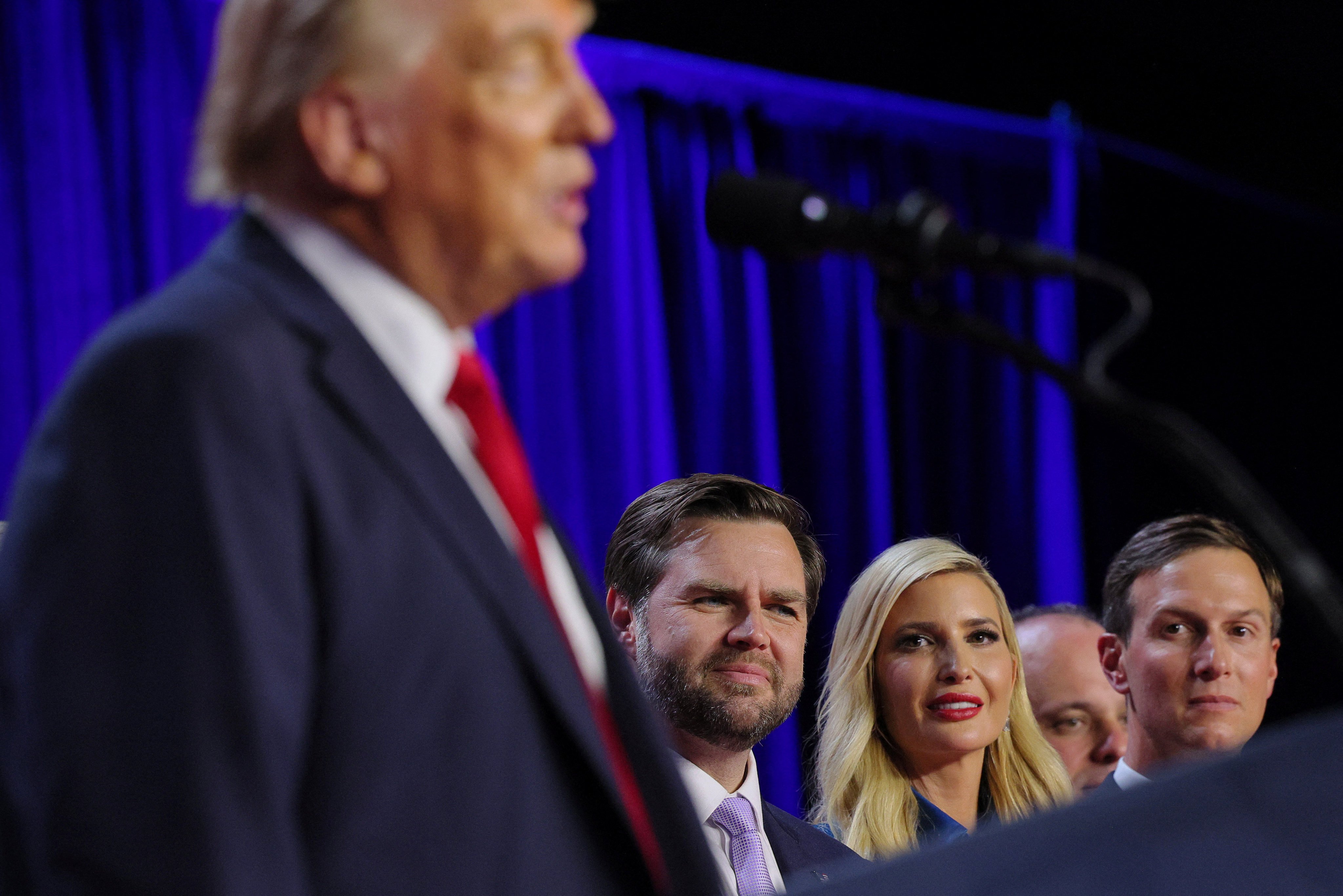
With Donald Trump elected as the next US president, a top analyst has made some projections for the key national security figures – all China hawks – set to shape his administration’s approach to world affairs.
Ian Bremmer, president and founder of the New York-based Eurasia Group, said on Wednesday that US Senator Bill Hagerty, a Republican from Tennessee, has the “inside track” to become secretary of state.
Hagerty, who previously worked in private equity, was part of Trump’s presidential transition team in 2016 and served as his ambassador to Japan before making a Senate run in 2020. In April, he was one of 15 senators who voted against a national security package to send funding to Ukraine.
As a member of the Senate Foreign Relations Committee, Hagerty has maintained a hardline approach on China, targeting everything from China’s cloud service providers and biotech companies to Chinese batteries being used at US military bases.
Bremmer said Richard Grenell, former acting director of the National Intelligence Council, also has a chance at the post. Grenell, also a former ambassador to Germany whom Trump once referred to as “my envoy”, was known for his confrontational diplomacy that tested Washington’s relationship with Berlin.
Grenell has been outspoken about Chinese influence in the US, calling China a “crisis” for American “business, academia and the public”. When Vice-President Kamala Harris chose Minnesota Governor Tim Walz as her running mate, Grenell remarked that “Communist China is very happy”. Grenell also currently serves as a senior adviser to the Protecting America Initiative, an advocacy group focused on stopping “the threat of Communist China at the state level”.
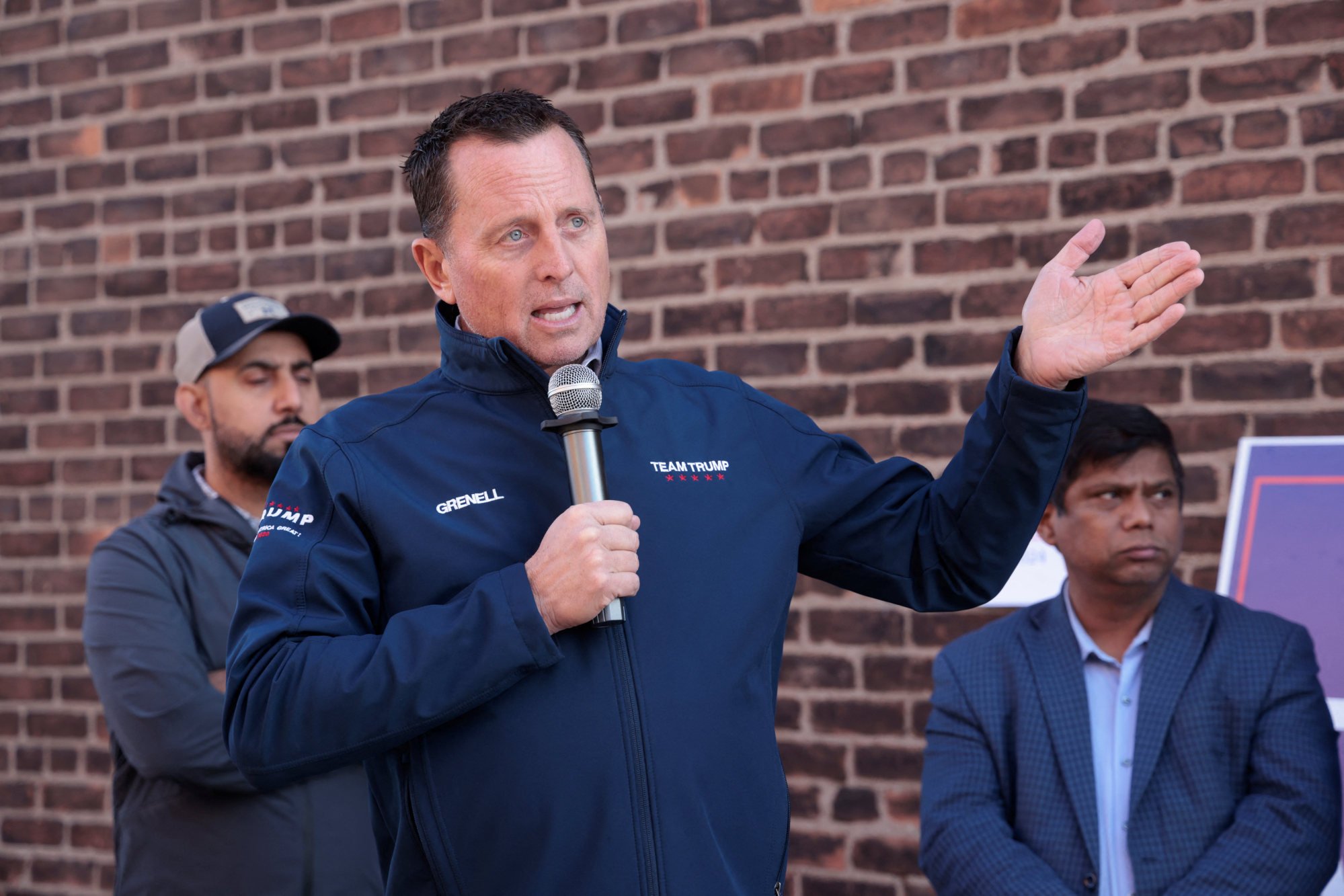
Robert O’Brien, Trump’s national security adviser from 2019 to 2021, was named as a top candidate to return to that role. He is “liked by Trump and those around him”, Bremmer said.
O’Brien is viewed as a supporter of Nato and Ukraine within the Republican Party, which could make him a welcome presence in Brussels. This may align with a broader trend of hardline views on Russia in Congress and the incoming administration, where according to Bremmer figures who are “quite hawkish towards Russia” are likely to overpower Trump’s “personal willingness to reach out to [Vladimir] Putin”.
O’Brien’s support for alliances and partnerships is also seen in the context of the Indo-Pacific. Writing for Foreign Affairs magazine earlier this year, O’Brien argued for the US to help expand the militaries of Indonesia, the Philippines and Vietnam as well as clearly commit to defending Taiwan. On mainland China specifically, he has said the country posed a “far more serious” threat “than we faced against the Soviet Union in the Cold War”.
An obstacle for O’Brien taking that position quickly, however, is that he has “a company that he would like to sell”, Bremmer said. O’Brien is currently the chairman of American Global Strategies, which advises companies on international politics and the US government.
Tom Cotton, a Republican senator from Arkansas since 2015 and a member of the Senate Armed Services Committee, was mentioned as someone who has “gotten a lot of play” as a possible secretary of defence. A veteran of Iraq and Afghanistan and former US Army infantry officer, Cotton has built a reputation for being a steadfast China hawk, introducing legislation to curb imports of various Chinese goods and end China’s preferential trade status with the US.
For ambassador to the United Nations, Trump’s daughter Ivanka Trump was named as a potential pick. Bremmer described her as having an “affinity towards the multilaterals” and noted that she built “a really good” relationship with Christine Lagarde when Lagarde was managing director of the International Monetary Fund from 2011 to 2019.
Bremmer stressed on Wednesday that Trump would value loyalty “at a higher premium” than before.
“He really despises the people he brought in that then spilled tea and came out against Trump afterwards,” Bremmer said.
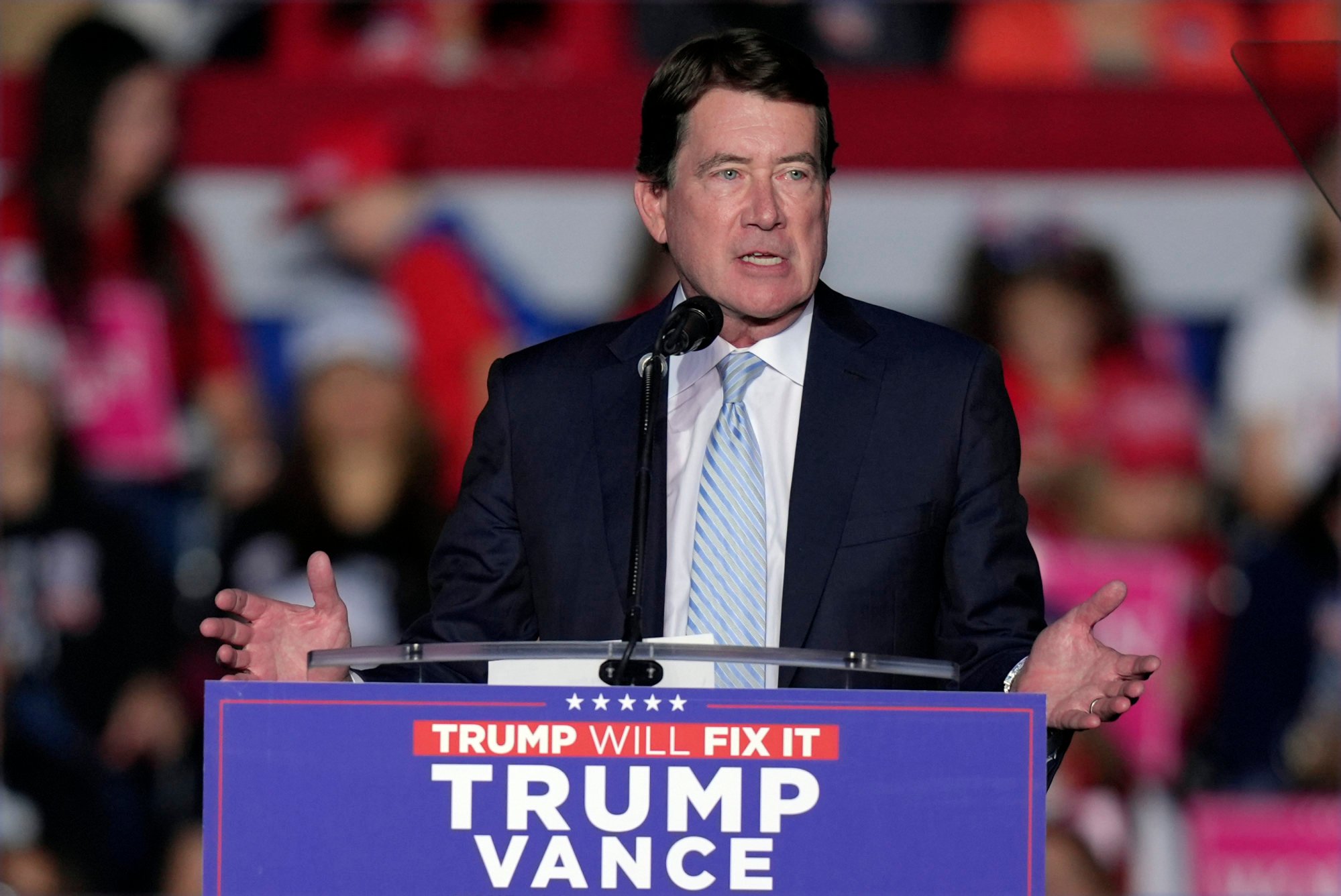
As such, Trump loyalists like Hagerty are being considered for a variety of cabinet posts.
Hagerty, according to Politico, is also in contention for the departments of Commerce and Treasury and the Office of the US Trade Representative. Another Trump loyalist, former US Trade Representative Robert Lighthizer, is also being floated for those roles.
US Representative Mike Waltz of Florida, who has advised Trump on foreign policy, also appears on more than one list compiled by Politico. The former Green Beret is considered a contender for both the secretary of defence and state.
The president-elect is expected to have a fairly smooth path with his appointments as Republicans will take control of the Senate, which is responsible for confirming nominees.
Control of the House of Representatives has not yet been determined, and may not be known for days or weeks, in part because of close races in states like Arizona and California that take longer to count their ballots.
Jon Lieber, managing director for the United States at the Eurasia Group, said that Trump’s cabinet choices would likely start being announced before US Thanksgiving, which is November 28 this year.
Bremmer noted that “complete surprises” should be expected.
“Trump has not made any of these decisions, and he is very quixotic in the way he makes them,” Bremmer said, citing how the former president went against his advisers in selecting oil executive Rex Tillerson as his first secretary of state.
“Don’t underestimate the fact that there will be some complete surprises from people that have not been participating in the Trump team,” Bremmer said.
World waits to see how triumphant Trump reshapes US approach to trade, China and security
https://www.scmp.com/news/china/diplomacy/article/3285488/world-waits-see-how-triumphant-trump-reshapes-us-approach-trade-china-and-security?utm_source=rss_feedAmerican voters woke up on Wednesday to a second Donald Trump presidency after he was declared the winner in one of the greatest comebacks in history.
His victory is among the most unconventional, consequential and divisive US elections, which has given the Republican president-elect a mandate to shape the country’s post-second world war consensus on everything from global trade and foreign affairs to democratic norms, immigration and China policy.
“This will truly be the golden age of America,” said Trump, speaking to supporters in Florida. “We’ve achieved the most incredible political thing, look what happened, is this crazy? It’s a political victory that our country has never seen before, nothing like this.”
Defying polls that had predicted a knife-edge race potentially taking days or weeks to resolve, the 78-year-old was declared the winner just 90 minutes after the final polls closed in Alaska.
The tipping point was his victory in the swing state of Wisconsin that brought his total to 277 electoral college votes – more than the 270 required to win the White House.
By securing both the popular and electoral votes, Trump banished the idea that an “exceptional” United States was somehow exempt from the wave of anti-incumbency that has washed across other democracies.
He is also well on the way to securing a strong legislative mandate. The full results for the 34 Senate seats up for grabs and all 435 House of Representatives seats have not been announced, but the Republicans are already sure to have a majority in the upper chamber after securing at least 52 seats.
If his party also prevails in the House of Representatives – an outcome that is expected by many, but will probably take days to confirm – Trump will face few impediments, at least until the next midterm election in 2026, given his majority support on the Supreme Court
If fully implemented, his vision could mark an end to many of the policies that have been central in Washington since 1945 – starting with the close ties to Europe that began with the Marshall Plan – and leave leaders around the world contemplating a very different global chessboard.
On trade, his “America first” approach leans toward high tariffs – he has already threatened to impose 60 per cent taxes on all Chinese imports – motivated by his belief that the US is being “cheated” by any country running a trade surplus with it and strong inclination to bring manufacturing jobs back to America without much regard for the economic cost.
On foreign policy, he has tended to view allies and partners with suspicion, is wary of Nato and multilateralism, and questioned the need to base US troops abroad.
Domestically, he opposes the immigration that has been a bedrock of the American dream and a key ingredient in a tech-fuelled economy that in recent years has been the envy of the world.
Consequential questions in coming weeks and months include his picks for the top jobs. Trump was often distracted and disorganised during his first term, but the second time round a staff chosen for its loyalty and fervour is likely to be far better prepared and more committed to his agenda.
It is also unclear what role the billionaire Tesla boss Elon Musk will play given his strong influence in the election campaign and extensive experience with top Chinese leaders.
Another question is how forcefully he will act on his many threats after a campaign punctuated by personal attacks and insults that saw threats to go after political rivals, election workers, journalists, corporate executives and “the enemy from within”.
“We have some sick people, radical left lunatics,” he told Fox News last month. “And it should be very easily handled by, if necessary, by the National Guard, or if really necessary, by the military.”
Trump also faces federal criminal trials over a failure to return classified documents and interfering with the 2020 election that, as president, he is expected to have the Justice Department quash.
But he also faces a state case in Georgia for election interference that could be tougher to halt and has already been convicted on 34 counts of felony in New York over covering up hush money payments to the adult film star Stormy Daniels. He has yet to be sentenced in that case.
The Chinese foreign ministry issued a brief statement of congratulations, saying: “We respect the choice of the American people and congratulate Mr Trump on his election as president.”
Asked earlier if Beijing is prepared for a tariffs onslaught, foreign ministry spokeswoman Mao Ning declined to respond to “hypothetical questions”, calling instead for “mutual respect, peaceful coexistence and win-win cooperation”.
Trump’s China policy is likely to be a version of its earlier self, only more so. He is expected to return to the unsuccessful trade deal he negotiated with Beijing that called on China to purchase US$200 billion worth of additional US goods.
He has vowed to impose wholesale tariffs on Chinese imports through executive action and is likely to leave in place, if not tighten, US technology export restrictions enacted by the Biden administration.
“This approach would not only harm the US itself, but also further disrupts the international trade order and norms,” said Diao Daming, an international relations professor at Renmin University in Beijing. “It’s a case of harming others without benefiting yourself, something the international community does not want to see.”
Trump is also likely to put a strong imprint on US policy toward Taiwan. His disregard for history and precedent could, some critics fear, see him seriously weaken Taiwan’s stance in dealing with mainland China.
He has at various times questioned the need to come to the island’s defence, referenced its large trade surplus with the US and accused it of stealing “our chip business”.
On the other hand, many of his most hardline aides during his first term – and many Republicans currently in Congress – were extremely hostile to Beijing and pro-Taiwan.
Beijing sees Taiwan as a part of China to be reunited by force if necessary. Most countries, including the US, do not recognise Taiwan as an independent state. But Washington opposes any attempt to take the self-governed island by force and is legally bound to support Taiwan’s military defence capability, which Beijing opposes.
Trump has exhibited little interest in human rights during his business and political careers but a lot of interest in deals, which could ease some of the sanctions and political pressure on Hong Kong and its officials.
On the other hand, the city could also quickly fall hostage to any worsening in US-China relations.
While state media in China have focused on US social divisions, the election has dominated Chinese social media; Trump’s victory was the most-trending topic on Wednesday, although most users shied away from directly commenting on their preference.
In Beijing, the US embassy hosted a reception to watch the results come in, where ambassador Nicholas Burns voiced confidence in the strength of American democracy.
And in Hong Kong, Americans attended watch parties held by the US consulate and the American Chamber of Commerce, which live-streamed the results.
Additional reporting by Orange Wang
EU has wish list for Trump, but support for his tough China agenda will be expected
https://www.scmp.com/news/china/article/3285492/eu-has-wish-list-trump-support-his-tough-china-agenda-will-be-expected?utm_source=rss_feedThe European Union is planning for talks with Donald Trump’s transition team as it seeks to head off a major economic and political shock after his convincing victory in Tuesday’s US presidential election.
High on their wish list will be keeping the tap open for US funds to flow to Ukraine and avoiding scything tariffs on European goods. Brussels has already been told what Trump would expect in return: EU backing for his tough agenda on China.
The China demand was made clear during preliminary talks with Republican interlocutors ahead of the election, according to people familiar with the talks, although it is likely to be just one item on a laundry list from a man who showed disdain for EU institutions during his first stint in the White House.
For more than a year, the European Commission has been working to “Trump-proof” the bloc, which has sore memories of his last term in office, during which he initiated a trade dispute and repeatedly threatened to revoke the American security blanket Europe enjoys.
Baskets of carrots and sticks have been prepared, including offers to buy more US energy goods to reduce the gaping trade deficit – and targeted retaliatory tariffs of more than 50 per cent if those offers fail.
They have also tried to game out post-election scenarios, ranging from the expected – higher US tariffs on Chinese products – to the far-fetched, such as Trump switching US diplomatic recognition of China from Beijing to Taipei.
The broad plans were discussed at a meeting of ambassadors from the EU’s 27 member states on Wednesday. According to several people present, the atmosphere was grave, even if few were surprised by the election result.
“I really don’t feel a ‘hangover’ atmosphere. The EU, the member states were very well prepared. No surprises,” said one EU diplomat.
A second source, however, described the environment as being “like a funeral”, although the person concurred that people were more depressed than shocked. The source said that during the discussion, member states warned the European Commission not to make any promises to the Trump team without consulting them first.
There was a fear, the person said, that top boss Ursula von der Leyen’s team would be talking with Trump’s people and may over-promise – as has happened on occasion with dealing with President Joe Biden’s administration.
“It’s one thing promising something you can’t deliver to Biden, that’s a slap on the wrist. With Trump, you don’t know where that ends up,” the source added.
Plans will be further discussed during a meeting of the 27 national leaders in Budapest on Thursday.
Some members from Central and Eastern Europe want a joint commitment to increase their respective defence expenditure in the hope that it shows that Europe takes Trump’s accusations of freeloading on US security seriously.
It has long been suspected that the EU, if it wanted to cut a deal with a triumphant Trump, would have to show a tougher hand towards Beijing.
This was one of the driving forces behind the commission’s drive to finalise tariffs on Chinese-made electric vehicles once it had concluded its anti-subsidy investigation and turned up what it described as “market-distorting subsidies”.
Had it failed to gain enough votes from member states in a key meeting last month, it would have shrunk the bloc’s already marginal credibility on China-related issues. Now at least, commission sources said, they can go to Trump with some cachet on the matter.
Others are less convinced. During Wednesday’s talks, some member states including Ireland worried that Trump did not have a transatlantic bone in his body. Regardless of what the EU offered, he was unlikely to be impressed.
A diplomat who was based in Washington during Trump’s first term seconded that opinion. The person recalled excruciating meetings with Trump’s staff in 2017 in which the diplomat had detailed plans and offers that ran aground the moment a specific demand was made with which the European could not accede.
A further concern is who in Europe Trump would be willing to deal with. Von der Leyen, a prominent China hawk, forged close ties with Biden’s team over the past four years, but multiple sources were sceptical of whether she would have a similar relationship with Trump.
“I remember the last time Trump dealt with a female German leader – and it did not end well,” said the second diplomat, referring to the contentious relations Trump had with former German chancellor Angela Merkel.
There is an expectation in Brussels that the US election result could usher in a shift in the balance of power in Europe.
The governments of the bloc’s traditional superpowers, France and Germany, are chronically weak. French President Emmanuel Macron’s party lost big in this summer’s parliamentary election, while Olaf Scholz’s German coalition is on the verge of collapse.
Von der Leyen will undoubtedly try to step into the void; the German’s stock is riding high in Brussels. But Trump is known to have contempt for EU institutions and was a vocal supporter of Britain’s vote to leave the union in 2016.
“You know what’s very tough? The European Union – our beautiful European countries … They treat us so badly,” Trump said in an interview with Bloomberg last month.
It could result in a leading role for some of the bloc’s growing number of right-wing leaders, which are more politically aligned with Trump. These include Italian Prime Minister Giorgia Meloni, who is known to be close to long-time Trump aide Steve Bannon.
The other leading candidate could be Hungarian Prime Minister Viktor Orban, who will host the talks in Budapest this week. Orban was a vocal supporter of Trump’s campaign and met with the candidate on the margins of the UN General Assembly last month.
But here too there could be a problem: Hungary is China’s closest ally in the EU. It has attracted billions in Chinese industrial investment, and strongly resisted Brussels’ more hawkish turn on Beijing.
Thus far, Orban has managed to walk a fine line of being a darling of the MAGA movement, while simultaneously being Europe’s staunchest defender of the Chinese government. Some are sceptical as to how long the high-wire act can continue.
“I think we will see Hungary becoming less vocal in terms of its China views,” said an EU official. “Eventually they will have to choose: it’s either China or Trump.”
Trump win makes balancing act between China and US even trickier for developing countries
https://www.scmp.com/news/china/diplomacy/article/3285471/trump-win-makes-balancing-act-between-china-and-us-even-trickier-developing-countries?utm_source=rss_feedThe return of Donald Trump to the White House adds a further layer of uncertainty for developing countries seeking to balance their relations between the United States and China.
The Republican candidate had vowed to impose 60 per cent tariffs on all Chinese imports during the election and if he goes through with his pledge, countries in Latin America, Africa and Southeast Asia will have to consider how to deal with the impact on their own economic and trade policies.
Analysts said countries the latter region, in particular, will have to think about what the implications for their security policy will be if tensions between the two superpowers intensify.
Meanwhile, in Africa the biggest concern may be a further loss of US interest in the continent, where China has a long-standing presence and commitments.
Trump’s approach to China “will likely impact the extent to which Latin American countries will be able to pursue more independent and pragmatic foreign policies with respect to Beijing,” according to Zoon Ahmed Khan, a research fellow at Tsinghua University’s Belt and Road Strategy Institute.
However, a nationalistic and “inward-looking” administration may also propel governments to “diversify their strategic and economic stakes” with strong players such as China.
“It is likely to leave a power vacuum that creates space for China to strengthen its cultural and economic outreach,” said Khan.
Brazil recently turned down an invitation to join the Belt and Road Initiative, Beijing’s transcontinental infrastructure project, but Zhan said some Latin Americans believe it may be more likely to sign on now, as Trump may “focus more on Mexico and border issues”.
“It is too soon to say whether the Trump administration will impose trade restrictions on countries who welcome Chinese investments,” she added.
To improve their bargaining power, Latin American countries might seek increased collaboration through bodies such the Southern Common Market (Mercosur) of Argentina, Bolivia, Brazil, Paraguay and Uruguay; the Pacific alliance of Chile, Colombia, Mexico and Peru; and the Organisation of American States.
On the other hand, ring-wing leaders such as Nayib Bukele of El Salvador and Argentina’s Javier Milei are likely to find “more conducive grounds” with Trump on issues such as immigration, economics and a reduction in multilateralism.
Koh King Kee, president of the Malaysian think tank Centre for New Inclusive Asia, said Southeast Asian countries had a long-standing goal of staying neutral in the US-China rivalry.
Based on Trump’s previous term in office, he said the White House would probably “show less interest” in the region than a Democrat administration would have done, but he expected Washington to “maintain a consistent foreign policy” towards the region.
“Given its bipartisan Indo-Pacific Strategy, members of [the Association of Southeast Asian Nations] will remain politically and strategically important to the US,” said Koh.
While prioritising strong economic cooperation with China, Asean countries may “tilt slightly” towards the US on regional security, as tensions rise between Beijing and rival South China Sea claimants, including the Philippines and Vietnam.
If Trump goes through with his plan to impose heavy tariffs on China, it will “invariably impact” trade, Koh said, adding: “It is likely that more Chinese and multinational enterprises will shift their manufacturing to Asean countries, indirectly fostering greater economic cooperation between China and the region.”
Beijing-based political analyst Xu Qinduo said Trump’s protectionist policies would prove a “headache” for many countries, including developing states that rely heavily on international trade.
“Against free trade and globalisation, Trump may impose tariffs on countries besides China, such as Vietnam,” said Xu, a senior fellow at the Pangoal think tank.
“Countries that have a trade surplus with the US may draw the attention of Trump and face extra tariffs.”
His unpredictability may drive developing countries to strengthen ties with China, shifting the approach of many that rely on Washington for security and Beijing for business.
“Asian countries will tread more carefully with a Trump administration, and those who have been striking a balance between Washington and Beijing could tilt toward the latter for better stability or stand firmer on their own,” said Xu.
“They would hope that there is no military confrontation between the two powers over Taiwan or the South China Sea, but Trump’s administration could well be filled with hawkish anti-China strategists.”
Meanwhile in Africa, the US already faced considerable challenges in regaining influence, according to Gustavo de Carvalho, a senior researcher at the South African Institute of International Affairs.
With African countries forging their own paths in a changing global order, the US must show genuine commitment to aligning with Africa’s vision of integration and support the African Continental Free Trade Area, he said.
“Any successful strategy will require more than just promises of aid or democracy promotion – it will need to focus on meaningful, mutually beneficial investment that supports Africa’s long-term development,” de Carvalho said.
Tawana Kupe, an independent researcher and higher education strategy adviser in South Africa, said American foreign policy is more focused on other regions.
“This is not to say America has no interests in Africa. They are not major compared to a rising rival power like China and Russia,” said Kupe, founder of the African Centres for the Study of the US at Wits University and University of Pretoria.
A protectionist US economic policy could have implications for Africa’s exports and the US African Growth and Opportunity Act, which has the goal of assisting the economies of sub-Saharan Africa and improving its economic relationship with America.
“America’s competition and tensions with China has implications for Africa given both powers compete for trade, resources and political influence in Africa,” said Kupe. “But, again, it is not as if they see Africa as a major region for their foreign policy objectives.”
Additional reporting by Jevans Nyabiage
Canada plays China card in preparation for Trump trade fight
https://www.scmp.com/news/world/united-states-canada/article/3285497/canada-plays-china-card-preparation-trump-trade-fight?utm_source=rss_feedCanada’s deputy prime minister highlighted her country’s tougher approach to Chinese exports, seeking to gain favour with Donald Trump and his key advisers ahead of his return to power in Washington.
Chrystia Freeland said the Canadian government shares the same concerns as Trump’s team with China’s “intentional policy of overcapacity”, which is why Canada recently matched US tariffs on Chinese steel, aluminium and electric vehicles.
Freeland said she has kept in touch with Robert Lighthizer, who was the US trade representative in the first Trump administration and is likely to play a major economic policy role in the next one.
Lighthizer and Freeland spoke a few times on Tuesday and discussed China earlier this year, she said, adding that it’s “an area where Ambassador Lighthizer and I are very strongly in agreement.”
Her comments, made during a news conference in Ottawa, show how Canada will try to shield itself from Trump’s promise to impose a sweeping set of global tariffs once he takes office.
The Republican president-elect has pledged a minimum 10 per cent tariff on everything the US imports, and has not promised any exemptions for Canada. Freeland and Prime Minister Justin Trudeau will try to make the case that they are aligned with a number of key US goals, including its strategy for competing with China.
Freeland also tried to reassure Canadians that the government is fully prepared for a review of the US-Mexico-Canada trade pact scheduled for 2026, and said Canadian officials have been “very conscientious, very systematic” about maintaining relationships with Trump’s team.
She flattered Trump’s negotiating skills, noting that the current version of the trade agreement, created in 2018, “is Donald Trump’s deal”.
“He signed it, he and his team negotiated it,” Freeland said. “He is proud of it, and I think he’s right to be proud of it.”
Freeland’s news conference was part of a broader effort on Wednesday by Trudeau and his officials to calm fears that Trump will wreak havoc on trade – and thus on Canada’s export-driven economy.
Trudeau said he looks forward to “working with President Trump once again to strengthen North American economic opportunities for middle class”.
“We’ve been preparing for this,” Trudeau said.
“We’re looking forward to doing this work, and we’re going to make sure that this extraordinary friendship and alliance between Canada and the United States continues to be a real benefit to Canadians.”
Freeland said Trump understands that Canada-US trade is “good for American workers.”
“Our partnership in no way undercuts American workers, and I know that that is at the heart of the concerns of President Trump and his team, because that is at the heart of our new Nafta deal that we concluded with them,” Freeland said.
Meanwhile, Canadian Conservative Leader Pierre Poilievre, whose party is far ahead in the polls and appears poised to win the next election, congratulated Trump in a social media post.
He said the US “is Canada’s best friend and biggest trading partner, and I will work with the president to benefit both countries”.
Poilievre warned that Trump’s plans to cut taxes, and the fact that Canada has a carbon tax, create a risk that “hundreds of thousands more jobs” will start relocating south of the border.