
英文媒体关于中国的报道汇总 2024-11-02
November 3, 2024 78 min 16604 words
这些西方媒体的报道内容主要涉及了中国与美国巴西肯尼亚等国的关系,以及中国的社会经济旅游国际航班等多方面情况。评论如下: 1. 美国媒体的报道倾向于突出中美之间的竞争和对抗,渲染中国威胁论,以强化其盟友关系。比如,关于美国大选的报道,强调无论谁当选,中国仍是美国的主要对手,在战略上没有区别。而关于中国在肯尼亚建造地热电厂的报道,则体现了美国对中国在非洲影响力的担忧。 2. 这些报道存在明显的偏见和误导。比如,关于中国与巴西的关系,报道强调巴西没有加入中国的一带一路倡议,而忽略了巴西希望在一带一路框架下与中国寻找协同合作,这体现了巴西内部的不同声音和复杂考量。关于中国国际航班数量增加的报道,强调了中国航司的优势,而忽视了中国航司也面临俄罗斯空域禁飞等问题。 3. 这些报道也暴露了西方媒体的傲慢和双标。比如,关于中国鼓励结婚和生育的报道,以西方价值观批判中国政府,而无视中国面临的人口危机和老龄化挑战。关于中国女性在婚姻中的角色描述,体现了西方对中国传统文化的偏见和歧视。 4. 此外,这些报道也体现了西方媒体对中国的恐惧和焦虑。比如,关于中国消费者热衷于购买日本奢侈品的报道,体现了他们对中国经济实力的担忧。关于中国发现重要矿产资源的报道,则体现了他们对中国在科技竞争中占据优势的焦虑。 5. 需要注意的是,这些报道也反映了中国在国际关系和国内治理中确实存在的一些问题和挑战,比如中美关系的复杂性中国与周边国家的领土争端中国社会面临的结婚和生育难等问题。因此,我们也需要直面这些问题,积极寻求解决方案,以促进中国的发展和进步。
Mistral点评
- US-China confrontation here to stay after election, says influential Beijing commentator
- No – but yes. Why Brazil is staying open to China’s Belt and Road Initiative without joining it
- ‘Marriage school’: China city’s bold measures to boost nuptials, birth rates spark criticism
- Chinese rush for gold sparked by uncertainties in US and at home
- China begins work on Kenyan geothermal power plant amid African renewable energy push
- China boss apologises for ‘let them rot’ remark forcing staff to put work before family
- China offers visa-free entry to 9 more countries in renewed tourism and diplomatic push
- Chinese consumers, still hungry for luxury goods, pounce on weak yen to feed cravings
- US finds a new use for old Patriots to counter China’s missile advancements
- China hails mineral finds amid push for security of supply chain, energy and nation
- Will Prabowo’s Brics ambitions reshape Indonesia’s ties with Russia and China?
- Joe Biden leaves a mixed legacy on US-China affairs as he exits the world stage
- Mainland China woman crashes Hong Kong wedding, poses as friend, enjoys banquet, posts videos online
- [Sport] Kim Jong Un was China's ally - until he became the 'comrade from hell'
- China’s international flights to reach new heights, led by domestic carriers
- US penalises GlobalFoundries US$500,000 for shipping chips to Chinese firm
- China adoption fallout: US lawmakers urge Biden to help families after Beijing ends scheme
- US boosts scrutiny of foreign land deals near military bases amid China concerns
- How China and India can build on border truce to normalise ties
US-China confrontation here to stay after election, says influential Beijing commentator
https://www.scmp.com/news/china/diplomacy/article/3284957/us-china-confrontation-here-stay-after-election-says-influential-beijing-commentator?utm_source=rss_feedCompetition between the United States and China appears inevitable, but the result of next week’s presidential election will determine whether Washington’s tactics are “coarse” or “refined”, a leading academic has said.
Vice-President Kamala Harris has a better chance of winning the election, Jin Canrong, vice dean of the school of international studies at Renmin University, told a forum at the university, adding that she would be “more refined and more systematic… and more covert” in her approach.
In contrast, he said Donald Trump “may be more simple and coarse” but his position now was “milder” than it had been during his presidency and showed subtle changes.
“Trump is a bit like the kind of people who ‘kill the old master with random punches’ - making you dizzy with random punches,” Jin told a forum at the Chongyang Institute for Financial Studies last month, acccording to a transcript published by the university on social media on Saturday.
Other observers have said Trump will create greater uncertainty and might reverse efforts to ease strained ties, whereas Harris, who is likely to continue President Joe Biden’s approach, will be more predictable.
“No matter who comes to power, China will remain the main opponent. There is no difference in strategy, but how they treat us tactically,” said Jin, adding that “big characteristics remain unchanged”.
He said China will need to develop high-end domestic manufacturing and promote the Belt and Road Initiative, its global infrastructure programme, to put itself into a “very proactive” strategic position.
“The fact that the US wants to confront us is a constant and cannot be changed. We can only face it, acknowledge that China-US relations have entered a period of comprehensive competition,” said Jin.
He also said the issue of Taiwan “will not be delayed for long” and has to be faced by whoever wins the election.
The People’s Liberation Army’s most recent drills around the island, dubbed “”, came days after a speech by Taiwanese leader that Beijing said promoted separatism.
“No matter how well-mannered we are, people have tempers, and when it reaches a certain point, we may have no choice but to take action,” said Jin, labelling Lai an “independence activist” under Washington’s control.
Beijing views Taiwan as part of its territory that must be reunited with the mainland, by force if necessary. The US, in common with most countries, does not recognise Taiwan as an independent state, but it opposes any attempt to take the island by force and is legally bound to arm the island to help it defend itself.
Jin is an influential figure on social media, boasting nearly over 11 million followers on Douyin, the Chinese version of TikTok, where he frequently uploads political commentary.
He also said that a trade war between the superpowers would be “guaranteed” under Trump, whom he said had an “isolationist” view that would manifest itself in “the implementation of the America First policy and the disrespecting of allies’ interests”.
Jin added: “Europe and Japan are quite nervous and will ponder how to protect their own interests in the face of such a strong leader.”
He also said Trump’s vow to impose against China would be met with backlash from Washington’s own allies, so it remains to be seen whether he will be able to go ahead with the policy.
“The US of today is highly dependent on its alliance system, [its] own capabilities are not very strong. If Trump comes to power and pursues isolationism, it will hurt its alliance system. He will gain some small advantages, but it will not be good for the US in the long run,” he said.
No – but yes. Why Brazil is staying open to China’s Belt and Road Initiative without joining it
https://www.scmp.com/news/china/diplomacy/article/3284926/no-yes-why-brazil-staying-open-chinas-belt-and-road-initiative-without-joining-it?utm_source=rss_feedFor now, Brazil is saying no – but yes.
On Monday in Beijing, Celso Amorim, special presidential adviser for international affairs, said the country would not be joining China’s Belt and Road Initiative, a trillion-dollar transnational infrastructure programme launched a decade ago.
However, in the same breath, Amorim also said Brazil would use some of the belt and road framework to find “synergy” between Brazilian infrastructure projects and the investment funds associated with the initiative.
Observers say the announcement reflects divisions within the Brazilian administration over the initiative but it should not affect ties with China, its biggest trading partner, as it looks for a framework that best meets its needs.
Before the announcement, there had been some hope that Brazil would sign up for the initiative during Chinese President Xi Jinping’s visit to the Latin American country this month.
Amorim, alongside Chief of Staff Rui Costa and Gabriel Galípolo, head of Brazil’s Central Bank, visited Beijing last month, to lay the groundwork for the visit.
But, according to Marco Fernandes, a Brazilian geopolitical analyst in Beijing, there was a lack of consensus in President Luiz Inácio Lula da Silva’s government.
Officials at the economy and foreign affairs ministries opposed the idea over concerns that the plan offered few immediate benefits for Brasilia and could complicate ties with Washington. However, Agriculture Minister Carlos Favaro argued that membership could counter protectionist measures from the United States and the European Union amid a long-time battle between the US and Brazil over protections for ethanol and other products, as well as rivalry in exports of farm goods, like corn, cotton and soybeans.
Brazil exports mostly low value-added commodities to China, which generates limited wages and tax revenue, and does not require much innovation. To improve its economy, Brazil is looking for ways to move up the value chain to areas such as renewable energy, minerals processing, telecommunications and artificial intelligence.
“Although China is Brazil’s largest trading partner and Brazil had around a US$50 billion surplus with China last year, their trade pattern is still very unbalanced,” said Fernandes.
Selective – rather than wholesale – involvement in the belt and road could be a better way to do this.
“Amorim said that Brazil was looking for ‘synergy’ with the belt and road and, more importantly, he said that Brazil wanted to elevate its economic partnership with China, which I believe is the key issue of that matter,” Fernandes said.
“I don’t think they went to China just to say, ‘we are not interested in strategic Chinese investments’.
“There is a need to shift the pattern of Chinese investments in Brazil according to our current strategic demands.”
According to Zoon Ahmed Khan, a foreign-policy analyst and research fellow at Tsinghua University’s Belt and Road Strategy Institute, there is much room for the two countries to engage through frameworks that predate the initiative.
“Brazil and China have a history of economic cooperation, and the specific benefits derived from signing a belt and road agreement may perhaps be more symbolic than tangible,” Khan said. “Through Brics, G20 and multiple bilateral mechanics, Brazil’s cooperation with China will only be enhanced.”
Brazil’s decision has drawn comparisons to India’s longstanding reluctance to join the initiative. Both countries are members of the China-backed Brics grouping of emerging economies but Khan said the two were different.
“Contrary to many analyses comparing this to India’s decision, for Brazil, the overarching signal is not to limit cooperation with China but instead to expand it,” he said.
“Brazil sees China as the key player in the [South American] region, especially with respect to its core challenges concerning infrastructure, overall development, food security, and so on.”
Still, it was possible that Brazil would miss out on some key opportunities and representation in initiatives that are specifically curated for the scheme.
“This could mean the Global Development Initiative, and general cooperation on issues such as agriculture, poverty alleviation, technical transfers, and [technical and vocational education and training],” Khan said.
Josef Gregory Mahoney, a professor of politics and international relations at East China Normal University in Shanghai, said the decision might also have been influenced by a “poisonous” media landscape that weighs heavily on Brasilia’s balancing act with Beijing and Washington.
“There has been a tremendous amount of poisoning the well with various false descriptions of the [belt and road] and what it aims to achieve,” Mahoney said.
“This is the media milieu that local leaders have to weigh, in addition to the fact that Brazil needs to maintain good trade relations with both the US and China.”
US trade representative Katherine Tai has urged local officials to assess the risks of joining China’s plan, saying they should “really think about what the best pathway forward is for more resilience in the Brazilian economy” and look at the trade partnership through an “objective lens” and a “risk management lens”.
The Chinese embassy in Brasilia called Tai’s comments “irresponsible” and “disrespectful” and said Brazil’s sovereignty in choosing its trading partners “should be respected”.
“What appears to be the case is that American policymakers as well as influential people in Latin America who support closer relations with the US have been promoting various discredited narratives about the belt and road, for example that it creates debt traps, that it exists as a means to accommodate Chinese overcapacity, and so on,” Mahoney said.
Leaders in South America could risk losing votes at home if they acted against those narratives as they tried to balance finding new investment for Latin America’s largest economy with maintaining amicable ties with the West, its main source of foreign direct investment.
“Because Brazil does have good relations with China, it can seek alternative forms of engagement that would perhaps compensate for refusing to join the initiative,” Mahoney said.
“However there might also be a short-term delay, in other words, Brazil might wait to see what happens with the US presidential elections and what sort of direction the administration takes after its inauguration early next year to [decide upon] how it wants to deal with its relationship with China.”
As reported by the Post last month, Lula was advised by diplomats to delay any announcement about joining the Chinese initiative until after the US presidential election.
“For example, if Brazil finds itself facing a trade war under the Trump presidency then we might see a Brazil that is more inclined to join the belt and road. However, a decision was needed now because it was hoped that this partnership might be announced during President Xi’s upcoming visit.”
‘Marriage school’: China city’s bold measures to boost nuptials, birth rates spark criticism
https://www.scmp.com/news/people-culture/gender-diversity/article/3284665/marriage-school-china-city-bold-measures-boost-nuptials-birth-rates-spark-criticism?utm_source=rss_feedA city in southern China has launched bold initiatives and slogans to encourage marriage and boost birth rates, igniting widespread controversy.
In October, Changsha, the capital of Hunan province, unveiled the country’s first “marriage-themed” cultural street.
The historic street showcases both Chinese and Western wedding scenes, providing visitors with plenty of photo opportunities.
However, what truly captures attention are the pink slogans displayed throughout the area, featuring phrases like “I enjoy making breakfast”, “I’d be willing to take care of the baby”, and “Having three children is the coolest”.
These slogans have drawn significant criticism online for their depiction of women’s roles in marriage.
“Cooking and child-rearing are portrayed as female responsibilities, emphasised in pink, which feels both disrespectful and discriminatory towards women,” one user commented on Xiaohongshu.
Another female commenter expressed her outrage: “That’s ridiculous. Am I not ‘cool’ if I don’t have three children? My self-worth should not be tied to marriage and motherhood.”
An angry observer challenged the government: “Why don’t the leaders have eight kids themselves first? Promoting marriage and children overlooks the real issues young people face, such as job struggles and low wages. It’s simply a waste of taxpayer money.”
The street also features a “marriage school”, where visitors can rent traditional Chinese wedding attire and participate in lessons on love and marriage.
Travel influencer Uncle Huzi shared his experience at the marriage school, where he tried a labour-pain simulator.
“Thank you, Mum; that was incredibly painful. Every man should experience this. Childbirth is truly arduous for women,” he remarked.
Visitors can also practise parenting tasks, such as diaper-changing and preparing formula.
Those who complete all the challenges will receive a “marriage permit certificate”, symbolising their graduation from this unique educational experience.
Changsha officials explained that the street aims to creatively promote marriage culture in a way that resonates with young people, fostering high-quality population growth.
However, the slogans and activities have elicited mixed reactions on mainland social media.
One supporter on Weibo called it “very educational”, asserting that marriage and childbirth are essential components of society.
Conversely, a local from Changsha voiced her discontent: “I’m embarrassed by these activities. Marriage and parenthood should remain personal choices.”
In China, 3.43 million marriages were registered in the first half of this year, marking a 12-per-cent decrease from last year, the lowest in a decade.
Meanwhile, the birth rate has plummeted to a record low of 9.02 million births last year, according to the National Bureau of Statistics.
Experts warn that declining marriage and birth rates could exacerbate China’s labour shortage and accelerate its ageing population crisis.
Recently, some mainland companies have introduced incentives for employees to marry and have more children. In June, a machinery firm offered a bonus of 210,000 yuan (US$29,000) to employees who welcomed a third child.
Chinese rush for gold sparked by uncertainties in US and at home
https://www.scmp.com/economy/global-economy/article/3284814/chinese-rush-gold-sparked-uncertainties-us-and-home?utm_source=rss_feedEven though gold prices are at record highs, Chinese consumers and retail investors are still buying the precious metal, spurred on by the uncertainty surrounding China’s economic outlook and next week’s US presidential election.
A couple of weeks ago, Wendy He, the director of administration for a private company in Guangzhou, bought gold bullion worth 200,000 yuan (US$28,026) through online banking, which gives her the option to convert it to cash at any time.
“If [Donald] Trump wins, uncertainty over China’s exports and the yuan exchange rate will be set to soar,” she said.
“Inflation in the United States is also full of uncertainty, although interest rate cuts have started.
“Besides, the effect of China’s fiscal stimulus policy is uncertain, and it has affected my expectations for the stability of the yuan exchange rate.
In short, gold is, so far, the most reliable value-preserving asset for ordinary Chinese investors like me.”
Spot gold was trading at US$2,746.3 an ounce on Friday, after hitting a record high of US$2,790.15 on Thursday.
Americans will go to the polls on Tuesday to elect a new president. Two days later, the US Federal Reserve is due to meet to discuss interest rates – with its decision likely to influence gold prices.
“Markets are still concerned with geopolitical tension, combined with the uncertainty surrounding the outcome of the US presidential election, supporting gold prices and strengthening the rebound of spot gold,” analysts at China Construction Bank said in a note issued on Monday.
Amid the trend of de-dollarisation, some central banks around the world are diversifying their foreign reserves and gradually increasing holdings in gold, analysts said.
“The US is currently imposing economic sanctions on nearly 100 countries, and the sanctions are escalating,” said Chen Weidong, from the Bank of China Research Institute.
“This has prompted the countries to increase their holdings of gold, as well as other currencies.”
The retail price of gold bars at Guangzhou’s Dongshan department store rose from 590 yuan (US$82.9) a gram on October 10 to over 640 yuan on Wednesday.
“Since the day the gold price broke 500 yuan [a gram], customers began to come and line up to buy, and the counters were crowded every day,” a saleswoman at the store said.
“Just a few days ago, a regular customer took out his fixed deposit early and bought 2,000 grams of gold bars for more than US$1.2 million.”
She said gold bars weighing over 200 grams were already sold out, adding that “profit-taking investors are waiting to buy on the dip anytime”.
In the first three quarters of this year, gold consumption in China fell by 11 per cent year on year to 742 tonnes, according to the China Gold Association, which said high prices had put off consumers.
Chinese consumers bought 400 tonnes of gold jewellery, a year-on-year decrease of 27.53 per cent, but they purchased 282.721 tonnes of gold bars and gold coins, up 27.14 per cent year on year, the council said.
Due to the low threshold for investment and simple rules, physical gold sales have increased at Chinese banks, with many recently increasing minimum purchase amounts.
According to data from the China Gold Association, trading on the Shanghai Gold Exchange increased by 47.49 per cent year on year in the first three quarters of this year, with holdings of gold exchange-traded funds up nearly 50 per cent since the start of the year.
While domestic gold prices have risen by more than 30 per cent this year, it remains the go-to choice for weddings in China, with costly gold jewellery putting Guangzhou bride-to-be Cindy Wang and many others under pressure.
The retail price for gold wedding jewellery at popular stores such as Chow Tai Fook and Chow Sang Sang rose to over 820 yuan a gram this week from 630 yuan in January.
“The price of gold is ridiculously high, but my wedding day is getting closer and closer,” Wang said.
China begins work on Kenyan geothermal power plant amid African renewable energy push
https://www.scmp.com/news/china/diplomacy/article/3284769/china-begins-work-kenyan-geothermal-power-plant-amid-african-renewable-energy-push?utm_source=rss_feedBeijing’s push for renewable energy projects across Africa has been highlighted at a groundbreaking ceremony at the site of a new Chinese-led geothermal power plant project to be built in Kenya’s Great Rift Valley.
State-owned energy and construction company PowerChina will build the 35-megawatt Orpower 22 geothermal plant at the Menengai Crater, with the facility owned by Chinese firm Kaishan Group, which is spending US$93 million on the construction.
During the ceremony, President William Ruto said the plant will raise the country’s global ranking in geothermal production to fifth overall, and “highlights our commitment to unlock Kenya’s vast geothermal potential to drive economic growth”.
Kenya was the first African nation to harness geothermal power, which uses heat from the Earth to generate electricity, but Ruto said just 10 per cent of the country’s geothermal energy has been explored.
“So far, we have tapped only 950MW, a small fraction of our geothermal potential of nearly 10,000MW, leaving immense opportunities still untapped,” he said.
Last year, PowerChina commissioned another 35MW geothermal power plant in Kenya, owned by Sosian Geothermal Power Station. It followed a 14-year contract between China’s Kaishan Group and Kenya’s Sosian Energy to run the geothermal plant before handing it back to Sosian after its investment has been recouped.
The Kenyan power plants represent a growing footprint of Chinese-built or funded renewable energy projects in Africa – from solar and wind to hydropower projects. It follows Chinese President Xi Jinping’s 2021 pledge to stop financing new overseas coal-fired power plants and increase funding for renewable projects instead.
This was reinforced in September at the Forum on China-Africa Cooperation summit in Beijing, when part of the action plan said China would “encourage investments in a range of renewable energy projects across Africa”.
Xi also pledged US$51 billion in African financing over the next three years, with part of that to go towards clean energy and green development initiatives, including 30 specific projects.
African energy investment from China Eximbank and China Development Bank also increased last year after a two-year lending hiatus, with loans worth US$502 million committed to three renewable energy projects including a solar plant in Burkina Faso and a hydropower plant in Madagascar, according to data from Boston University’s Global Development Policy Centre.
The centre’s researchers said the rebound in energy loans at a smaller scale showed that Beijing’s “small is beautiful” approach to African infrastructure lending was taking shape.
“This approach, first promoted by Xi Jinping in 2022, is characterised by smaller loans that can be deployed more rapidly to projects with beneficial environmental and social impacts, rather than the massive infrastructure projects of the past,” said the researchers, including Lucas Engel, a data analyst at the centre.
Other Chinese-led renewable energy projects in Africa include the De Aar Central Solar Power Plant being built by Power China, which at a capacity of 342MW will be the biggest single-unit solar plant in South Africa.
In September, PowerChina also announced the grid connection of the 100MW Redstone concentrated solar power plant in South Africa. When completed, it will supply 480GWh of energy per year, powering around 200,000 households.
Previously, China has also invested in Morocco’s Noor II and Noor III concentrated solar power projects, the 500MW Gulf of Suez II wind farm in Egypt and the 55MW Garissa solar plant in Kenya, funded by China Eximbank.
China boss apologises for ‘let them rot’ remark forcing staff to put work before family
https://www.scmp.com/news/people-culture/trending-china/article/3284600/china-boss-apologises-let-them-rot-remark-forcing-staff-put-work-family?utm_source=rss_feedA project manager in China has sparked online outrage by calling on employees to prioritise work over family and telling them to focus on the job and “if someone dies at home, let them rot”.
The remarks were revealed in an online group chat which showed the manager, surnamed Pu, from Mianyang, Sichuan province in southwestern China, indoctrinating employees to prioritise work on a construction project.
In the message, Pu first tagged all employees and asked a series of questions about their clarity on project roles.
“Is everyone clear on their responsibilities? Please take a moment to reflect. None of you are new to the project, so is everyone fully aware of their role?”
He went on to emphasise that employees must be fully dedicated to their responsibilities, mandating that any leave must be subject to project demands rather than personal needs.
“My personal view is that if you are on this project, then project work comes first. If someone dies at home, let them rot for a while. First, finishing project matters, then handle personal issues. Maybe it’s just my personal view, but I wonder if everyone agrees!” he added.
On October 29, the Mianyang Internet Information Office acknowledged awareness of the incident and announced that it was verifying the situation.
The following day, they told Jimu News that after a comprehensive investigation, the project was not located in the city of Mianyang.
According to the news outlet Fujiang Observation, Pu, the project head, is employed by a private company headquartered outside Mianyang.
Details about the company for which Pu works and specific information about the construction projects remain unclear.
Following the controversy, Pu issued an apology on social media, acknowledging that his comments in the work group were inappropriate and pledged to correct his behaviour.
“My recent comments in the work group were inappropriate and hurtful to my colleagues. I am deeply regretful and remorseful. I sincerely apologise to each colleague in the group.
“Moving forward, I will correct my mistakes through concrete actions, treat everyone with sincerity, use respectful language and accept supervision from all,” his statement read.
Despite this, Pu’s remarks sparked condemnation online.
One online observer said: “A smart way to put his words aligns with the common Chinese saying, ‘Sacrificing the small family for the public good’. Isn’t it the way we’ve always been educated and encouraged?”
“People like this are everywhere. They lose their humanity in these roles. He just happened to be foolish enough to leave a written record,” said another.
A third person said: “This is not an individual problem but a societal issue. It’s deeply rooted in the inherent Chinese values of obedience, collective consciousness and resilience. Individual interests are expected to be subordinate to the collective good.”
China offers visa-free entry to 9 more countries in renewed tourism and diplomatic push
https://www.scmp.com/news/china/diplomacy/article/3284923/china-offers-visa-free-entry-9-more-countries-renewed-tourism-and-diplomatic-push?utm_source=rss_feedPeople from nine more countries, including South Korea, Norway, Finland and Slovakia, will have visa-free entry to China from Friday, as Beijing tries to attract more tourists and improve international ties.
From November 8, nationals from these countries, which also include Denmark, Iceland, Andorra, Monaco and Liechtenstein, will be allowed to enter China for business, tourism, family visits or transit for up to 15 days without a visa, China’s Ministry of Foreign Affairs said on Friday.
The policy will be in effect until the end of next year and take the total of countries in this category to 25.
The announcement followed President Xi Jinping’s meeting with Slovak Prime Minister Robert Fico in Beijing on Friday.
According to the ministry, Fico said Slovakia welcomed Chinese investments in its clean energy sector and was “willing to join the Friends of Peace”, a group spearheaded by China and Brazil to find a political settlement to the war in Ukraine.
Fico’s trip came just days after the European Commission, which oversees European Union trade policy, decided to impose tariffs on Chinese-made electric vehicles. Slovakia was one of the five EU countries that opposed the tariffs, counting on Chinese investment to help build an EV battery plant.
As he announced the elevation of ties with Slovakia to a higher level on Friday, Xi said Beijing attached great importance to relations between China and the EU.
“China-EU relations should demonstrate due maturity and stability,” Xi was quoted by state news agency Xinhua as saying.
“[EU institutions] should adopt a positive and pragmatic approach, properly manage differences, and refrain from politicising economic and trade issues.”
Meanwhile, the EU’s top diplomat, Josep Borrell, is in East Asia to foster closer defence partnerships with Japan and South Korea following reports of North Korean soldiers receiving Russian army uniforms at a base near Ukraine.
The North Korean presence raises the spectre of a wider conflict and South Korea is one country that could potentially be drawn in.
China and South Korea maintain robust trade ties but these have been tested in recent years by Seoul’s closer security and political relations with Washington under the Yoon Suk-yeol administration.
China has been without an ambassador in South Korea for more than three months, the longest vacancy since the two countries established diplomatic ties.
Relations are also complicated by China’s ally, North Korea, but China’s visa relaxation appears to signal Beijing’s willingness to warm ties.
It is also a sign of China’s desire to boost inbound tourism.
China has been easing travel curbs imposed during the Covid-19 pandemic to foreign visitors since last year to inject life into the economy and to ease the way for people-to-people exchanges to help offset tensions with the US, Europe and its Asian neighbours.
So far, residents of 16 countries, including France and Germany, are allowed to enter the country without a visa for up to 15 days for business, tourism, family visits and transit.
Citizens of a further 54 countries, including the United States, Canada and Britain, are allowed to enter the country through one of 37 entry ports and stay for up to 72 or 144 hours without a visa, provided that they have a valid onward ticket to another country.
In the first half of the year, 14.64 million foreigners visited China, marking a 152 per cent year-on-year increase, according to the National Immigration Administration.
More than 8.5 million visa-free entries were recorded from January to June this year, making up 58 per cent of inbound travel, reflecting a 190 per cent increase from a year earlier.
During the July to September period, 8.18 million foreigners visited China, up by nearly half year on year. Among them, 4.9 million visa-free entries were recorded, surging by 78.6 per cent from a year earlier.
Chinese consumers, still hungry for luxury goods, pounce on weak yen to feed cravings
https://www.scmp.com/economy/global-economy/article/3284813/chinese-consumers-still-hungry-luxury-goods-pounce-weak-yen-feed-cravings?utm_source=rss_feedFrequent traveller Yang Yang makes extra money by hooking up Chinese customers with luxury items from Japan, with her business surging this year amid the yen’s sustained depreciation.
“I mainly sell products from Japan’s vintage markets, now with the favourable exchange rate, prices for second-hand luxury items are also lower, and we saw a significant increase in customers compared to last year,” said the 27-year-old, who lives in the eastern port city of Qingdao.
Despite an economic slowdown at home that has sent sales of luxury goods plummeting, demand for products from Japan – brand new or second-hand – are much sought after by affluent Chinese consumers who are becoming price conscious and are taking advantage of a cheaper yen that makes items more affordable.
They either flock to Japan to travel and shop, or buy through proxy shopping services provided by online users like Yang, who live in or frequently travel to Japan and share real-time yen exchange rates and luxury goods prices on Instagram-style platform Xiaohongshu.
On Friday, the yen exchange rate was around 153 to the US dollar, after having hit a 34-year low of 161.956 in July.
Louis Vuitton’s official website lists a black leather OnTheGo bag for the equivalent of US$3,075.37 in China, while the same item is priced at the equivalent of US$2,727.32 on the Japanese website, creating a price difference of US$348.05.
According to the global luxury giant LVMH, its performance in Japan has maintained strong momentum, with growth reaching 20 per cent in the third quarter, following robust increases of 32 per cent and 57 per cent in the previous two quarters.
The French multinational, which counts Louis Vuitton and Christian Dior as some of it many brands, has already attributed the exceptional growth to “purchases made by Chinese travellers”.
LVMH, though, reported a 16 per cent decline in sales in its China-dominated Asian market, expecting Japan.
Chief financial officer Jean-Jacques Guiony said Chinese consumer confidence had slumped to all-time lows of the coronavirus era, although he added that LVHM still believed in the future of the market in China.
A prolonged domestic demand crisis has raised questions about the future of luxury goods in China, with global watchmaking giant Switzerland reporting its steepest decline of watch exports this year in September.
Two-thirds of the downturn was attributed to weak performance in mainland China and Hong Kong, according to the Federation of the Swiss Watch Industry.
Switzerland’s watch exports to China fell by 49.7 per cent year on year in September, said the Bienne-based association.
But a McKinsey study released at the end of September revealed that Chinese consumers had not lost their appetite for luxury goods, but were instead opting to make purchases outside China.
“It is easy to forget that prior to the Covid-19 pandemic, Chinese consumers made 60 per cent of their luxury purchases outside China. This trend is now returning,” the study said.
It said overseas spending on luxury goods by Chinese consumers in the first half of 2024 had already exceeded the levels seen in 2019, with spending in May 32 per cent higher.
“The depreciation of the Japanese yen, which drove substantial increases in spending in Japan, provides a partial explanation for this surge,” the study added.
China also became Japan’s top source of tourists for the first time in July, receiving more than 5 million Chinese tourists in the first nine months of the year, up by 228.4 per cent year on year, according to Japan National Tourism Organisation.
Japan has already received more foreign tourists, who have already spent more money, in the first nine months than in the whole of 2023, the organisation added.
“While Japan may hike [interest] rates further, the yen heavily depends on the highly uncertain US inflation and the US Federal Reserve,” said Gary Ng, a senior economist at French investment bank Natixis.
“Even if the yen appreciates, it is much cheaper than in the past, meaning Chinese consumers will still find shopping in Japan very price-competitive.”
US finds a new use for old Patriots to counter China’s missile advancements
https://www.scmp.com/week-asia/politics/article/3284860/us-finds-new-use-old-patriots-counter-chinas-missile-advancements?utm_source=rss_feedIn the high-stakes arena of Pacific military power, the United States looks set to deploy cutting-edge Patriot missile systems on its naval vessels, responding to China’s rapidly expanding missile arsenal.
Reports suggest that the US Navy plans to equip its ships with Patriot Advanced Capability-3 Missile Segment Enhancement (PAC-3 MSE) interceptors – originally a staple of the US Army’s defence arsenal – in acknowledgement of the evolving threats posed by Chinese hypersonic weapons.
Demand for these interceptors has gone “through the roof”, according to Tom Karako, a missile defence expert at the Centre for Strategic and International Studies think tank in Washington – though the exact number needed by the US Navy remains unclear.
Integrating the Lockheed Martin-made missiles into US warships’ air defences could be “a game changer”, Abdul Rahman Yaacob, a research fellow at the Lowy Institute’s Southeast Asia programme, told This Week in Asia.
This capability not only strengthens US defences but also provides strategic advantages for its allies in the face of Chinese actions, he said.
The PAC-3 MSE interceptors will “reduce the effectiveness of China’s anti-access/area denial strategy” in the Taiwan Strait, Rahman explained, referring to a military concept that aims to restrict opposing forces from entering critical zones, such as the waters surrounding the self-ruled island.
“The Chinese strategy is to overwhelm the opposition forces numerically, either in terms of troops, missiles or weapon platforms such as aircraft and warships,” he said, adding that he had based his assessment on discussions with Southeast Asian military officials.
Iran’s successful attack on an Israeli airbase earlier in October exemplified this strategy, Rahman said. “Overall, it is a battle of quality against quantity.”
The US is unlikely to share its advanced Patriot technology with many countries in the region, except close allies such as Japan and South Korea, he said.
“These two countries have highly skilled military personnel capable of operating the Patriot platform, and they could afford it.”
The US Congress has expressed support for integrating PAC-3 MSE interceptors into existing defence systems on naval ships, according to naval expert Paul J. Smith, a professor at the US Naval War College, speaking in a personal capacity.
These new interceptors feature improved engines and guidance systems, making them invaluable for maritime defence, he said – complementing the US Navy’s primary defensive missiles, the SM-2 and SM-6 surface-to-air systems that are used for long-range air defence against threats like anti-ship missiles and high-altitude aircraft.
“The PAC-3 MSE innovation, combining a traditionally land-based capability with the navy’s pre-existing air defences and radar architecture, would help mitigate China’s ballistic and cruise missile threat to US ships in the region, including hypersonic varieties,” Smith said.
While these advancements represent a significant evolution in naval defence capabilities, Smith cautioned that PAC-3 MSE missiles do not fully counter the anti-access/area denial strategy, suggesting that future solutions may include “lasers or other technologies” that could be developed or deployed in future.
Japan agreed to co-produce PAC-3 MSE systems, as well as Advanced Medium-Range Air-to-Air Missiles, during the US-Japan Security Consultative Committee meeting held in Tokyo on July 28.
A US Department of Defence statement said this partnership would help “meet critical demand for such advanced systems, address timely procurement and readiness requirements, and deter aggression”.
Chinese military experts cited in the nationalistic Global Times tabloid on Sunday argued that the US is exploiting the perceived threat of Chinese missiles as a pretext to pursue “absolute military superiority”.
“Previously, the US military had worked to transfer the vessel-based Tomahawk cruise missile system to land, enhancing its missile strike capabilities against other countries,” Chinese military expert Zhang Junshe was quoted as saying.
“Now, it is attempting to deploy land-based missile systems at sea to improve missile air defence capabilities.”
Smith said one of the biggest challenges face by modern navies has been the growing threat to surface vessels posed by cruise and ballistic missiles, as well as low-cost drones. He added that the new PAC-3 MSE variant, which has proven effective on land in Europe, offers US forces an additional tool to counter these maritime threats.
“Obviously, more testing needs to be done. But the current trends are promising,” he added.
In August, the US approved the sale of 600 PAC-3 MSE missiles, worth an estimated US$5 billion, to Germany, which has heavily invested in its Patriot air and missile defence capabilities this year, some of which have been sent to Ukraine to support its fight against Russia’s invasion.
Similarly, Spain announced in July its acquisition of comparable missiles and support equipment, part of a broader effort to enhance its air and missile defence inventory, while Switzerland signed a contract in October last year to modernise its air defence with the PAC-3 MSE.
“The other key here is innovation and creativity,” Smith said, noting that the PAC-3 MSE represents pre-existing technology being deployed in a new context.
“This is what’s required to win wars in the future,” he said.
“As Ukraine has demonstrated, we must be willing to take reasonable risks, such as taking older or pre-existing technologies and applying them in new ways.”
Additional reporting by Reuters
China hails mineral finds amid push for security of supply chain, energy and nation
https://www.scmp.com/news/china/diplomacy/article/3284776/china-hails-mineral-finds-amid-push-security-supply-chain-energy-and-nation?utm_source=rss_feedChina has reported “prominent results” in its hunt for green-energy minerals, with the Ministry of Natural Resources saying new deposits of the resources deemed crucial for national security had been discovered.
Among those at the top of the list released by the ministry last week were gold, copper, molybdenum, phosphorite and fluorite – minerals important for clean energy, semiconductors, quantum and other industries key in the competition between Washington and Beijing for tech supremacy.
“In the first three-quarters of this year, we made new significant discoveries of a batch of large-scale mines with verified deposits,” the ministry said. “It has significant meaning for our supply chain security, energy security and national security.”
It said that more than 57 tonnes of gold, 3.8 million tonnes of copper and 137,000 tonnes of molybdenum reserves were found in the northeastern province of Heilongjiang. A total of 446 million tonnes of phosphorite reserves was detected in the southwestern provinces of Sichuan and Guizhou, while a combined 6.9 million tonnes of fluorite was found in Inner Mongolia in the north and Zhejiang in the east.
The finds are part of a “mineral hunting” initiative launched in 2021 that aims for breakthroughs within 15 years in the search for crucial minerals that will determine the future of manufacturing, emerging technologies and the defence industry, as well as the geopolitical landscape.
China is not a world leader in reserves of most minerals but it does have the biggest shares of natural graphite and rare earths.
According to the International Energy Agency (IEA), China has 28 per cent of the world’s reserves of natural graphite, a major anode material in lithium-ion batteries.
It also has 38 per cent of the globe’s rare earth reserves, which are widely used for electronic generators in wind turbines, lasers and precision-guided missile systems.
China is also a major processor of key minerals, controlling the processing of 65 per cent of the world’s lithium, 74 per cent of cobalt, 90 per cent of rare earths and almost all natural graphite as of 2022, IEA data shows.
Lithium, cobalt and graphite are central to battery longevity and are estimated to be in great demand under the global decarbonisation drive.
Beijing has imposed export controls on minerals such as rare earths and graphite in response to Washington’s ramped-up semiconductor restrictions, generating concerns about the weaponisation of the minerals.
In 2022, the US set up the Minerals Security Partnership – a framework of 13 countries and the European Commission – in a bid to diversify supply chains for critical minerals.
In September, it announced the establishment of a minerals-security finance network with its allies, aiming to “strengthen cooperation and promote information exchange and co-financing” among participating institutions from Indo-Pacific and European nations, according to the US State Department. It will also “advance diverse, secure and sustainable supply chains for critical minerals”.
As part of that network, Australia will open applications for the Quad Clean Energy Supply Chain Diversification Programme this month, providing A$50 million (US$33 million) to support projects that develop and diversify solar panel, hydrogen electrolyser and battery supply chains in the Indo-Pacific, the White House said in September.
India has committed to investing US$2 million in new solar projects in Fiji, Comoros, Madagascar and the Seychelles while Japan has pledged grants and loans of US$122 million for renewable energy projects in Indo-Pacific countries, according to the White House. It said the US would continue to “mobilise private capital to solar, wind, cooling, batteries and critical minerals to expand and diversify supply chains”.
Meanwhile, Beijing has sought opportunities within developing countries, hosting resources ministers from more than 10 countries at the annual China Mining conference in the northern port city of Tianjin last month.
During the conference, Turkey and China signed a memorandum of understanding for cooperation in natural resources and mining. Highlighting its recent discovery of significant rare earth elements and critical minerals reserves, Turkey expressed interest in partnering with companies and other countries to jointly develop industrial technology.
Ministerial meetings were also held between China and the Democratic Republic of the Congo, which supplies more than 60 per cent of China’s cobalt. The gatherings followed talks between Chinese President Xi Jinping and DRC President Félix Tshisekedi in Beijing in September, when Xi pledged to deepen agriculture and mineral processing cooperation to help the African nation “transfer resource advantage into development momentum”.
Chinese companies already control two-thirds of cobalt in the DRC, which accounts for an estimated 74 per cent of global output, putting the African country at a “high risk” of falling foul of the foreign entity clause in the US Inflation Reduction Act (IRA), according to London-based minerals research and pricing firm Benchmark Mineral Intelligence.
A key focus of the IRA, which was enacted in 2022, is to amplify the federal government’s financial support to the clean energy sector. However, an entity designated as a foreign entity of concern (FEOC) and/or any products containing components or materials produced or processed by an FEOC will be disqualified from financial incentives and tax credits under the law.
Several Asian countries are vying for a role in the US-led supply chain. Indonesia, the Philippines, Malaysia and India have been lining up to sign a sectoral free-trade agreement to benefit from the IRA’s critical minerals-linked electric vehicle tax credits – but so far to no avail.
Sourabh Gupta, a senior policy specialist with the Institute for China-America Studies in Washington, said that ultimately, “China and most of its neighbours will be drawn together in region-wide green supply chains that are tied initially to Chinese production and, at a later day, to Chinese final consumption”.
“A new ‘Great Game’ is under way in this mineral energy space and – under Democratic administrations at least – the game has been joined energetically on both sides of the Pacific. At this early date though, China is many body-lengths ahead in this race. And the gap will get larger if a Republican president is elected to office,” Gupta said, referring to next week’s US presidential election.
Will Prabowo’s Brics ambitions reshape Indonesia’s ties with Russia and China?
https://www.scmp.com/week-asia/politics/article/3284862/will-prabowos-brics-ambitions-reshape-indonesias-ties-russia-and-china?utm_source=rss_feedJust weeks into his presidency, Prabowo Subianto is already working to make Indonesia’s presence felt on the world stage.
Not only has his government expressed its desire to join Brics, but it’s also set to engage in the country’s first naval drills with Russia – all while the president himself plans a globe-spanning five-nation diplomatic tour.
Though rooted in Indonesia’s long-standing “bebas dan aktif” (independent and active) foreign policy tradition, analysts say the West will be closely watching Prabowo’s dealings with Russia and China, in particular.
Both are founding members of the Brics bloc, which Indonesia announced its intention to join on October 25, and both now have agreements to hold joint drills with the Southeast Asian nation – after August’s decision to restart joint military exercises with China, which were suspended in 2015 over maritime disputes.
The Indonesian Navy has heralded the coming bilateral exercise with Russia, from Monday to Friday off Surabaya, as a “milestone”. Three Russian corvettes, a tanker, a helicopter and a tugboat will be deployed for the drills, Moscow’s envoy Sergey Tolchenov confirmed last week.
No rival power was being targeted by the drills, Tolchenov said last Monday, the aim is “just to increase the capabilities and potential of our two fleets”.
Despite these recent engagements, political analyst Yohanes Sulaiman said Prabowo would maintain a certain “strategic ambiguity” in his foreign policy.
Aligning too closely with either side in the US-China rivalry could compromise Indonesia’s diplomatic outreach, the associate professor of international relations at Jenderal Achmad Yani University in West Java warned.
He described the naval drills with Russia as a relatively “small-scale exercise” compared to the extensive Super Garuda Shield operations Indonesia hosted in late August that featured troops from the United States, Australia, Japan, Britain, France, Canada and Singapore.
Indonesia’s military ties with the West run deep, with generations of personnel trained alongside American troops at US military schools, said Ahmad Rizky Umar, a postdoctoral research fellow at Aberystwyth University in Wales.
Yet for Russia, the naval drills may serve a broader purpose: “minimising US hegemony in the region”, according to Yokie Rahmad Isjchwansyah, a Jakarta-based military analyst.
Prabowo’s interest in Brics stands in stark contrast to his predecessor, Joko Widodo, who opposed the idea, instead advocating for Indonesia’s membership in the Organisation for Economic Cooperation and Development, which includes the US, Japan and 36 other nations.
While many in Western political circles see Brics as a geopolitical vehicle for Beijing and Moscow to expand their influence, analysts say Prabowo’s push to join may stem from his broader aspiration to position Indonesia – and himself – as a leader of the Global South.
He articulated this goal during a presidential debate in January, asserting that Indonesia would be well-equipped to assume such a leadership role.
On Monday, Prabowo told national broadcaster SCTV that joining Brics “will expand partnerships globally and make Indonesia not only part of a particular bloc”. He emphasised the importance of having a presence on the world stage and being “good in all places”.
Though primarily an economic bloc, Yohanes noted that most Brics members do the vast bulk of their trade with China. This has raised questions about Prabowo’s personal ambitions for joining, given that the Asian economic giant is already Indonesia’s largest trading partner and has invested heavily in the Southeast Asian nation through the Belt and Road Initiative.
The Brics move signalled that Prabowo “is not afraid to engage with Russia and other countries that are critical of the West” and adopt a more “active foreign policy” than under Widodo, Umar said.
“This is part of a broader ambition to diversify engagement with a wide range of partners,” he added.
Throughout his time as president-elect from April to September, Prabowo was busy forging international ties, meeting with heads of state and defence ministers from more than a dozen countries.
His first overseas trip after his electoral victory took him to Beijing in April, where he engaged with Xi Jinping and Premier Li Qiang. This was followed by visits to Japan, Malaysia, and the Middle East, culminating in an August meeting with Russian President Vladimir Putin, as well as discussions with officials from France, Serbia and Turkey. Prabowo wrapped up his travels with a tour across Southeast Asia in September.
As president, Prabowo has already planned a five-country trip that will include stops in both the US and China, as well as Peru, Brazil and the UK, local newspaper Kompas reported on Tuesday.
While not yet confirmed, analysts suggest that this itinerary reflects a reaffirmation of Indonesia’s non-aligned foreign policy approach.
In meetings with both the US and China, Prabowo’s stance on their rivalry is likely to be a focal point, but he is expected to maintain a position of strategic ambiguity while upholding his “good neighbour policy”, according to Yohanes.
“Prabowo is unlikely to do anything rash so early into his leadership.” he said.
However, recent tensions between Indonesia and China in the South China Sea may surface during his diplomatic engagements. Just a day after Prabowo’s inauguration, a Chinese vessel that disrupted a survey in the North Natuna Sea by Indonesia’s state energy firm was escorted away by the Indonesian coastguard.
While Beijing acknowledges Indonesia’s control over the Natuna Islands, its “nine-dash line” claim overlaps with Indonesia’s exclusive economic zone, which has led to confrontations in the past. Analysts predict that Prabowo may adopt a more assertive stance in defending Indonesia’s sovereignty if disputes escalate.
In his inauguration speech, Prabowo stressed the importance of a “strong, independent, sovereign, just and prosperous” Indonesia.
“We do not want to disturb anyone. We do not want to disturb other nations, but we will also not allow any nation to disturb us,” he said.
Ultimately, Prabowo faces a delicate balancing act in engaging with China, analyst Yokie said.
“The only way to realise a peaceful South China Sea is to promote constructive dialogue with China, so intensifying dialogue with China is a must.”
Joe Biden leaves a mixed legacy on US-China affairs as he exits the world stage
https://www.scmp.com/news/china/article/3284899/joe-biden-leaves-mixed-legacy-us-china-affairs-he-exits-world-stage?utm_source=rss_feedAmerica is heading into a general election that has been unprecedented in terms of rhetoric, surprises and the potential to alter the founding principles of US democracy. , the Post looks at the legacy of the departing president, Joe Biden, and the influences and policies of the two contenders, former president Donald Trump and Vice-President Kamala Harris.
During this year’s Nato summit in Washington, US President Joe Biden warned his Chinese counterpart Xi Jinping of a “price to pay” if Beijing continues aid to Moscow, after Nato labelled China a “decisive enabler” in Russia’s war against Ukraine.
For the third year in a row, Indo-Pacific nations took part in the transatlantic security alliance’s meeting, included US chip partners Japan and South Korea, and Five Eyes allies Australia and New Zealand.
The Nato gathering was just one of Biden’s efforts to bring more countries into coalitions that have underpinned US geopolitical strength for decades. Observers say they have inflicted some degree of competitive “pain” on Beijing, from economy and technology to defence, and helped to craft a more unified “China threat” narrative among allies.
But for all of the accolades and the implicit approval from Republicans, who have pushed the Democratic president to fortify some of these coalitions further, some analysts have also said that Biden’s China strategy lacked a clearly defined “end goal”.
That lack of clarity, they say, could undermine the alignment that he has worked so hard to build, particularly if Biden’s vice-president, Kamala Harris, loses the presidential election on Tuesday to former president Donald Trump.
Yun Sun, director of the China Programme at the Stimson Centre, a think tank in Washington, said Biden’s coalition-building in targeting China was particularly successful in the security arena, including getting Nato allies to label China as a “systemic challenge” and be more involved in Indo-Pacific military coordination.
Nato released its first Strategic Concept focused on the Indo-Pacific in 2022, outlining policies that included strengthening maritime cooperation with nations in the region to address China’s “growing assertiveness”.
Since then, aircraft or vessels from Nato countries such as France, Germany and the Netherlands have been seen more often in the contested East and South China Seas and the Taiwan Strait.
The US and its allies have strengthened deterrence efforts against China’s military presence in the South China Sea, the site of dangerous close encounters between China and the Philippines amid competitive claims of sovereignty.
Last year, Manila allowed US troops to use four additional military bases in the country, bringing total American access to nine bases.
During his administration, Biden formed the Aukus coalition, with plans to base US and British submarines in Australia while helping it acquire nuclear-powered submarines. Beijing criticised the move, saying it created “bloc confrontation” and disrupted regional peace.
Bonnie Glaser, managing director of the German Marshall Fund’s Indo-Pacific programme in Washington, said the Biden administration made “progress in producing a more distributed and survivable force posture for US forces” by working with allies in the region while strengthening coordination to better respond to the Chinese military.
On Taiwan, Glaser said the Biden administration has bolstered deterrence through increasing arms sales and working with allies to improve Taiwan’s international status.
“The Biden administration has … come up with some creative mechanisms to help bolster Taiwan’s capabilities as foreign military financing and presidential drawdown authority. These are new in the Biden administration,” she said.
Beijing sees Taiwan as part of China to be reunited by force if necessary. Most countries, including the United States, do not recognise Taiwan as an independent state, which the Biden administration consistently stressed to Beijing in high-level meetings.
But Washington is opposed to any attempt to take Taiwan by force and is continuing arms sales to the island, including a US$80 million deal last year through the Foreign Military Financing programme – funding usually reserved for sovereign nations.
Zhang Baohui, an international relations professor who teaches American foreign policy at Hong Kong’s Lingnan University, credited the Biden administration with preventing conflicts with Beijing over Taiwan and the South China Sea.
“Compared to the Trump administration, the Biden administration is more aware of the security dilemma or strategic mistrust between rival countries,” he said. “The administration truly understands the importance of the Taiwan issue to China, hence its consistent efforts to assure Beijing.”
Sun said the US narrative of China’s manufacturing “overcapacity” and its ties with Russia have affected Washington’s European allies.
“China’s own position in the Ukraine war has successfully alienated European countries from China. That’s not necessarily a US policy. But I would say that US policy has played a main role in shaping that result, that European countries are more sceptical about China’s intention,” Sun said.
China’s relations with the European Union have become strained over Beijing’s close ties to Moscow and a “de-risking” policy to reduce trade dependence. The bloc joined the US in sanctioning more than a dozen Chinese companies accused of transferring dual-use goods that empowered Russia’s defence industrial base, as well as additional tariffs of up to 35 per cent on Chinese electric vehicles.
The EU tariffs are expected to have a considerable impact on Chinese EV exports to the continent, the product’s largest market, accounting for 38 per cent of its total exports last year, according to data from the China Passenger Car Association.
“I would say that US policy under Biden has very successfully made China suffer the consequences and feel the pain,” Sun said.
Sun Chenghao, a visiting scholar at the Paul Tsai China Centre at Yale Law School, said the United States’ tech alliances against China have put immense pressure on Beijing’s technology development.
The US-China tech battle has intensified as Biden clamped down on Beijing’s access to advanced technologies that are key to its military development.
The administration pressed Congress to pass the Chips and Science Act, which became law in 2022, with a “small yard, high fence” policy to ban semiconductor exports to China’s hi-tech sector while imposing investment bans on AI and quantum computing.
Biden has also encouraged allies to do the same, forming the Chip 4 Alliance with Japan, South Korea and Taiwan and the Minerals Security Partnership with 13 nations and the European Commission to block China from tech supply chains.
“[The US] cannot cut off the industrial chain by itself. So that’s why it needs to unite its allies … if it successfully controls the chain with its allies, it will be a huge challenge for China,” said Sun Chenghao, who also leads the US-Europe programme at Tsinghua University’s Centre for International Security and Strategy.
“Of course China can certainly invest a lot of money, for example, to find a way to localise all productions, but this process will be very long and the investment will be huge.”
Ryan Hass, director of the John L. Thornton China Centre at the Brookings Institution, said with strengthened alliances, “America is in a better competitive position in relation to China than when Biden entered office.”
“The US-China relationship is more durable and functional now,” he said. “The Biden administration has pursued sustained, direct communication with China’s leaders to manage sources of stress in the relationship … This is a significant contrast to the dysfunctional state of the relationship when Biden entered office.”
US-China relations had gone through a turbulent period during Trump’s last year in office.
Apart from the continuing trade war over the US$300 billion worth of tariffs on a wide range of Chinese products, Trump repeatedly blamed China for the Covid-19 pandemic – calling it the “Chinese virus” – and of conducting espionage on American soil, which led to the shutdown of the Chinese consulate in Houston in 2020.
Bilateral ties continued in a downward spiral in the first two years of the Biden administration, from heated exchanges over human rights during the Alaska summit to former US House speaker Nancy Pelosi’s visit to Taiwan, which froze almost all communication channels between China and the US. And the downing of a Chinese spy balloon over US airspace in February 2023 further strained ties.
“I think these two crises made the Biden administration realise that if China-US relations continue like this, it may mess up everything,” said Sun Chenghao.
He said Biden’s first two years of China policy had not proven to be very effective, with a lot of criticism of his administration’s inability to manage China-US relations.
“So they realised that their China policy still needed to maintain a certain stability before competition … so in the second half of [the administration], the focus shifted to how to manage this competition and prevent it from getting out of control,” he said.
At last year’s summit in northern California, Xi and Biden agreed to manage tensions through a range of working groups from trade to the Indo-Pacific. Some constructive progress has been made in their anti-narcotics cooperation.
High-level contacts are consistent and increasing, with the two leaders expected to meet again before Biden leaves office on January 20.
But Biden’s policy to “manage competition” with China is often attacked by Republicans as lacking an “end goal”, with some arguing that the US should instead seek complete “victory” over China.
In an October event discussing a paper on the topic compiled by the Centre for Strategic and International Studies (CSIS) think tank, Rick Waters, former deputy assistant secretary of state for China and Taiwan in the Biden administration, argued that the presidencies of both Trump and Biden struggled to define objectives in Washington’s China policy, which he said could undercut coalition-building efforts.
“They contributed to subtle hedging behaviours among our allies to assume, if there’s no clear explanation of what our goal is, it must be regime change,” Waters said.
He suggested that US goals should be more clearly articulated in different domains of competition with China, instead of merely stating that Washington wanted a “steady state” in the relationship.
In the CSIS paper, Rush Doshi, former deputy senior director for China and Taiwan affairs at the National Security Council in the Biden administration, defended Biden’s strategy of using diplomacy to manage competition with China in order to avoid conflicts.
He agreed with Biden’s three pillars of China strategy released in 2022, which stressed the need to invest in America’s strength, align with allies to take on the “China challenge”, and to “powerfully compete” to blunt China’s “order-building efforts”.
“US strategy should be anchored on a steady state that envisions terms of coexistence – however uneasy and fraught that may be – with the [People’s Republic of China] that are maximally favourable to the United States.”
“None of this is inconsistent with diplomacy with China that seeks to manage competition, avoid escalation and enhance transnational cooperation – all of which contribute to a more competitive and sustainable US approach.”
Sun Chenghao agreed that the Biden administration did not have a clear end goal in its China strategy, which led to confusing policies and potentially dangerous miscalculations.
He added while Harris is expected to largely continue Biden’s China policy, Trump and his fellow China hawks would likely reverse Biden’s efforts at managing competition with Beijing, particularly the communication channels that have been built up.
“If we don’t communicate, it will be more troublesome to let each other guess the intentions behind each other’s policies,” he said.
“[China’s] perspective is that there must be boundaries in competition. For example, if you want to build a small yard with high fence, you have to tell us clearly about the boundaries, what areas can be excluded. … Now we don’t know what exactly is in your US national security ‘basket’.”
Paul Triolo, who leads the China and technology policy sector at the Albright Stonebridge Group, an advisory firm based in Washington, said Biden’s “small yard, high fence” policy had backfired.
“US allies continue to push back on the imposition of more controls that they feel do not have major national security gains but have significant economic impact,” Triolo said, citing Tokyo’s concerns over China’s retaliation and US export controls that included memory equipment, of which Japanese companies lead in manufacturing.
He added that increasing US pressure had also boosted China’s innovation.
Xi has made “new productive forces” – manufacturing and innovation of high technology – a priority.
Under the strategy, China has built up labour and capital resources to develop its tech industry and figure out ways to deal with US restrictions, while retaliating with export controls on minerals needed for chip manufacturing.
“By massively incentivising Chinese domestic firms, US controls over the past two years in particular have meant Chinese companies are working together, innovating more and will become more globally competitive,” he said.
“While Chinese firms cannot yet reproduce all of the ‘chokepoint’ technologies that are the target of the ‘small yard, high fence’ policy, they will continue to make gains, and will continue to take significant market share from foreign competitors.”
Scott Kennedy, senior adviser and trustee chair in Chinese business and economics at CSIS, said Biden’s trade moves against China, including additional tariffs and export controls, could have “mixed effects”.
The administration introduced a series of measures to strengthen US competitiveness in key sectors, including imposing a US$18 billion tariff on EVs and semiconductors and providing billions of federal subsidies to those industries.
“Those tariffs and restrictions will provide protection for the American industry and give them an opportunity to continue to develop at home, but they will have zero effect on the continued progress of China’s own auto industry globally,” he said.
“And in fact, what we’ll see, perhaps, is them expanding their investment and activities in the rest of the world. So we may see a more successful Chinese auto industry globally than we otherwise would have seen.”
Despite significant progress in security cooperation in the Indo-Pacific, Glaser said the administration’s economic engagement with the region turned out to be “limited”.
“The US has not put forward a sort of trade initiative that has been really appealing to the region. … It will be very difficult for the United States to provide market access going forward in any trade agreement, but it nevertheless remains one of the asks of many of our allies and partners,” she said.
Biden did launch a trade initiative – the Indo-Pacific Economic Framework for Prosperity – with 13 nations in 2022, aiming to recommit the US to the region after Trump pulled the country out of the Trans-Pacific Partnership, who accused the free trade pact of taking advantage of the United States.
Negotiations on how to implement the initiative have been slow. It did not eliminate any tariffs, prompting some Asean members to start losing interest. And if Trump wins the election, the future of the initiative itself will be dim.
Mainland China woman crashes Hong Kong wedding, poses as friend, enjoys banquet, posts videos online
https://www.scmp.com/news/people-culture/trending-china/article/3284592/china-woman-crashes-hong-kong-wedding-poses-friend-enjoys-banquet-posts-videos-online?utm_source=rss_feedA mainland woman who sneaked into a wedding banquet in Hong Kong, pretended to be a friend of the newlyweds and posted a video of herself enjoying the feast, has sparked online outrage.
The woman, who goes by the name @kuailefeizhaidejiejie on social media, posted videos of her having a wedding feast in the city in mid-September.
In a video, she appears to be casual, enjoying wine and premium dishes such as abalone and roasted suckling pig while talking to other guests about her camera and exchanging her contact details.
The bride, known by her first name Angela, said the woman sat at a table shared by groups of friends who did not know each other previously. She thought the woman was a friend of theirs.
Angela only realised the next day that no one at the wedding knew the woman. She also did not give any gift money.
Guests at Chinese weddings in Hong Kong are expected to give red envelopes to the newlyweds as gifts. The customary amount for a wedding gift usually ranges from HK$800 to HK$1,000 (US$100 to US$130).
People flocked to the woman’s social media account to denounce her “shameless” behaviour. Some said she “lost the mainlanders’ faces”.
It appeared that the wedding was just another tourist spot for the woman from central China’s Henan province.
She continued to share videos of her trip in Hong Kong, saying she need not apologise because a friend took her to the wedding. However, she could not name the friend.
She later deleted the wedding videos to “avoid more disputes”, according to the mainland news outlet gznf.net.
Her account with 2,000 followers was then removed.
Some online observers speculated the woman wanted to attract traffic by posting controversial videos.
She had previously posted herself blow-drying her damp hair using hair dryers at shopping malls to test their quality, and breaking into a private yard in China’s southern island province of Hainan.
The woman has reportedly committed the crime of theft by “obtaining property by deception”, and could face imprisonment of up to 10 years, according to Hong Kong law.
In September, another KOL from the mainland posed as an officer of Hong Kong’s Independent Commission Against Corruption (ICAC) outside the agency’s headquarters in North Point, while displaying a fake staff warrant card with her name, photograph and “principal investigator” position on it.
The agency warned her against the behaviour after the KOL posted the photos online, saying that impersonating an ICAC officer is a criminal offence that faces a punishment of up to one year in prison and a HK$25,000 (US$3,200) fine.
The woman later removed the photos from her social media account.
[Sport] Kim Jong Un was China's ally - until he became the 'comrade from hell'
https://www.bbc.com/news/articles/c207gzprr33oKim Jong Un was China's ally - until he became the 'comrade from hell'
 BBC
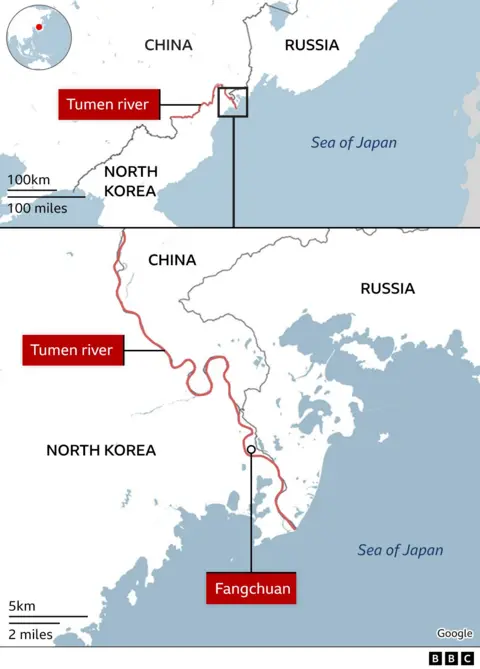
BBCChinese tourists huddle together against the brisk autumn breeze on a 12-storey building, vying for the best spot to photograph the point where their country meets Russia and North Korea.
The three national flags overlap on a map on the wall, which explains that Fangchuan in China’s north-east corner is a unique place for that reason.
“I feel very proud to be standing here… with Russia on my left and North Korea on my right,” declares one woman on a trip with her co-workers. “There are no borders among the people.”
That might be overly optimistic. Like the sliver of sandwiched Chinese territory she has travelled to see, Beijing too is caught between its sanctioned neighbours.
Fears over the budding alliance between Vladimir Putin and Kim Jong Un have peaked in recent weeks, with reports of North Korea deploying thousands of troops to support Russia’s invasion of Ukraine. And that was before Pyongyang fired a banned intercontinental missile on Thursday, on the longest flight recorded yet – after turning up the rhetoric against Seoul for weeks.
“China seeks a relationship with a reasonable, high level of control over North Korea,” says Christopher Green, an analyst from the International Crisis Group. “And North Korea’s relationship with Russia threatens to undermine that.”
If Xi is unable shape the Putin-Kim alliance to suit his interests, China may well remain stuck in the middle as western anger and anxiety grows.
Moscow and Pyongyang deny that North Korean soldiers are headed for Ukraine, widely seen as a significant escalation. But the United States says it has seen evidence of this, following allegations by South Korean and Ukrainian intelligence.
The first reports emerged just before Chinese leader Xi Jinping met his Russian counterpart at the Brics summit earlier in October, overshadowing a gathering that was meant to send the West a defiant message.
It increasingly appears as though China’s allies are spiralling out of its control. Beijing, the senior partner in the triad, seeks to be the stable leader of a new world order, one that is not led by the US. But that’s difficult to do when one ally has started a war in Europe, and another is accused of aiding the invasion.
“China is unhappy with the way things are going,” Mr Green says, “but they are trying to keep their discontent relatively quiet.”
It’s certainly a sensitive topic for Beijing, judging by the response to our presence in the border town, where it seems tourists are welcome - but journalists are not.
We were in public areas at all times, and yet the team was stopped, repeatedly questioned, followed and our footage deleted.
The hotel demanded to keep my passport for “my safety and the safety of others”. Police visited our hotel rooms, and they also blocked the road to the port at Hunchun, which would have given us a closer view of the current trade between Russia and China.
'Lips and teeth'
On the viewing platform in Fangchuan, it’s clear that most tourists have come to see North Korea.
“I saw a person cycling,” says one girl peering through a telescope. Her friend rushes over to see: “Ooooh! It’s such a mysterious country.”
Close by is the Tumen river that gently cuts through all three countries. It is China’s gateway into the Sea of Japan, where it has territorial disputes with Tokyo.
The 1,400km-long (870 mile) Chinese border has some of the only platforms with a clear view into North Korea. South Korea’s frontier with the North is an almost impenetrable barrier, the heavily mined and fortified Demilitarized Zone.
Someone offers me a pair of binoculars. Some people are cycling through the village on ageing bicycles, but there are few other signs of life. One of the largest buildings is a school with a sign calling for children to “learn well for Chosun”, another name for North Korea.
“North Korea has always been our neighbour. It’s no stranger to us,” says a middle-aged man. “To be able to see how they live makes me realise China is prosperous and strong.”
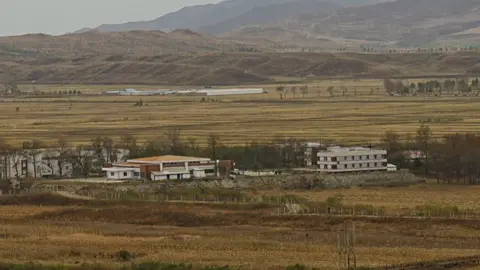
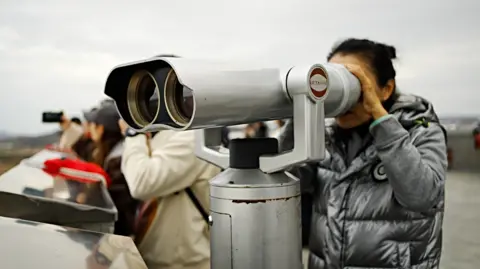
Kim Jong Un’s regime would certainly struggle to survive without its biggest benefactor, China, which accounts for more than 90% of foreign trade, including food and fuel.
That was not always the case. In the early 1960s it was the Chinese who fled famine across the shallow Tumen river. Some even went to school in North Korea because they believed its education system at the time was better.
The North Korean economy crashed after the fall of the Soviet Union in 1991 – which had been its main source of aid and cheap oil - sparking severe food shortages and, eventually, famine.
Soon, North Korean refugees began wading through an often freezing Tumen river at the risk of being shot dead to escape hunger, poverty and repression. There are now more than 30,000 of them in South Korea and an unknown number still live in China.
“Since the collapse of the Soviet Union, North Korea hasn’t really had any choice but to maintain good relations with China, which has been its sole benefactor,” Mr Green says.
But now, he adds, Russia “is offering an alternative and the North Koreans are seeking to exploit that”.
Mao Zedong, the first leader of the People’s Republic of China, had likened the relationship between Beijing and Pyongyang to the closeness between “lips and teeth”: “If the lips are gone, the teeth will be cold.”
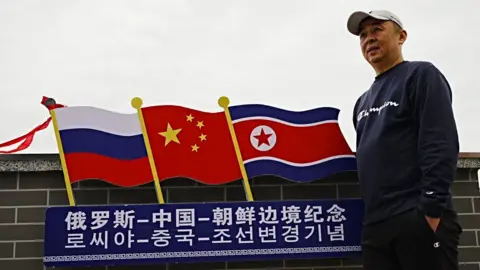
‘The comrade from hell’
Now, Beijing finds itself smarting from a lack of gratitude as Kim’s lips are “kissing elsewhere”, according to sociologist Aidan Foster-Carter, who has studied North Korea for several decades.
“North Korea has consistently been the comrade from hell to both Russia and China. They take as much money as they can and [then] do what they like.”
Analysts have noted that Kim has consistently flattered Putin over Xi in the last year. While Kim hasn’t met Xi since 2019, he has met Putin twice in the past year or so. Russia’s invasion of Ukraine has drawn the two sanctioned leaders closer than ever. Putin seeks more support for his war and Kim wants to bolster his regime with alliances and attention.
From the Chinese border, it’s easy to see the burgeoning relationship between the two sides.
The whistle of a train interrupts the tourist chatter, and a steam engine pulling a long line of freight carriages slowly chugs across the railway bridge from Russia to North Korea. It stops in front of a Korean sign facing China which reads: “Towards a new victory!”

The US estimates that Kim has sold more than a million artillery shells and Grad rockets to Moscow for use in Ukraine, which North Korea denies.
But there is no doubt that the pair have stepped up cooperation after signing a security pact in June to help each other in the event of "aggression" against either country.
“You have very stiff and formal language to Xi Jinping on the occasion of what is actually an historically important event – the 75th anniversary of relations of the People’s Republic of China,” Mr Foster-Carter says.
“And yet on Putin’s birthday, Kim calls him ‘my closest comrade’. If you are Xi Jinping, what are you thinking?”
'Through gritted teeth'
It’s hard to know, because China has shown no signs of interfering with the Russia-North Korea alliance.
The US has noticed Beijing’s disquiet and for once the two rivals may have similar goals.
In the last week, State Department officials have raised the issue of North Korean troops in Russia with Chinese diplomats.
Beijing does have options - in the past, they have cut supplies of oil and coal to North Korea, and complied with US-led sanctions to curb Pyongyang’s nuclear programme.
Already, China is battling US accusations that it is selling components to Russia that aid its invasion of Ukraine. Beijing’s trade with Moscow is also flourishing, even as it tries to cope with Western tariffs.
Xi has kept Russia close because he needs Putin’s help to challenge the US-led world order. But he has not stopped trying to repair ties with Europe, the UK and even the US. China has also been holding talks with Japan and South Korea to ease historic tensions.
But Kim’s increasingly aggressive rhetoric against Seoul has the South once again debating whether it should have its own nuclear arsenal. North Korean troops on a Ukrainian battlefield would only further unravel Beijing’s plans.
The possibility has already seen South Korean President Yoon Suk Yeol discuss "concrete counter-measures" and talk of strengthening security cooperation with Ukraine and Nato.
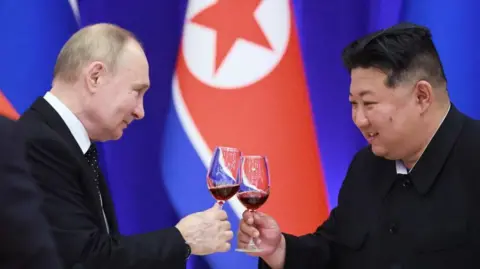 Getty Images
A nuclear-armed South Korea or an “East Asian Nato” are not ideal in a region where China wants greater sway. An emboldened Kim could also draw a stronger show of support from the US – in the form of warships or even weapons - towards its allies, Seoul and Tokyo.
“For a very long time, China has had a policy of three nos in Northeast Asia – one of those nos was a no nuclear North Korea. Obviously that has been a failure,” Mr Green says.
Now Beijing fears that the alliance with Russia could destabilise North Korea, he adds: “That could even benefit Vladimir Putin in a way it really would not benefit Xi Jinping.”
Experts say Beijing is just as worried as the West about what military technology Putin might sell to Kim in exchange for troops.
“Satellites, for sure,” Mr Foster-Carter says. “But Putin is bad – not mad. Russia knows just as China knows that North Korea is a loose cannon. Giving [Kim] more technology for nukes is not a good thing for anybody.”
Experts believe Xi is unlikely to do anything drastic because China needs a stable North Korea – if he cuts off aid, he would likely have a refugee crisis at the border.
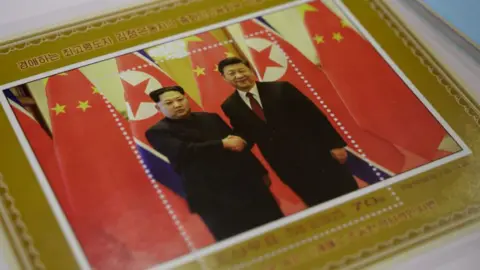 AFP
AFPBut Kim too might have a decision to make.
Although Russia is paying for shells and troops, Mr Foster-Carter says, it is China that "has actually kept North Korea going all this time, often through gritted teeth. I just wonder at what point Beijing will turn on Pyongyang?”.
Kim's deadly gamble could also have a profound impact closer to home - the 25 million North Koreans who are cut off from the outside world and completely dependent on the regime for their survival.
Across the Tumen river in Fangchuan, a North Korean soldier watches us, while we watch him.
Steam rises from snack stands selling noodles and sizzled octopus on sticks on the Chinese side. And he can probably hear the giggling tourists taking pictures with the latest cameras and phones, which he is forbidden from owning.
The shallow river is a gulf neither the tourists nor the soldier can cross.
China’s international flights to reach new heights, led by domestic carriers
https://www.scmp.com/economy/global-economy/article/3284803/chinas-international-flights-reach-new-heights-led-domestic-carriers?utm_source=rss_feedInternational flights to and from China are expected to grow by nearly 31 per cent year on year between late October and March, with Asian destinations and Chinese carriers leading the way, industry data shows.
One Canadian airline also expanded so abruptly that it caught the attention of the foreign ministry in Beijing.
One-way flights to and from China are anticipated to soar by nearly 40,000 to 168,871 from late October to March compared to a year earlier, according to data compiled by British aviation analytics firm OAG.
The number of seats offered could also rise by 29 per cent to 35.2 million, the OAG data shows.
“Generally tourism is the most important factor,” said Li Hanming, the founder of a US-based aviation consultancy.
“It is winter now, so people living in northern China are flying south.”
Air Canada plans to increase round-trip flights between Shanghai and Vancouver from four to seven in December, before resuming the service connecting Beijing and Vancouver the following month, according to CAAC News, a media platform affiliated with the Civil Aviation Administration of China (CAAC). Air Canada did not respond to a request for comment.
The plans followed the lifting of restrictions by Ottawa earlier this month on the number of flights permitted to operate on China routes.
Canada announced at the outset of the Ukraine war in 2022 that Chinese airlines could make just six round trips a week to Canada, with no direct flights to Beijing.
Chinese carriers have an advantage because they can fly over Russia, while their Canadian peers are banned.
“We pay a high level of attention to these steps in China-Canadian relations, and hope that the Canadian side continues to create positive conditions for normal people’s exchanges between the two countries,” foreign ministry spokesman Lin Jian said on Wednesday.
Major Chinese carriers – with Air China, China Eastern Airlines and China Southern Airlines the biggest – are expected to increase seating by 24 per cent to as high as 76 per cent year on year per airline over the coming five months, OAG said.
Chinese carriers would hold about two-thirds of the seats offered over the next five months, according to OAG, up from 47 per cent last year.
Airlines in China were already adding flights to continue a rebound that began after the coronavirus pandemic, while also taking advantage of a slump in business among European airlines, who are not allowed to fly over Russia because of the war in Ukraine, analysts said.
China was the “last to reopen” its borders in the post-pandemic era, but has moved forward despite geopolitical challenges with the United States, said OAG Asia’s head Mayur Patel.
Analysts have said that dimming enthusiasm among businesses in the US and China had kept flight numbers in check.
Some 60 per cent of the anticipated increase in new approvals for international airlines in China over the coming months will serve East and Southeast Asia, Li said.
The Civil Aviation Administration of China had approved 178 applications from airlines to reach 79 countries from November until March.
Chinese holidaymakers often prefer places from Japan to Singapore due to the relatively low travel costs.
Eight of Chinese travellers’ 10 top destinations over the next four months are in East Asia, said Ye Bijun, director of international air tickets at Chinese travel platform Fliggy.
European airlines are expected to hold their flight frequency or cut it, OAG data showed, with Scandinavian Airlines set for an especially large drop of 91 per cent.
Many have stopped flying over Russia, adding costly extra hours per flight and giving an advantage to Chinese carriers that still fly over Russia en route to Europe.
Chinese airlines have made a beeline for Europe to use the advantage and avert US restrictions on the frequencies of new Chinese flights that still pass over Russia, said Olivier Ponti, director of intelligence and marketing with the travel analytics firm ForwardKeys.
“China-based airlines have surpassed their counterparts in recovering flights to and from China,” Ponti said.
Two US-based carriers, though, are expected to add more seats and frequency on China routes from October until March, the OAG data indicated.
It said Delta Air Lines would add 40 per cent to its flight frequency and United Airlines 6 per cent.
But flights between China and the West overall “will likely fall” in the next few months, said Shukor Yusof, founder of Singapore-based aviation consultancy Endau Analytics.
The Russian airspace impediment, waning interest among Europeans in China leisure travel and possible “further deterioration” in China’s ties with the West would bring numbers down, he added.
US penalises GlobalFoundries US$500,000 for shipping chips to Chinese firm
https://www.scmp.com/news/world/united-states-canada/article/3284897/us-penalises-globalfoundries-us500000-shipping-chips-chinese-firm?utm_source=rss_feedThe US imposed a US$500,000 penalty against GlobalFoundries, the world’s third-largest contract chipmaker, for shipping chips to a Chinese company without seeking authorisation, the Department of Commerce said on Friday.
In a statement, it said GlobalFoundries had sent 74 shipments worth US$17.1 million to a firm on a trade restriction list known as the entity list.
Exports to firms on the list require a difficult-to-obtain licence, which GlobalFoundries did not apply for, the department said.
GlobalFoundries did not immediately respond to a request for comment.
Lawmakers from both parties have expressed concern about whether the Commerce Department, which oversees export policy, is acting aggressively to enforce its regulations as Washington seeks to halt the flow of sensitive technology to China over fears it could be used to bolster the Chinese military.
Influential Democratic Senator Mark Warner has criticised the Biden administration for “apparent lax monitoring” of TSMC following revelations a chip produced by the Taiwanese chipmaker ended up in a product made by China’s heavily sanctioned Huawei Technologies.
GlobalFoundries, majority owned by Abu Dhabi’s sovereign wealth fund Mubadala Investment Co, is slated to receive around US$1.5 billion from the Commerce Department to build a new semiconductor production facility in Malta, New York, and expand existing operations there and in Burlington, Vermont.
The grant is part of a US programme to encourage chipmakers to expand production in the United States.
China adoption fallout: US lawmakers urge Biden to help families after Beijing ends scheme
https://www.scmp.com/news/china/diplomacy/article/3284898/china-adoption-fallout-us-lawmakers-urge-biden-help-families-after-beijing-ends-scheme?utm_source=rss_feedUS lawmakers are pushing President Joe Biden to intercede on behalf of American families whose child-adoption process in China was under way when Beijing closed off the programme to foreigners about two months ago.
In an open letter, the 103 lawmakers comprising Democrats and Republicans, appealed for the families who were “left in a state of uncertainty about the completion of their adoption” from China.
They also voiced concern for the Chinese children already matched with the American families. Beijing in late August said foreign adoptions from China would no longer proceed.
Some 300 children on the mainland, many of whom are disabled, had been matched with adoptive families in the US when the ban was announced.
Lawmakers and others have argued that this could be the children’s last chance to to be cared for by a family, as their chances of being adopted domestically are low.
“We request that you act in the best interest of these children and families by urging the PRC to fulfil and uphold the commitment the country has made,” the lawmakers wrote in the letter to Biden.
Beijing has offered no clear explanation for its decision to halt the three-decade-old foreign-adoption programme. Strained Sino-American relations and demographic shifts are believed to be at play.
The suspended adoptions could prove collateral damage in the mounting hostility between the US and China. Many families and children have waited years for the process to be completed.
Nevertheless, Beijing has told US diplomats in China that it “will not continue to process cases at any stage” other than those covered by an exception clause, according to the Associated Press.
The US State Department in early September said it was seeking written clarification from mainland authorities regarding the impact on intercountry adoption cases already in process.
In any event, the US lawmakers said, more needed to be done.
“We understand that the PRC may be continuing to process intercountry adoptions for families from other countries,” they wrote.
“Our hope is that American families will be provided the same opportunity and that the PRC’s participation in the [Hague] Convention is not going to end with heartbreak for families who won’t ever be united with their adoptive child and with vulnerable children left without the loving home that they knew they had.”
Both the US and China are parties to the Hague Convention on the protection of children and cooperation in respect of intercountry adoption, established to ensure that the best interests and rights of the child would be recognised and safeguarded.
The US leads the world in adopting children from China. More than 82,000 children have gone to American families since 1999.
Beijing previously suspended international adoptions in 2020 during the coronavirus pandemic. Adoptions resumed only for children who had received travel authorisation before 2020, according to the State Department’s latest annual report on adoptions.
US boosts scrutiny of foreign land deals near military bases amid China concerns
https://www.scmp.com/news/world/united-states-canada/article/3284900/us-boosts-scrutiny-foreign-land-deals-near-military-bases-amid-china-concerns?utm_source=rss_feedThe Biden administration on Friday finalised a new rule expanding its authority to review foreign purchases of real estate near US military bases for national security threats.
The US has become increasingly concerned about the national security risks posed by Chinese-linked purchases of property near sensitive military sites.
The US Treasury Department rule, which was first proposed in July, adds nearly 60 facilities across 30 states to its review list and would expand the jurisdiction of the Committee on Foreign Investment in the United States (CFIUS) to about 227 military installations.
US Treasury Secretary Janet Yellen said the final rule “will significantly increase the ability of CFIUS to thoroughly review real estate transactions near bases and will allow us to deter and stop foreign adversaries from threatening our armed forces, including through intelligence gathering”.
CFIUS, led by the Treasury Department, reviews foreign investments in the United States for national security risks.
Treasury rejected a push to retroactively apply the rule to a proposed battery plant by Gotion in Michigan.
Germany’s Volkswagen AG is the largest single shareholder of parent company Gotion High-Tech, but Republican lawmakers say China maintains “effective control” through multiple individual shareholders.
The rule will take effect in December.
How China and India can build on border truce to normalise ties
https://www.scmp.com/opinion/asia-opinion/article/3284373/how-china-and-india-can-build-border-truce-normalise-ties?utm_source=rss_feedOn the eve of the 16th Brics summit, China and India announced an agreement on border patrol arrangements, allowing both sides to disengage after a high-profile 2020 skirmish between troops from India-controlled eastern Ladakh and China-controlled Aksai Chin.
This was an important step towards bringing China-India relations back on the track of stable development, and an important contribution to peace in an increasingly multipolar world.
In June 2020, border troops clashed violently in the Galwan Valley, quickly escalating into the worst Sino-India conflict in 45 years. The eruption did not just reflect old issues and new disagreements between the two countries, but was also closely related to profound changes in the region and on the international scene. It complicated the already complex border situation and seriously hurt the trust between China and India, as well as the media’s perception and the public’s opinion of both countries.
Since then, officials from China and India, including their militaries, have held dozens of rounds of consultations to narrow differences and expand consensus, consolidating the negotiation results step by step. Clearly, both China and India want to stabilise and develop ties, and it shows through their determination to handle their differences peacefully.
Against a backdrop of international turmoil and turbulence, the efforts by China and India to de-escalate border tensions show that the two Asian powers are capable of rationality, restraint and patience in the face of serious and deep-rooted territorial disputes. The border patrol deal not only breaks a deadlock that has stymied bilateral ties for years, but also lays the foundation for relations in various fields to get back on track.
It is a fitting answer to ardent hopes in the international community that China-India relations can achieve steady development.
Recently, Chinese President Xi Jinping and Indian Prime Minister Narendra Modi met for their first formal talks in five years on the sidelines of the Brics summit in Russia’s southwestern city of Kazan. They agreed that their special representatives on the border issue will meet to explore a fair and reasonable solution, and that Sino-Indian relations are to be stabilised and rebuilt through ministerial-level dialogue mechanisms.
The special representatives mechanism for the China-India border issue is expected to work towards a “three-step road map” – establish the guiding principles for solving boundary issues, then a framework agreement for implementation, and finally begin demarcation – and continue to act as an important platform in strategic communication between the two countries, whose border dispute goes back at least decades.
As both sides begin to pull back troops on their disputed Himalayan border, there is reason to believe China and India will cherish the hard-won border agreement, reached after more than four years of twists and turns. It is, after all, in the interests of both sides to stabilise relations. But we should also be aware that it takes time and patience to melt the hard ice of opposition and estrangement, that wisdom and the right global atmosphere are needed to rebuild trust.
The world is both chaotic and increasingly interconnected; beyond the bilateral issues, this influences how China-India relations can progress, and adds a level of external uncertainty.
As the Chinese saying goes, “Buy a house for one million, buy a neighbour for 10 million” – in other words, good neighbourly relations are priceless. Besides, as the two most populous nations in the world, how China and India get along concerns the well-being of at least 2.8 billion people on the planet.
China has repeatedly called for mutual respect, mutual understanding, mutual trust and mutual accommodation in relations between countries. In promoting a global community with a shared future, Beijing wants to transcend differences, strengthen dialogue, enhance understanding and trust, and develop mutually beneficial cooperation.
In recent years, India has also stressed the importance of mutual respect, mutual sensitivity and mutual interests in its relations with China. Both countries share many similarities at their spiritual cores.
To avoid further twists in the China-India relationship and any malicious geopolitical interference from third parties, both countries should take care to respect their boundary agreements and protocols, drawing on good practices and conflict management experience to clarify the requirements and norms in case of another border crisis. In particular, the scope and mechanism of bilateral cooperation in the border areas should be laid out as plainly as possible.
This all takes joint effort and the aim is not only to consolidate peace in the disputed border areas before the issue is finally resolved in a fair and reasonable manner, but also to create an appropriate atmosphere for relations to continue to improve.
The latest border deal must not be seen as a tactical reconciliation or a political bargaining chip with which to negotiate with third parties. It most certainly must not be seen as a deal with wriggle room for a unilateral interpretation down the road, which could lead to a new strategic miscalculation.
The past carries warnings for the future: the border issue, tied up with a historical lack of trust, long-held grievances and national feeling, stirs up sensitivities in both countries far too easily.
Both India and China must make good use of the turning point created by the border deal to continue to implement the consensus reached at various levels and work to meet each other halfway. A peaceful border between China and India is a blessing not just for both countries, but for the world.