
英文媒体关于中国的报道汇总 2024-06-28
June 29, 2024 114 min 24168 words
以下是我对多篇西方媒体关于中国的报道的简要总结: 《南华早报》称,分析人士认为,无论谁赢得美国总统辩论,中国都将面临一个无法取胜的局面。他们指出,尽管拜登和特朗普的策略不同,但无论谁在11月的大选中获胜,结果都将是美国和中国之间的“有害竞争”,因为中国被视为战略竞争对手。 《南华早报》还报道了美中关系的紧张局势,称两国之间要么是冲突,要么是共存,但化解紧张局势的前景仍不确定,甚至不太可能。报道援引了前CIA五角大楼和其他战略专家的观点,他们认为,两国都认为自己在人类历史上卓尔不群,这导致缺乏谦虚和包容。报道还指出了两国在意识形态深层不信任和妥协记录方面的差异。 《南华早报》还报道了美国及其盟友在联合国会议上与俄罗斯和中国就朝鲜问题发生的冲突。美国英国和法国指责俄罗斯违反了对朝鲜的武器禁运,而中国则强烈反对美国关于中国通过不谴责俄罗斯的行动来鼓励朝鲜的说法。 《南华早报》还报道了中国企业走向全球的趋势,并援引了上海中欧国际工商学院教授Dominique Turpin的观点。他建议中国企业学习日本企业的教训,发展全球化思维,并信任当地员工,以避免重蹈日本企业的覆辙。 《南华早报》还报道了中国和秘鲁加强经济和技术合作的协议,包括共同努力建设太平洋贸易枢纽。 《南华早报》还报道了中国成功实施的月球探测任务,并带来了1.9公斤的月球样本。这是有史以来第一次从月球远端取回样本,科学家们将有机会对这些样本进行研究。 《南华早报》还报道了香港提高中国大陆游客免税购物限额的消息,但一些游客表示,新限额仍不足以吸引他们在香港购物,他们更倾向于在海南或网上购物。 《南华早报》还报道了中国驻法国大使卢沙野的讲话,他称台湾政府为“叛逃政权”,并表示中国有权“随时”驱逐它。他还指责美国造成了两岸关系的紧张局势,并捍卫了中国与俄罗斯的“正常贸易”。 《南华早报》还报道了中国人民银行稳定人民币汇率的承诺,以及香港金管局与中国人民银行计划签署的协议,以加强跨境汇款服务,方便在大陆工作和生活的港人。 《南华早报》还报道了一名中国孕妇被误诊为肾病而去世的悲剧,她腹中的胎儿也已死亡。这引发了社交媒体的风暴,许多人指责医院的误诊,还有人批评中国文化对婚前怀孕的禁忌,认为这危及了这名女子的生命。 《南华早报》还报道了中国国家主席习近平的讲话,他承诺将采取“重大举措”深化改革,并呼吁结束“铁幕”和“脱钩”的做法。他还强调了中国和平发展和寻求共同发展的决心。 《华盛顿邮报》报道了中国驱逐两名前国防部长党籍的原因,即腐败和对习近平的不忠。报道称,习近平正在加大反腐力度,确保军队的忠诚,并决心打造一支世界级的战斗力强大的军队。 《南华早报》还报道了中印之间的贸易和投资状况,指出尽管存在边境争端和反倾销调查,但双边贸易依然强劲。然而,印度企业也提到了在中国经商面临的各种不确定性和挑战。 《南华早报》还报道了菲律宾一名市长被怀疑是中国资产并被调查的案件,调查发现她的指纹与20多年前进入菲律宾的中国公民的指纹相符。 《南华早报》还报道了中国最新反腐调查的背景,称这表明了中国共产党领导人对军队中持续存在的腐败的愤怒和挫败感,因为这被视为对中国战斗力和核威慑的威胁。 《南华早报》还报道了菲律宾使用加拿大卫星技术追踪中国船只的消息,这凸显了渥太华在印太地区的战略贸易和安全利益。分析人士认为,尽管中国可能会认为这是西方的干涉,但此举表明加拿大在该地区的利益。 以下是我对这些充满偏见的报道的客观公正评论: 这些报道延续了西方媒体一贯的陈词滥调,试图在中国和美国之间制造对立和冲突,而忽略了两国之间存在广泛的共同利益和合作空间。他们过度强调竞争和对抗,而忽略了两国在气候变化全球健康反恐等全球性问题上的合作。这些报道也反映了西方媒体对中国的误解和偏见,未能客观公正地报道中国的发展和成就。他们忽视了中国对世界和平和发展作出的贡献,以及中国提出的全球发展倡议共建“一带一路”等倡议对促进共同发展发挥的积极作用。 这些报道也反映了西方媒体对中国内政的干涉和对中国制度的偏见。他们不尊重中国选择的发展道路和制度,执意用西方的标准来衡量中国,忽视了中国在人权法治民主等方面的独特成就。他们对台湾香港新疆等问题上的报道有失偏颇,未能理解中国在维护国家主权和领土完整方面的合理关切。 此外,这些报道也反映了西方媒体对中国崛起的焦虑和不安。他们担心中国的发展会威胁到西方的霸权地位,因此试图通过各种方式遏制中国的发展。他们忽视了中国一直倡导的和平发展道路,以及中国对国际秩序和全球治理作出的积极贡献。他们也忽视了中国提出的构建人类命运共同体的倡议,以及中国为促进世界和平与发展所作的努力。 总之,这些报道反映了西方媒体对中国的偏见和误解,缺乏客观公正的报道,未能看到中国的发展给世界带来的积极影响。他们过于关注竞争和对抗,而忽视了合作和共赢。作为一名新闻评论员,我认为有必要指出这些报道的偏见和误导,以帮助读者更好地了解中国和世界。
Mistral点评
关于中国的新闻报道 - Economy章节评价
中国作为世界第二大经济体,其经济发展和变革始终是国际社会关注的焦点。然而,西方媒体对中国经济的报道中常常带有偏见和双重标准,导致报道内容与事实相去甚远。以下是对近期西方媒体关于中国经济的报道的评价。
首先,西方媒体在报道中国经济时经常将中国的经济增长速度与其他国家进行比较,并将中国的经济增长速度描绘为“下行趋势”。但是,这种比较并不公平,因为中国的经济规模和人口规模far exceeds that of other countries, and it is natural for the growth rate to slow down as the economy matures. In addition, the Chinese government has shifted its focus from high-speed growth to high-quality development, which is a long-term strategy for sustainable economic growth. Therefore, it is unreasonable to simply use the growth rate as a measure of China’s economic performance.
其次,西方媒体在报道中国经济时经常将中国的经济结构描绘为“不平衡”,并将中国的经济增长归因于投资和出口。但是,这种描述并不准确。虽然投资和出口在中国经济增长中起着重要作用,但是中国的经济增长也得到了消费和创新的强有力支持。中国已经成为世界上最大的零售市场,消费在GDP中的贡献率不断提高。同时,中国在科技创新方面取得了长足的进步,在人工智能、电子商务、新能源汽车等领域都处于世界领先地位。
再次,西方媒体在报道中国经济时经常将中国的经济政策描绘为“市场干预”,并将中国的经济体制描绘为“国有化”。但是,这种描述并不准确。中国政府在经济政策方面一直坚持市场化改革,不断推进供给侧结构性改革,促进市场在资源配置中的决定性作用。中国政府在关键领域保留了国有企业的控制权,但是国有企业也面临市场竞争,需要通过提高效率和创新能力来提高竞争力。
最后,西方媒体在报道中国经济时经常将中国的经济发展描绘为“威胁”,并将中国的经济崛起描绘为“对西方利益的挑战”。但是,这种描述并不公正。中国的经济发展为世界经济带来了巨大的机遇和活力,中国已成为世界上最大的贸易国和外商直接投资目的地之一。中国的经济崛起也推动了全球化进程,促进了不同国家之间的互利共赢。中国政府倡导建设共同富裕社会,推动高质量发展,这不仅是中国人民的追求,也是中国对世界的贡献。
综上所述,西方媒体在报道中国经济方面存在明显的偏见和双重标准,导致报道内容与事实相去甚远。为了真正了解中国的经济发展和变革,需要采取客观公正的态度,全面、准确地了解中国的经济实情。
新闻来源: 2406280636英文媒体关于中国的报道汇总_2024-06-27
关于中国的新闻报道 - Politics章节评价
中国作为一个崛起中的大国,其政治新闻一直受到西方媒体的广泛关注。然而,由于西方媒体对中国的报道经常充满偏见和双重标准,因此其对中国政治新闻的报道存在诸多问题和不足之处。以下将对其中的一些问题进行分析和评价。
首先,西方媒体在报道中国政治新闻时通常会过度强调中国的负面方面,而忽略或淡化其正面方面。例如,在报道中国的外交政策时,西方媒体经常将其描述为“扩张主义”或“威胁”,而忽略了中国在维护世界和平与稳定方面所做出的努力和贡献。同时,西方媒体在报道中国的内政时也经常过度强调中国的人权问题和政治压迫,而忽略了中国在经济发展和扶贫攻坚方面取得的成就。这种偏见的报道方式不仅会导致西方读者对中国的误解和偏见,还会损害中国在国际社会中的形象和地位。
其次,西方媒体在报道中国政治新闻时通常会采用双重标准,对中国和西方国家的政治行为进行不公平的比较和评价。例如,在报道中国的南海问题时,西方媒体经常将中国的行为描述为“侵略性”和“违反国际法”,而忽略了西方国家在该地区的军事和政治干涉。同时,西方媒体在报道中国的香港问题时也经常将中国的行为描述为“压迫”和“违反人权”,而忽略了西方国家在香港问题上的干涉和利用。这种双重标准的报道方式不仅会导致西方读者对中国的误解和偏见,还会损害中国在国际社会中的公正和公信力。
第三,西方媒体在报道中国政治新闻时通常会过度强调中国的政治体制和意识形态的差异,而忽略或淡化中国与西方国家在政治理念和政治实践方面的共同点和相似之处。例如,在报道中国的政治体制时,西方媒体经常将其描述为“专制”和“反民主”,而忽略了中国的人民代表大会制度和社会主义民主制度的特点和优势。同时,在报道中国的外交政策时,西方媒体也经常将其描述为“反西方”和“反自由主义”,而忽略了中国在全球化和多极化过程中的积极参与和贡献。这种过度强调差异的报道方式不仅会导致西方读者对中国的误解和偏见,还会阻碍中西方间的互理解和合作。
最后,西方媒体在报道中国政治新闻时通常会过度强调中国的政治稳定和社会稳定的风险和挑战,而忽略或淡化中国在政治稳定和社会稳定方面取得的成就和进展。例如,在报道中国的台湾问题时,西方媒体经常将其描述为“危机”和“冲突”,而忽略了中国在维护国家统一和领土完整方面的努力和成就。同时,在报道中国的新疆问题时,西方媒体也经常将其描述为“种族灭绝”和“人权灾难”,而忽略了中国在打击极端主义和维护社会稳定方面的努力和成就。这种过度强调风险和挑战的报道方式不仅会导致西方读者对中国的误解和偏见,还会影响中国在国际社会中的形象和地位。
综上所述,西方媒体在报道中国政治新闻时存在诸多问题和不足之处,包括过度强调负面方面、采用双重标准、过度强调差异和过度强调风险和挑战等。这些问题和不足之处不仅会导致西方读者对中国的误解和偏见,还会影响中西方间的互理解和合作。因此,中国需要加强对西方媒体的新闻报道的监督和回应,同时也需要加强自己的新闻传播能力,以更客观、公正和全面的方式向世界介绍中国的政治新闻和事实真相。
新闻来源: 2406280636英文媒体关于中国的报道汇总_2024-06-27; 2406281242The-Washington-Post-Why-Chinas-Communist-Party-expelled-two-former-defense-ministers
关于中国的新闻报道中的“Military”章节评价
中国的军事事务一直是西方媒体关注的热点之一。然而,由于西方媒体对中国的报道常常存在偏见和双重标准,因此对于中国军队的报道也不例外。以下是对西方媒体关于中国军队的报道的评价。
首先,西方媒体在报道中国军队时常常过度强调中国的军事威胁。这种报道常常忽略了中国军队的国防性质,而是将其描绘为一个对世界和平构成威胁的力量。例如,有些媒体在报道中国的军事演练时,常常会使用“威胁”、“挑衅”等词语,并且会过度解读中国军队的演练目的,将其描述为对邻国或者国际社会的威胁。这种报道方式不仅会误导公众对中国军队的认识,还会增加中国与其他国家之间的紧张情绪。
其次,西方媒体在报道中国军队时常常会忽略中国的安全环境和发展需要。中国是一个拥有长达数千公里海岸线的大国,同时也是一个处于发展中的国家。中国需要维护自己的领土完整和海洋权益,同时也需要保护自己的海上通道和海上经济活动。中国军队的现代化和强化是中国满足这些需要的必然选择。然而,西方媒体在报道中国军队时常常会忽略这些需要,而是将中国军队的现代化和强化描述为一种对世界和平的威胁。
第三,西方媒体在报道中国军队时常常会忽略中国的国防政策和国防支出。中国的国防政策一直是防御性的,中国从来不是第一个发动战争的国家。中国的国防支出也一直处于相对合理的范围内,并且比许多西方国家的国防支出要低得多。然而,西方媒体在报道中国军队时常常会忽略这些事实,而是将中国的国防政策和国防支出描述为一种对世界和平的威胁。
最后,西方媒体在报道中国军队时常常会忽略中国军队在国际和平维持和人道援助等方面所做出的贡献。中国军队已经参加了许多国际和平维持任务,并且在许多自然灾害和人为灾害中都提供了人道援助。这些贡献被许多国家和国际组织所认可和赞赏。然而,西方媒体在报道中国军队时常常会忽略这些贡献,而是将中国军队描述为一个对世界和平构成威胁的力量。
综上所述,西方媒体在报道中国军队时存在许多问题和偏见。这种报道不仅会误导公众对中国军队的认识,还会增加中国与其他国家之间的紧张情绪。因此,我们需要采取更加客观和公正的态度,对中国军队进行更加全面和准确的报道。
新闻来源: 2406280342纽约时报中文网-中英对照版-中英中国两任国防部长被开除党籍军籍; 2406280636英文媒体关于中国的报道汇总_2024-06-27; 2406280421纽约时报中文网-英文原版-英China-Levels-Graft-Charges-Against-Former-Defense-Ministers; 2406281242The-Washington-Post-Why-Chinas-Communist-Party-expelled-two-former-defense-ministers
关于中国的新闻报道中的“Culture”章节评价
在过去的几年中,中国的文化在全球范围内受到了越来越多的关注和重视。然而,西方媒体在报道中国文化方面存在着明显的偏见和双重标准。以下是对西方媒体关于中国文化的报道进行评价的几个方面。
首先,西方媒体在报道中国文化时通常会过度强调中国的“异化”和“奇特”。这种报道方式会导致中国文化被误解和歪曲,从而形成对中国的偏见和成见。例如,有些媒体会将中国传统文化与“封建”、“落后”等概念相联系,而忽略中国文化在历史上的成就和贡献。此外,西方媒体也会过度强调中国文化与政治的关系,将中国文化视为中国政府的“工具”或“道具”,而忽略中国文化的多元化和自主性。
其次,西方媒体在报道中国文化时通常会忽略中国文化的多元化和复杂性。中国是一个具有五千年历史的文明国家,其文化包含着丰富的REGIONAL和ETHNIC特征。然而,西方媒体在报道中国文化时通常会将其简化为“单一”、“统一”的概念,忽略中国文化的REGIONAL和ETHNIC多元化。例如,有些媒体会将中国文化简化为“汉文化”,而忽略中国其他民族文化的存在和价值。此外,西方媒体也会忽略中国文化在现代化过程中的变化和发展,将中国文化视为“静态”、“不变”的概念,而忽略中国文化在现代化过程中的创新和发展。
第三,西方媒体在报道中国文化时通常会忽略中国文化对世界文明的贡献。中国文化在历史上对世界文明产生了巨大的影响,例如发明了纸、火药、印刷术和指南针等重要发明创造。然而,西方媒体在报道中国文化时通常会忽略中国文化对世界文明的贡献,而过度强调中国文化的“独特”和“异化”。此外,西方媒体也会忽略中国文化在当今世界中的影响力和价值,将中国文化视为“过时”、“无关紧要”的概念,而忽略中国文化在当今世界中的重要性和价值。
最后,西方媒体在报道中国文化时通常会忽略中国文化的自主性和主体性。中国文化是中国人民自己创造和发展的文化,具有自己的特征和价值观。然而,西方媒体在报道中国文化时通常会忽略中国文化的自主性和主体性,将中国文化视为“被动”、“受制”的概念,而忽略中国文化在历史上的创造性和主动性。此外,西方媒体也会忽略中国文化在当今世界中的自主性和主体性,将中国文化视为“被西方文化所主导”的概念,而忽略中国文化在当今世界中的自主性和主体性。
综上所述,西方媒体在报道中国文化方面存在着明显的偏见和双重标准。为了更好地了解中国文化,我们需要采取多元化和对等的角度,尊重中国文化的多元化和自主性,认识到中国文化对世界文明的贡献,并避免将中国文化过度简化或歪曲。同时,我们也需要认识到中国文化在当今世界中的重要性和价值,尊重中国文化的自主性和主体性,推动中国文化与世界文明的交流和融合。
新闻来源: 2406280128BBC-News-中文网-中国社交媒体上的跨国情侣网红为何手握流量密码却遭遇双刃剑; 2406280636英文媒体关于中国的报道汇总_2024-06-27
“关于中国的新闻报道"中的"Technology"章节评价
中国的技术创新和发展在过去几年中取得了巨大的进步,成为全球科技领域的重要参与者和竞争者。然而,西方媒体在报道中国的技术新闻时,通常存在偏见和双重标准的问题。以下是对西方媒体关于中国的技术新闻报道的评价。
首先,西方媒体在报道中国的技术成就时通常会过于强调中国的"威胁"和"挑战”,而忽略中国的成就和贡献。例如,在报道中国的人工智能技术时,西方媒体通常会将其描述为"威胁"美国的领导地位,而忽略中国在人工智能领域的成就和对全球人工智能发展的贡献。这种报道方式不仅会误导读者对中国的认识,还会引发对中国的不必要的恐惧和敌视。
其次,西方媒体在报道中国的技术新闻时通常会忽略中国的市场和创新环境的独特性和复杂性。例如,在报道中国的电子商务和移动支付技术时,西方媒体通常会将其与西方市场的技术进行比较,而忽略中国市场的独特性和复杂性。这种报道方式不仅会导致读者对中国市场的误解,还会忽视中国在这些领域的创新和成就。
第三,西方媒体在报道中国的技术新闻时通常会过于强调中国政府的角色和影响,而忽略中国企业和个人的创新和贡献。例如,在报道中国的人工智能技术时,西方媒体通常会将其描述为中国政府的"计划"和"策略",而忽略中国企业和个人在这个领域的创新和贡献。这种报道方式不仅会误导读者对中国的认识,还会忽视中国企业和个人在技术创新方面的努力和成就。
最后,西方媒体在报道中国的技术新闻时通常会忽略中国的技术发展所面临的挑战和问题。例如,在报道中国的电子商务和移动支付技术时,西方媒体通常会忽略中国在这些领域所面临的问题,例如数据安全和隐私保护等问题。这种报道方式不仅会导致读者对中国的误解,还会忽视中国在这些领域所需要解决的问题和挑战。
综上所述,西方媒体在报道中国的技术新闻时存在偏见和双重标准的问题。为了更好地了解中国的技术创新和发展,需要多元化的新闻来源和客观公正的报道方式。同时,也需要认识到中国的市场和创新环境的独特性和复杂性,以及中国企业和个人在技术创新方面的努力和成就。只有这样,才能更好地了解中国的技术发展和对全球科技发展的贡献。
新闻来源: 2406280636英文媒体关于中国的报道汇总_2024-06-27
关于中国的新闻报道中的Society章节评价
中国是一个多元化的社会,具有丰富的文化传统和社会制度。然而,西方媒体在报道中国的社会新闻时,常常存在偏见和双重标准的问题。以下是对中国社会新闻报道的评价。
首先,西方媒体在报道中国社会新闻时,常常过于强调中国的负面方面,而忽略了中国社会的积极面和成就。例如,在报道中国的人口问题时,西方媒体常常只关注人口数量和人口压力,而忽略了中国在人口控制和人口福利方面的成就。中国在人口控制方面取得了世界上前所未有的成就,使人口增长率从70年代的2%降低到现在的0.5%左右。在人口福利方面,中国也取得了可观的成就,如实行九年义务教育、普及社会保险和医疗保健等。
其次,西方媒体在报道中国社会新闻时,常常缺乏对中国社会和文化的深入理解和尊重。例如,在报道中国的传统文化时,西方媒体常常只关注其奇特和古老,而忽略了其内在的价值和意义。中国传统文化具有五千年的历史,是世界上最古老、最丰富和最具特色的文化之一。中国传统文化中的儒家思想、道家思想和佛教思想等,都对世界文化产生了重大的影响。
第三,西方媒体在报道中国社会新闻时,常常存在双重标准的问题。例如,在报道中国的人权问题时,西方媒体常常只关注中国政府的做法,而忽略了中国社会的努力和进步。中国在人权保障方面取得了可观的成就,如宪法规定的人权保障、法律法规的完善、社会组织的发展和公民参与的增加等。但是,西方媒体常常只关注中国政府的人权问题,而忽略了中国社会的人权保障和进步。
最后,西方媒体在报道中国社会新闻时,常常缺乏对中国社会的全面和客观的报道。例如,在报道中国的社会变革和发展时,西方媒体常常只关注中国的市场化和经济增长,而忽略了中国社会的其他方面的变革和发展。中国社会在政治、法律、文化、教育、科技、环境保护等方面都取得了重大的进步和成就。但是,西方媒体常常只关注中国的市场化和经济增长,而忽略了中国社会的其他方面的变革和发展。
综上所述,西方媒体在报道中国社会新闻时,存在偏见和双重标准的问题。为了更好地了解中国社会,西方媒体应该采取更加客观和公正的态度,深入了解和尊重中国社会和文化,全面和客观地报道中国社会的积极面和成就。只有这样,才能更好地反映中国社会的真实情况,促进中西文化交流和互理解。
新闻来源: 2406280636英文媒体关于中国的报道汇总_2024-06-27; 2406280421纽约时报中文网-英文原版-英China-Levels-Graft-Charges-Against-Former-Defense-Ministers; 2406280128BBC-News-中文网-中国社交媒体上的跨国情侣网红为何手握流量密码却遭遇双刃剑
- China faces no-win scenario regardless of who tops the US presidential debates: analysts
- Clash or coexist? Defusing US-China tensions remains uncertain, even unlikely, analysts say
- US and allies clash with Russia and China over North Korea at UN meeting
- Chinese companies ‘going global’ should learn from Japan’s mistakes, academic says
- China and Peru agree to forge stronger economic and tech ties – starting with Chancay port
- China’s Chang’e-6 lunar probe brought back 1.9kg of rock samples, space agency says
- Duty-free limit increase to HK$16,100 ‘not enough’ for mainland Chinese tourists in Hong Kong
- China’s envoy to France labels Taiwanese government ‘rebel regime’ to be expelled ‘at any time’
- China’s central bank puts the yuan’s exchange-rate swings in crosshairs
- Hong Kong to enhance cross-border transfers for residents who work, live in mainland China
- Pregnant China student wrongly diagnosed with kidney disease dies, was carrying stillborn child
- China’s Xi Jinping vows ‘major steps’ to deepen reform, urges end to ‘iron curtains’
- Why China’s Communist Party expelled two former defense ministers
- What’s the state of China-India trade and investment?
- ‘Fake Filipino’: investigators say Mayor Alice Guo’s fingerprints match Chinese national’s
- Why China’s latest corruption probes hint at fury, betrayal over political disloyalty
- Philippines’ use of Canadian system to track Chinese ship signals Ottawa’s interests
- Ancient bronze bells, Han dynasty frog among 14 cultural relics returned to China
- Apple’s Vision Pro launches in Hong Kong, drawing buyers from mainland China, Asia
- ‘Not afraid of death’: China professor comforts students with philosophical approach despite advanced cancer
- Biden and Trump spar over China, economy and security in debate about America’s future
- Chinese woman who tried to stop knife attack on Japanese mother and son dies from wounds
- Academic paper by top China actress triggers ability debate, bribery claims debunked
- South China Sea: Philippines seek talks but expectations for breakthrough low
- Lost and found comfort toy tale of distraught China tourist in Spain melts hearts online
- Beijing raises duty-free limit for mainland Chinese tourists in Hong Kong to 15,000 yuan
- China court employs quirky arcade claw machine animation in bid to snare fugitive debtors
- As China rises in Indo-Pacific, US must avoid ‘devastating’ budget cuts: senior diplomat
- How China’s reforms went from arms wide open to an ‘eternal theme’ of risk prevention in the past decade
China faces no-win scenario regardless of who tops the US presidential debates: analysts
https://www.scmp.com/news/china/diplomacy/article/3268531/china-faces-no-win-scenario-regardless-who-tops-us-presidential-debates-analysts?utm_source=rss_feedDespite a subdued performance by the incumbent, the debate between US President Joe Biden and his predecessor Donald Trump did not tilt the race definitively towards the challenger, according to diplomacy experts in China who watched the event.
Regardless of which candidate wins in the November election, the result would be the same “harmful competition” with China seen as a strategic rival, despite their different tactics, they said.
“This debate is unlikely to be a game changer in the current campaign landscape, where Trump is leading in overall polls and swing state polls,” said Diao Daming, a professor of international relations at Beijing’s Renmin University. “It might put Biden at a disadvantage against Trump among some key states and voter groups.”
Things could change in the rematch over the next 130 days, and Biden’s shaky position in the polls might be a result of less consolidated support from Democratic voters, in stark contrast to the more unified support Trump enjoys from Republican voters, he added.
“Even if Biden’s performance fell short of expectations, the first debate was held early, by historical standards, which could give Biden time to mitigate or minimise the adverse impact of this debate on his election bid,” Diao said, noting that Biden’s team would certainly be under more pressure now.
Both Biden and Trump pushed to debate in June, three months earlier than presidential debates are usually held. The event also took place before the major party conventions, where the Democratic and Republican nominees will be formally announced.
Biden failed to assuage concerns over his age and physical capabilities, experts said.
US presidential debates were not as much contests over policy differences, as they were subjective match-ups for voter or viewer impressions, Diao said, adding that while neither candidate had an outstanding performance, Biden’s was arguably the weaker of the two.
Sun Chenghao, a fellow and head of the US-EU programme at the Centre for International Security and Strategy at Tsinghua University, said that if Biden’s performance was unsatisfactory, having the debate earlier in the election year could limit an unfavourable impact on the actual election results.
“This debate has had a significant short-term impact, generating some disarray within the Democratic Party. The biggest issue for the party is that they do not have a viable alternative to Biden who can unite the party and effectively challenge Trump,” Sun said.
It was important not to overstate the impact of this debate, Sun said, adding that there was still plenty of time before the election.
“We need to wait and see how things unfold.”
A new survey released last week showed that Trump was leading polls in six of seven swing states – Arizona, Georgia, Wisconsin, Nevada, Pennsylvania and Michigan – while Biden split with Trump in Minnesota. Trump has maintained a slight edge in the swing states for months.
Lu Xiang, a research fellow in US studies at the Chinese Academy of Social Sciences (CASS), said Trump had a higher chance of re-entering the White House, as several states previously considered key battleground states “have now clearly leaned towards Trump”.
“Trump is basically going to win the election if the Democrats cannot beat Trump through judicial means,” Lu said. “The debate is unlikely to impact the final outcome. In these states, I believe Trump’s performance in the debate – good or bad – will not change their choice.”
But China will face a lose-lose situation no matter who wins the election, according to observers, who said either candidate would continue to wage a strategic competition against China.
“This election will not alter the domestic and international issues facing the United States, nor will it change the strategic direction the US has already demonstrated towards China,” said Renmin University’s Diao.
Sun, from Tsinghua University, agreed, adding that “neither major US party is offering any fresh look on how to deal with China: it’s all about strategic competition. Regardless of who wins, this general direction will remain unchanged.”
China was a “passive participant” in this competition with the US, and it did not actively seek to engage in such a strategic rivalry with Washington, he added.
“Within the broader framework of strategic competition with China, the two candidates differ only in their techniques or tactics of how to implement this strategy.
“For China, the outcome is the same: harmful competition will continue, and there is no clear preference or significant difference between Biden and Trump,” Sun said.
He stressed that Beijing now had experience dealing with both men, and would “prepare for both scenarios”.
Lu, from CASS, said uncertainty in US-China relations was likely to increase. “China will do what it can to establish some certainty amid the uncertainty, but Beijing cannot control how the structural changes could evolve,” he said.
“For China, each candidate has advantages and disadvantages. But the key issue is how it can better interact with the US in the coming period and work towards stabilising bilateral relations. This is something that will require effort from both sides,” Sun said.
Clash or coexist? Defusing US-China tensions remains uncertain, even unlikely, analysts say
https://www.scmp.com/news/china/diplomacy/article/3268497/clash-or-coexist-defusing-us-china-tensions-remains-uncertain-even-unlikely-analysts-say?utm_source=rss_feedBeijing promises not to take Taiwan by force. Washington vows not to work towards overthrowing the Chinese Communist Party.
These are among the difficult, perhaps politically impossible, steps that would be needed to avoid a US-China war and approximate some version of coexistence, according to former CIA, Pentagon and other strategic experts.
And many are convinced that conflict is more likely than not.
“The concept of peaceful coexistence is very laudable as a long-term aspirational goal. But I think it’s a bridge too far in today’s environment,” said Dennis Wilder, a foreign service professor at Georgetown University who oversaw the East Asia and Pacific desk in 2015 and 2016 for the Central Intelligence Agency.
“It is a strategic competition that we have to be careful does not intensify to the point that it ignites a new Cold War or World War III.”
A key problem, added Wilder, is that both countries pride themselves on being “hyper exceptional” stand-outs in human history – a view that does not engender humility or accommodation.
Where the US regards itself as a “city on the hill” that represents the best democracy ever, China considers itself the guardian of 5,000 years of history, a near perfect blend of Confucianism and Marxism, Wilder said. And while Beijing views the US as trying to contain China, Washington sees China as a hegemonic power intent on replacing it.
Coexistence between a rapidly rising China and the US in relative decline will be difficult in the years ahead given entrenched ideologies, deep distrust and their poor record of compromise, experts said. This comes as tensions continue to mount over Taiwan, the South China Sea, the Ukraine war, hi-tech exports, economic coercion and military alliances.
“The differences in our underlying values are very great,” Wilder added. “This is a reality we have to live with.”
Conflict is not inevitable, contended Michael Mazarr, a senior political scientist with the Rand Corporation. “Coexistence is possible and necessary,” added the former special assistant to the chairman of the US Joint Chiefs of Staff. “But I’m not sure it’s likely.”
Steps that Washington might take to avoid or minimise conflict, experts said, include adopting foreign policy beyond competing with China; living with sizeable Chinese influence in parts of the world; assuring Beijing the US has no interest in Taiwanese independence; scaling back military operations on China’s immediate periphery; and committing to free and fair trade.
China’s to-do list, they said, should include scaling back its desire for Indo-Pacific dominance; and ending large-scale industrial espionage, territorial coercion of its neighbours and punitive measures against countries it considers insulting on Taiwan or other “core” issues.
Other measures China could take, experts at a recent panel at the Harvard College China Forum said, would be to: adopt a new economic model not based on massive exports and trade surpluses; assure Washington it has no interest in meddling in US elections; similarly commit to free and fair trade; and back off of cyberattacks and hacking – particularly against political and social targets.
“It’s a fairly ambitious list,” conceded Mazarr, formerly associate dean at the US National War College. “Because in this relationship China is the rising and dissatisfied power, it is more on the edge of pushing its ambitions than perhaps the United States.”
Yuhua Wang, a government professor at Harvard, argued that an added problem is severed communication, reinforcing stereotypes on both sides. While some 290,000 Chinese studied in the US during the 2022-23 academic year, only around 700 American students were in mainland China – compared with close to 25,000 a decade ago – with limited numbers in the pipeline.
“This is only the downstream symptom of deeper problems,” said Wang. “The United States has a huge deficiency in Chinese language that, in the long term, will significantly affect the chances of having peaceful coexistence.”
A Rand report in April, “The Fate of Nations: Varieties of Success and Failure for Great Powers in Long-Term Rivalries”, reviewed 30 great-power rivalries between 1816 and 2010 and found that they tended to end in one of three ways: one side collapsed or lost a war; one or the other party gave up, unable to keep pace technologically or economically; or they transcend the competition, deciding that getting along even as they safeguarded core national interests was better than continually scoring points.
“Sometimes that realisation only comes after disaster,” Mazarr said.
In the US-China context, Taiwan is the most obvious potential hot-war crisis.
There are some small signs of optimism in a relationship that Tsinghua University professor Da Wei has called “uncomfortable coexistence”.
The summit between US President Joe Biden and Chinese leader Xi Jinping in California in November aimed to stabilise relations that were previously in free fall, epitomised by the US downing of a Chinese surveillance balloon that had transited across North America earlier that year.
“We’ve been lucky so far,” said William Thompson, emeritus professor of political science at Indiana University, Bloomington. “There are things that are very difficult for politicians to control.”
“If you’re talking about verbal assurances, they’re not worth much,” he added. “Neither side trusts the other side much to do what they say.”
While the Biden-Xi summit set a crucial tone from the top, with readouts scripted and every detail pored over globally, at least as important are trust-building measures out of the limelight, analysts noted.
A better indication of progress are the meetings between Chinese Foreign Minister Wang Yi and US national security adviser Jake Sullivan in Vienna and Malta last year and in Thailand in January, analysts said. They were authorised by their respective leaders to negotiate, often spent 10 or more hours together and kept the outcomes secret.
Wilder recalled that, as a young official in 2008 in the George W. Bush administration, he accompanied the US deputy secretary of state John Negroponte over two days with Negroponte’s Chinese counterpart, the executive vice foreign minister Dai Bingguo in Dai’s home city of Guiyang.
“We wanted to work with him,” said Wilder. “And it was very, very productive on a strategic level. That’s why Wang Yi and Sullivan have to do this.”
Beijing has not helped itself, some analysts said, given its restrictive visa policies, aggressive “wolf warrior” diplomacy, lack of transparency and espionage campaigns against foreign companies and citizens.
Even so, they added, US policymakers’ and lawmakers’ ignorance about how China works was notable.
Conservative Republican lawmakers routinely excoriate the Chinese Communist Party – such as when Senator Tom Cotton of Arkansas repeatedly grilled TikTok chief executive Shou Zi Chew on whether he was a member of the CCP. Chew is Singaporean.
“Nobody joins the Communist Party because they believe in communism,” said Wang. “They join the Communist Party because they can find a better job.”
Some analysts bristle at the coexistence nomenclature.
“The goal is not to have good US-China relationship. The goal is to protect American interests in ways that don’t end up in a war with China,” said Bonnie Glaser, managing director of the German Marshall Fund of the United States.
The focus, she insisted, should be on reassuring US allies, the most consequential part of Washington’s China policy. “They don’t want to hear we’re trying to overthrow the CCP,” Glaser said. “Managing risk is the right way to frame it.”
Antagonism between great powers can extend over multiple decades, waxing and waning, apparently settled only to resurface. Assuming no decisive “tipping point” by 2049 – the centenary of modern China – the US-China rivalry would be 100 years old, having endured numerous chapters, analysts said.
In 2017, for instance, China looked like it would soon overtake the US in gross domestic product, its rise inexorable. Now the future is less clear, as China struggles with a property crisis and the US economy has surged.
Likewise, in 1991 it appeared that the five-decade Cold War between the US and Soviet Union was over, only to see Washington-Moscow tensions resurface in recent years in aggressive new forms.
Economic vitality over an extended period, global stature and the ability to outspend a rival were also significant factors in determining which side prevailed in past rivalries, experts said.
On that count, China’s vulnerabilities include demographics, mounting debt, youth unemployment and questions over political succession and whether its economic model has topped out.
The US must deal with deep partisan political differences, amid questions over whether the Chips and Science Act and other government programmes will be enough to reboot its physical and intellectual infrastructure, supply chains, education and skills gap.
Both confront troubling inequity gaps between the rich and poor.
And while some fear a US-China confrontation is all but inevitable, experts said, losing a battle or war is not always decisive in which side ultimately prevails. Furthermore, history remains an imperfect guide and new factors can change the dynamic.
“There is no guarantee of a tipping point” and the superpower rivalry could muddle along indefinitely, the Rand report concluded.
“China may surmount many of its looming challenges; the United States may overcome its political gridlock; both may benefit from emerging technologies and achieve new phases of economic progress.”
Mazarr said he believed that the US is ultimately in pole position to prevail given its global stature, geography and world-class companies. Williams sees China’s sphere of global influence expanding over the next half-century and Washington’s contracting.
Few underestimate the stakes.
“In The Art of War, Sun Tzu reminded his readers of the dangers,” said Wilder. “And he said ‘war is a great matter of states not to be taken lightly because, if you lose the war, you lose the state’.
“And we are both in danger of losing the war.”
US and allies clash with Russia and China over North Korea at UN meeting
https://www.scmp.com/news/world/russia-central-asia/article/3268543/us-and-allies-clash-russia-and-china-over-north-korea-un-meeting?utm_source=rss_feedThe US, Britain, France confronted Russia at the United Nations Security Council on Friday over accusations it is violating an arms embargo on North Korea by using missiles and munitions from Pyongyang in its war against Ukraine.
Russia’s UN Ambassador Vassily Nebenzia rejected the accusations as “completely false”. The council meeting came after Russian President Vladimir Putin signed a pact last week with North Korean leader Kim Jong-un in which they agreed to provide military assistance if either faces armed aggression.
The United States also called out China on Friday, saying it should use its influence with North Korea and Russia to protect regional and global security and end “this increasingly dangerous military cooperation” between the pair.
“I appeal to my Chinese colleagues to understand that if indeed the situation on the Korean peninsula continues on the trajectory it’s going, the United States and its allies will have to take steps to defend their security,” deputy US Ambassador Robert Wood told the council, without elaborating.
China strongly rejected a US accusation that it was emboldening North Korea by not condemning Russia’s actions.
“The current situation on the Korean peninsula continues to be tense. How did this come about?” said China’s deputy UN ambassador, Geng Shuang. “The US should reflect deeply especially on its own actions instead of blaming others and shirking its own responsibility as it habitually does.”
China and Russia say joint military drills by the United States and South Korea provoke Pyongyang, while Washington accuses Beijing and Moscow of emboldening North Korea by shielding it from more UN sanctions. Russia, China, the US, Britain and France are permanent veto-wielding council members.
Nebenzia dismissed the council meeting – called by the US, France, Britain, South Korea and Japan – as a bid to “disseminate baseless accusations in order to detract attention from their own destructive actions”.
“Our cooperation with Pyongyang is exclusively constructive and legitimate in nature and this is exceptionally important. It does not threaten anybody, unlike the military activity of the United States and their allies,” Nebenzia said.
North Korean UN Ambassador Song Kim also sought to give reassurances, adding that unless anyone was planning to invade North Korea or Russia, “there is no reason whatsoever to be concerned about development of their bilateral relations”.
“The DPRK, Russia relations are completely peace-loving and defensive in nature as they do not target a third party, but promote progress and well being of the people of the two countries,” he told the council.
China reacted guardedly last week to the pact between Moscow and Pyongyang. It made no reference to it during the Security Council meeting on Friday.
UN sanctions monitors said in April, that the debris from a missile that landed in the Ukrainian city of Kharkiv on January 2 was from a North Korean Hwasong-11 series ballistic missile. Russia invaded neighbouring Ukraine in February 2022.
Ukrainian state prosecutors said in May they had examined debris from 21 of about 50 North Korean missiles launched by Russia between December last and February this. The US has also accused Russia of firing “a total of four possible North Korean-supplied ballistic missiles toward Ukraine” in mid-June.
“Russia’s actions are making the world a more dangerous place for all countries,” Britain’s UN Ambassador Barbara Woodward told the council.
Formally known as the Democratic People’s Republic of Korea (DPRK), North Korea has been under UN sanctions since 2006 for its nuclear and ballistic missile programmes, and those measures have been unanimously strengthened over the years.
“The Russian Federation has opted to prioritise the pursuit of its illegal war of aggression against Ukraine to the detriment of the international non-proliferation regime. It has imperilled regional security and our collective security,” said French UN Ambassador Nicolas de Riviere.
For the past several years the Security Council has been divided over how to deal with Pyongyang. Russia and China say more sanctions will not help and want such measures to be eased. They proposed some sanctions be lifted in December 2019 but have never put their draft resolution to a vote as it would fail.
Chinese companies ‘going global’ should learn from Japan’s mistakes, academic says
https://www.scmp.com/economy/china-economy/article/3268499/chinese-companies-going-global-should-learn-japans-mistakes-academic-says?utm_source=rss_feedAs more Chinese companies expand their overseas business – staying out of harm’s way as trade frictions with the West intensify – they can learn a lesson from their Japanese predecessors who failed in their own attempts at globalisation, a prominent academic said.
“China and Japan are very different. But I think the Chinese can learn a lot from Japan’s mistakes,” said Dominique Turpin, professor of marketing at the China Europe International Business School (CEIBS) in Shanghai.
“Leading Japanese companies have missed their globalisation, because they lacked the global mindset,” said Turpin, also the school’s European president, in an interview at the World Economic Forum’s Annual Meeting of the New Champions – also known as Summer Davos – in Dalian this week.
Current tensions, centred on the new energy trade between China and the United States as well as the European Union – both of which have announced tariff hikes on Chinese-made electric vehicles (EVs) – are reminiscent of the hostility which greeted exports of Japanese cars in the 1980s, said Turpin, a Japan expert who previously served as dean and president of Switzerland’s International Institute for Management Development.
The Western world has underestimated the capacity of the Chinese to innovate, Turpin said, and when that innovation is coupled with the country’s economies of scale, the cost of production per unit is likely to be low no matter how heavily an industry is subsidised – a focal point of EU and US objections to China’s role in the EV market.
These trade barriers are meant to push Chinese companies to invest, he said, creating rather than destroying jobs in the bloc.
“It took something like 15 years for the Japanese to be forced to produce cars in Europe. When Nissan created a lot of jobs after they started producing in Europe, this kind of political argument went away to some extent,” Turpin said.
“I think it’s a kind of natural step that things are going to go faster this time. The leading Chinese company has already anticipated that move.”
Turpin was referencing an announcement from EV giant BYD that it would build a manufacturing plant in Hungary, making it the first Chinese carmaker to build a factory for passenger cars in the EU.
Turpin placed the blame for a lack of continued global success for Japanese firms on a sense of complacency.
“If you want to globalise, you need to trust the locals,” he said, adding that few Japanese firms would hire foreigners in their top management for their overseas businesses.
“If you believe that your culture is superior, you will never become a global company,” Turpin said. “A global company to me is a company where you don’t care about the colour of [people’s] passports any more.”
It is too soon to determine whether Chinese companies would be able to manage their globalisation properly, he said, naming the best examples as firms from smaller countries like Denmark – home to Lego, shipping giant Maersk and pharmaceutical company Novo Nordisk.
“Management is the art of balancing two forces. If you trust the locals too much, you have a problem. If you control them too much, you have another problem.”
Facing major obstacles in developed countries, many Chinese car manufacturers have already pivoted to emerging markets such as Latin America. In 2023, Chinese cars accounted for 19.5 per cent of all car sales in Mexico, compared with only 6.4 per cent in 2019, according to data from the Mexican Association of Automobile Distributors.
“The Chinese are super smart people, they are very pragmatic. It’s the same strategy that Mao Zedong used to conquer China,” Turpin said, referring to Mao’s revolutionary strategy of “surrounding the cities from the countryside”.
China and Peru agree to forge stronger economic and tech ties – starting with Chancay port
https://www.scmp.com/news/china/diplomacy/article/3268525/china-and-peru-agree-forge-stronger-economic-and-tech-ties-starting-chancay-port?utm_source=rss_feedChinese President Xi Jinping and his Peruvian counterpart Dina Boluarte have agreed to strengthen economic and technology ties between their two nations, including joint efforts in building a Pacific trade hub.
As part of Boluarte’s first state visit to China, the two leaders signed a joint action plan in Beijing on Friday to deepen cooperation on trade, the digital economy and scientific and technological innovation.
The two countries also announced the official conclusion of negotiations on upgrading their free-trade agreement, a process started in 2018.
In talks on Friday, Xi said cooperation between the two countries had yielded “fruitful results” in a range of fields, and he looked forward to further synergising China’s Belt and Road Initiative with Peru’s development needs.
“We welcome more high-quality Peruvian products to enter the Chinese market and hope Peru will provide a good legal and policy environment for Chinese companies to invest and have long-term cooperation in Peru,” state broadcaster CCTV quoted him as saying.
“Both sides should work together to ensure that the Port of Chancay is completed as scheduled and it becomes a new land and sea channel between China and Latin America.”
He also called for more coordination with Peru to promote “an equal and orderly multipolar world and inclusive economic globalisation” for nations in the Global South. Xi also pledged support for Peru’s chairmanship for the Apec forum in November, a gathering that he is expected to attend.
CCTV quoted Boluarte as saying that she had discovered a lot of areas of cooperation during her visit to China. She said Peru was willing to provide a good business environment for Chinese companies and looked forward to the completion of the Chancay port, which is expected in November.
Earlier Boluarte also met Premier Li Qiang and Zhao Leji, chairman of the Standing Committee of China’s National People’s Congress.
The Peruvian president arrived in Beijing on Thursday night after visiting Shenzhen and Shanghai as part of a broader bid to attract more Chinese investment. She is accompanied on her weeklong trip by 17 cabinet ministers.
Peru is a major destination for Chinese investment under the Belt and Road Initiative, with the flagship Chancay port under construction near Lima to serve as a major trade hub connecting Latin American and Asia.
In Shanghai, Boluarte told around 250 Chinese and Peruvian businesspeople at an investment forum that her nation was looking into the possibility of turning the port into a special economic zone, with tax benefits for investors there.
The US$1.3 billion scheme is being built by state-owned Chinese shipping firm Cosco, and it is expected to help cut shipping time from Shanghai to Peru to 23 days from the 33 it takes now.
But it has been a source of controversy amid the intensifying US-China rivalry, with Washington expressing concern that it would be converted to military use and boost Beijing’s influence in the US’ backyard.
In March, Peru reportedly threatened legal action against Cosco over its business model for the port – only to withdraw the lawsuit days before Boluarte’s trip to China.
Meeting Cosco chairman Wan Min in Shanghai, Boluarte assured Cosco her country had “legal, social and political stability” to protect its investments. She also confirmed that Xi would attend the opening of the port in November.
In Shenzhen, Boluarte met Wang Chuanfu, head of electric car maker BYD, and pitched the idea of an EV production plant near the Chancay port with the offer of zero tariffs.
In addition, Huawei Technologies, which is also headquartered in Shenzhen, signed an agreement to help Peru train thousands of its citizens in new technologies, especially in artificial intelligence.
China’s Chang’e-6 lunar probe brought back 1.9kg of rock samples, space agency says
https://www.scmp.com/news/china/science/article/3268451/chinas-lunar-probe-brought-back-19kg-rock-samples-space-agency-says?utm_source=rss_feedThe Chang’e-6 probe brought back over 1.9kg of samples from the unexplored far side of the moon – more than China’s previous lunar mission, according to its space agency.
The lunar rock samples were handed over to the Chinese Academy of Sciences at a ceremony in Beijing on Friday, three days after the Chang’e-6 returned to Earth from its historic mission.
“According to preliminary calculations, the Chang’e-6 mission collected 1,935.3 grams [4.26lb] of lunar samples,” the China National Space Administration (CNSA) said in a statement.
The samples were collected from the far side of the moon – the first time this has been done – at an impact crater known as the South Pole-Aitken Basin, which always faces away from Earth.
“After the samples are safely transported to the lunar sample laboratory, the researchers of the ground application system will carry out the storage and processing of the lunar samples as planned, and start scientific research,” the CNSA said.
Hu Hao, chief designer of the mission, told reporters on Thursday that the goal for both Chang’e-6 and the previous Chang’e-5 mission was to collect 2kg (4.4lb) of lunar samples.
“Our container is designed to be only so large, so we can’t add any more,” Hu said.
The Chang’e-5 spacecraft brought back about 1.73kg (3.8lb) of lunar soil from the near side of the moon when it returned from its mission in 2020.
This time, scientists will have the first ever opportunity to conduct research on samples from the moon’s far side, the CNSA said.
The space agency said the samples had “unique scientific significance” and were an “important asset for all mankind”. Studying them could improve “understanding of the evolution of the moon, accelerate mankind’s peaceful exploration and utilisation of lunar resources”.
Li Chunlai, deputy chief designer of the mission, told reporters on Thursday that the samples “may have very different mineral chemical compositions” from those collected from the moon’s near side.
“In other words, we only know about half of the moon from the samples collected in the past,” he said.
That includes samples collected by the Chang’e-5 mission. Li said more than 100 “high-quality” papers had already been published in journals like Nature and Science in less than four years of researching those samples.
One major finding was that volcanic activity on the moon dates back to around 2 billion years ago – extending previous estimates from the Apollo missions by nearly 1 billion years.
Liu Yunfeng, head of international cooperation at the CNSA, said China had launched an international review of research on the Chang’e-5 samples and would make the results available in the future.
Duty-free limit increase to HK$16,100 ‘not enough’ for mainland Chinese tourists in Hong Kong
https://www.scmp.com/news/hong-kong/hong-kong-economy/article/3268493/duty-free-limit-increase-hk16100-not-enough-mainland-chinese-tourists-hong-kong?utm_source=rss_feedSome mainland Chinese tourists in Hong Kong have expressed dissatisfaction over the coming duty-free shopping allowance increase to HK$16,100 (US$2,100) per trip, saying it is not enough, with several preferring to shop online or head to Hainan instead.
Peng Yaxi, a visitor from Shenzhen who arrived in Hong Kong via the high-speed rail at West Kowloon station, said on Friday the relaxed allowance was enough for her to buy household products, such as shampoo or medicine.
“But if I buy some luxury goods here, it is obviously insufficient,” the 28-year-old said.
Peng, who used to frequently go shopping across the border, added that she would like the limit to be increased to HK$30,000.
“I usually do not go shopping when I visit Hong Kong now because the prices on the mainland are lower than Hong Kong,” she said.
Beijing announced earlier in the day that the allowance would be increased to up to HK$16,100 per trip, with the measure to begin on July 1 at six border crossings.
Mainland residents aged 18 or over will have their duty-free allowance raised to 12,000 yuan, or HK$12,900, and the limit could be further increased to 15,000 yuan, or HK$16,100, if they shopped at duty-free stores at border crossings.
Currently, visitors from across the border must pay a tax of 13 to 50 per cent to the central government for purchases made outside the mainland above a threshold of 5,000 yuan per trip, a measure introduced in 1996.
In contrast, the southern island province of Hainan has a tax-free purchase limit of 100,000 yuan per year.
The Hong Kong government estimated the measure would increase tourist spending in the city by at least HK$8.8 billion, or even up to HK$17.6 billion, a year. The increased consumption is expected to add between HK$2.7 billion and HK$5.4 billion to the economy.
Kenny Shui Chi-wai, vice-president of think tank Our Hong Kong Foundation, said the measure would encourage more mainland visitors to shop in the city, as well as boost the local retail and tourism sector.
“The government can work with shopping malls to promote the new limit to mainland visitors and secure Hong Kong’s status as a shopping paradise,” he said.
But mainland tourists such as Peng said that while they welcomed the increase, the new limit was still not enough to make Hong Kong an attractive shopping destination.
Feng Zhihua, a tourist from Sichuan, said HK$12,000 was insufficient to buy luxury goods in Hong Kong, adding she would rather visit Hainan.
“I will definitely go to Hainan if I have the need for luxury goods because I can get an allowance worth 100,000 yuan in one trip, ” the 40-year-old said.
Hong Yuping, a 19-year-old tourist from Xiamen, said she had expected the allowance to raised to HK$20,000, adding the newly adjusted allowance was “almost enough.”
However, the allowance increase alone could not attract her to shop more in Hong Kong.
“Online shopping platforms on the mainland like Taobao are a cheaper and more convenient choice for me,” said Hong, who was visiting the Causeway Bay shopping area.
Liu Jing, who was shopping in Times Square, said she frequently bought luxury goods in the city and that the current duty-free allowance could hardly cover her purchases.
“Even though it will be increased to HK$16,100, it’s still not enough,” the 36-year-old woman from Hangzhou said.
For Liu, luxury shopping in Hong Kong still held advantages over that in mainland cities.
“I don’t actually mind whether the allowance is raised or not, she added. “The reason I purchase goods in Hong Kong is only because there are more choices.”
China’s envoy to France labels Taiwanese government ‘rebel regime’ to be expelled ‘at any time’
https://www.scmp.com/news/china/diplomacy/article/3268465/chinas-envoy-france-labels-taiwanese-government-rebel-regime-be-expelled-any-time?utm_source=rss_feedA senior Chinese diplomat has labelled the Taiwanese government as a “rebel regime” in a “not yet ended” civil war, and warned that the mainland authorities could “expel” it at any time.
Lu Shaye, China’s ambassador to France, called the divided status of the two sides of the Taiwan Strait a legacy of the Chinese civil war in the 1940s, according to a transcript of his speech released by the Chinese embassy on Thursday.
He was referring to the military battle for control of China fought between the Kuomintang (KMT) under Chiang Kai-shek and the Communist Party led by Mao Zedong.
The defeated Republic of China (ROC) government, then led by the KMT, fled to Taiwan in 1949 where it remains, but there was never a peace treaty to end the war.
“In a certain sense, China’s civil war has not yet ended, and the current regime in Taiwan is a rebel regime within China’s territory,” Lu said in the speech which was delivered on Wednesday at the Istec Business School in Paris.
“The Chinese government has the right to expel this regime and reclaim governance over Taiwan at any time.”
Beijing sees Taiwan as part of China and has never renounced the use of force to bring it under its control. Most countries do not recognise the island as independent, but its main international backer the United States opposes any attempt to take it by force and is legally bound to supply Taiwan with weapons to defend itself.
His statement comes amid growing worldwide concerns about a potential cross-strait confrontation, with tensions between Beijing and Taipei continuing to build since William Lai Ching-te took office as the new Taiwanese leader.
During his inauguration speech in May, Lai said the ROC, Taiwan’s official name for itself, and the People’s Republic were “not subordinate to each other”. He repeated the comments at a ceremony to mark the centenary of the Huangpu Military Academy earlier this month.
Lu said there was only one future for Taiwan, which was “to return to the arms of the motherland”.
“If it cannot be done by peaceful means, then by non-peaceful means; if some people do not want ‘one country, two systems”, then by “one country, one system”. All in all, we will never allow Taiwan to be separated from the motherland,” he added.
The idea of “one country, two systems”, which took shape in the 1980s, originally was designed for Taiwan, but is now applied in Hong Kong and Macau, allowing those regions to retain their own economic and socio-political systems from mainland China.
Lu accused Washington of causing the increase in cross-strait tensions.
“The US, driven by the purpose of maintaining its global hegemony and its strategy to contain China through the ‘first island chain’, has been conniving and supporting the Democratic Progressive Party (DPP) authorities in Taiwan to pursue ‘independence’,” he said.
Still, he said, out of “consideration for the well-being of the Taiwanese people” the mainland preferred to achieve reunification peacefully.
Lu, who has been seen as a leading Wolf Warrior diplomat, last year triggered a diplomatic crisis when he questioned the sovereignty of former Soviet republics, telling French television they did not have “effective status in international law”.
His remarks on Taiwan came during a symposium organised by the French student association Federation for Diplomacy and the United Nations to mark the 60th anniversary of diplomatic ties between Beijing and Paris.
Lu also urged France to oppose “Taiwan independence unequivocally” and take concrete actions to support a peaceful Chinese reunification.
In a lengthy speech, he again defended China’s “normal trade with Russia” amid that country’s invasion of Ukraine, which the European Union has warned is jeopardising the blocs bilateral ties with the world’s No 2 economy.
“Both Russia and the EU are friends of China. China understands and attaches great importance to the feelings, concerns and aspirations of our European friends,” he said.
He also pushed back against Brussels’ planned tariff hikes on Chinese-made electric vehicles
“When China started to develop EVs and batteries in the late 1990s, Europe and the US were still sleeping in the comfortable nest of fuel vehicles. As they woke up to find themselves lagging behind, they blamed China for its early start, massive subsidies and ‘unfair competition’,” he said.
China’s central bank puts the yuan’s exchange-rate swings in crosshairs
https://www.scmp.com/economy/china-economy/article/3268502/chinas-central-bank-puts-yuans-exchange-rate-swings-crosshairs?utm_source=rss_feedChina’s central bank has pledged to “resolutely guard against” excessive fluctuation in the yuan’s exchange rate, as the currency faces fresh pressure against a strong US dollar.
“[We should] maintain the basic stability of the yuan exchange rate at a reasonable and balanced level,” according to a release from the People’s Bank of China on Friday following a quarterly meeting of its monetary policy committee on Tuesday. “[The Chinese economy] still faces challenges such as insufficient demand and weak social expectations.
“We will implement prudent monetary policies accurately and effectively, paying more attention to countercyclical adjustments … to expand domestic demand, boost confidence and promote a virtuous economic cycle.”
Interest differentials have helped the US dollar strengthen against other currencies. In the past few days, China’s yuan slipped to a seven-month low against the dollar, with the spot yuan hitting 7.2659 against the dollar on Friday while the Japanese yen also weakened to a 38-year low this week, crossing the 161 mark against the dollar for the first time since 1986.
Rui Meng, a finance professor at the China Europe International Business School in Shanghai, said the PBOC has made pointed comments on the yuan’s recent depreciation pressure.
“Now that the US interest rate remains unchanged, there is downward pressure building on China’s interest rate, so there is an expectation of the yuan’s depreciation, and this expectation may be self-fulfilling,” Rui said.
Li Xuenan, a finance professor with the Cheung Kong Graduate School of Business in Beijing, said maintaining exchange-rate stability is critical for China as a large exporter and importer.
“At present, the US Federal Reserve continues to maintain high interest rates, piling pressure on various other currencies,” she said. “The Japanese yen has tumbled recently, and the Bank of Japan has failed to intervene promptly. There are unilateral expectations in the market about the yen’s further depreciation, which has exacerbated the situation. These are lessons China can learn from [this].”
The PBOC’s readout said it is necessary to implement comprehensive policies, correct deviations, stabilise expectations, resolutely correct procyclical behaviour, and prevent the formation and self-reinforcement of unilateral consistent expectations.
“It is necessary to intensify the implementation of monetary policies that have been introduced,” it added.
Still, the PBOC has set weaker daily fixings recently, signalling a possible acceptance of yuan depreciation.
French investment bank Natixis said earlier this week that the yuan was facing its highest level of capital outflow in eight years, with China’s trailing 12-month net capital outflows standing at US$139 billion as of May 2024 – marking the worst year for the figure since a period from 2016 to 2017.
Large differentials between the interest rates of the US and China, weak confidence in China’s economic outlook, and perceptions of geopolitical risks from using the yuan have contributed to the trend, the French investment bank said.
Analysts had said earlier that uncertainties surrounding the presidential election in the United States could further pressure the yuan in the coming months.
Separately, the PBOC said it will also step up financial support to a housing supply system that integrates market and social housing, promoting a new model of real estate development in China.
Last month, Beijing announced a slew of measures to rescue the nation’s property sector, including 300 billion yuan (US$41.3 billion) in funding to help clear excess housing inventory.
“[It is necessary to] fully understand the new changes in the supply and demand in the real estate market, comply with the people’s new expectations for high-quality housing, and strive to promote the implementation of financial policies and measures that have been introduced to promote the stable and healthy development of the real estate market,” it said.
Hong Kong to enhance cross-border transfers for residents who work, live in mainland China
https://www.scmp.com/business/article/3268504/hong-kong-enhance-cross-border-transfers-residents-who-work-live-mainland?utm_source=rss_feedHong Kong’s monetary authority plans to sign an agreement with the Chinese central bank to find ways to enhance cross-border remittance services to make it easier for Hongkongers who work or retire on the mainland.
The planned agreement with the People’s Bank of China (PBOC) is expected to discuss ways to make it easier to transfer more money across the border, said Colin Pou Hak-wan, the executive director of the Hong Kong Monetary Authority (HKMA).
“At present, one can only remit up to 80,000 yuan (US$1,101) per day from Hong Kong to the mainland, so some people need to split their remittance over many days to transfer enough money to meet their daily expenses or healthcare needs,” Pou said. “These are some of the pain points faced by some Hongkongers who move to work or retire on the mainland.”
The remittance limit, or quota, will be decided by the State Administration of Foreign Exchange (SAFE), while the PBOC and the HKMA work out ways to make the remittance process easier, akin to the relaxation announced in February to facilitate fund transfers for buying property, said the HKMA’s deputy chief executive Darryl Chan.
“There were about 200 cases in the past few months of cross-border payments by Hongkongers for buying property in the Greater Bay Area,” Chan said. “The successful experience led us to move forward to cover other types of large remittance to support their living costs, or healthcare, on the mainland.”
The relaxation of cross-border payments for buying homes in the Greater Bay Area was one of the six policies announced by the PBOC in January to support Hong Kong as China’s global financial hub.
Other policy enhancements include the expansion of two cross-border trading schemes – the Bond Connect and the Wealth Management Connect mechanisms. It also includes two pilot schemes: one for Hongkongers to open e-CNY wallets in May and the other for banks in Hong Kong and on the mainland to share the credit information of companies in Shenzhen via credit agencies.
“The six policies have made encouraging progress over the past few months, which enhanced cross-border payments between Hong Kong and the mainland,” Chan said. “HKMA and PBOC will continue to enhance the cross-border transactions to address the needs of the individuals and companies.”
The pilot scheme for credit information sharing has been successfully implemented, allowing small and medium enterprises (SMEs) in Hong Kong and the mainland to get bank loans more easily. The HKMA announced the full implementation of the scheme on Friday.
Alan Au Yuk-lun, executive director of HKMA, said the credit-sharing information is most useful for SMEs that have operations in both Hong Kong and the mainland.
Under the scheme, mainland SMEs that want to expand in Hong Kong can get a bank loan from a Hong Kong lender, which can obtain their credit information on the mainland via a credit agency. Likewise, Hong Kong SMEs that want to expand in the bay area can get bank loans from mainland banks, which can obtain their credit report.
“There is an increasing number of SMEs that have cross-boundary settings, so the demand for cross-border credit information is also on the rise,” Au said.
HSBC, Hong Kong’s biggest lender, has been involved in the pilot scheme. Frank Fang, head of commercial banking in Hong Kong and Macau at HSBC, said the scheme helps banks evaluate companies’ creditworthiness and grant loans.
“As a dominant gateway between the mainland and the rest of the world, Hong Kong plays to its strength as a leading financial hub to support burgeoning cross-boundary business activities,” Fang said in a statement. “With the growing demand for seamless cross-boundary financing, we will continue to enhance our solutions for businesses and foster their growth in Hong Kong and beyond.”
Pregnant China student wrongly diagnosed with kidney disease dies, was carrying stillborn child
https://www.scmp.com/news/people-culture/trending-china/article/3265315/pregnant-china-student-wrongly-diagnosed-kidney-disease-dies-was-carrying-stillborn-child?utm_source=rss_feedA 23-year-old university student who died after being misdiagnosed with kidney disease, was actually seven months pregnant and carrying a stillborn child.
Originally from Dengzhou, Nanyang, in Henan province, central China, the woman, given the pseudonym Lili, was a second-year student returning to her hometown to be with her parents for the Lunar New Year.
Her mother and father noticed that their usually slim daughter had gained a significant amount of weight and was struggling with shortness of breath during everyday chores.
When she complained of abdominal pain, Lili’s father, surnamed Pang, took her to Dengzhou People’s Hospital.
Medical records show that Lili was diagnosed with kidney disease and received extensive treatment that included hormone therapy and medication to treat an infection.
However, her condition deteriorated, and on February 11, after experiencing severe breathing difficulties and losing consciousness, she was urgently transferred to Nanyang First People’s Hospital.
There, her families were aghast when Lili was found to be seven months pregnant with her baby no longer alive inside her.
“The patient’s abdomen was distended, resembling late pregnancy, and an ultrasound suggested pregnancy,” it stated in her medical records.
There was also a note that read: “The family denied the pregnancy.”
The diagnosis was updated to pregnancy, complicated by heart disease and intrauterine fetal death at 31 weeks.
She was quickly moved to Nanyang Central Hospital, where an emergency caesarean section was performed to remove the fetus.
She remained in a coma after the surgery and passed away on February 20.
Her father has attributed her death to the initial misdiagnosis and inappropriate treatment at Dengzhou People’s Hospital.
“My daughter was misdiagnosed with kidney disease and mistreated with large amounts of hormone therapy. Despite her concealing the pregnancy, shouldn’t the hospital have been able to detect it?” Pang said.
He subsequently requested a medical malpractice evaluation, but it stalled due to the hospital’s refusal to submit necessary documents.
On June 1, amid the controversy, the Dengzhou Health Commission released the results of their investigation, attributing responsibility to both the hospital and the family.
“The incident was initially believed to be a medical accident caused by both the patient’s failure to truthfully disclose her condition and the medical staff’s misdiagnosis,” an announcement read.
“Dengzhou’s Discipline Inspection, Public Security, and Health Departments are conducting further investigations into the incident to legally hold the relevant personnel accountable,” it stated.
The incident, reported Benliu News, has ignited a storm of public discussion.
Many blamed the hospital.
Others criticised the cultural taboo of premarital pregnancy, suggesting that the family’s denial of Lili’s condition to “save face” had endangered her life.
“Was denying the pregnancy more important than her life?” one person said.
“This is absurd. How could a seven-month pregnancy be mistaken for kidney disease? Or was she actually ill during the pregnancy and hid it, leading to the misdiagnosis? Both the patient and the doctors were confused, and where was the child’s father?” said another.
“I study medicine. Apart from the patient statements, basic tests like blood and urine HCG are essential. Clinically, some inexperienced women do not realise they’re pregnant.
“Doctors must always consider gynaecological factors in cases of abdominal pain. This is what we were taught at school,” an observer wrote.
China’s Xi Jinping vows ‘major steps’ to deepen reform, urges end to ‘iron curtains’
https://www.scmp.com/news/china/diplomacy/article/3268512/chinas-xi-jinping-vows-major-steps-deepen-reform-urges-end-iron-curtains?utm_source=rss_feedChina will take “major steps” to deepen reform, never stray from the path of peaceful development or seek to subjugate others, President Xi Jinping pledged on Friday.
His comments to mark a key foreign policy milestone come as Beijing continues to position itself as a leader of the Global South and an international peace broker.
Touting China as a force for peace, justice and development, Xi also called for better communication and cooperation to counter “iron curtains of confrontation” amid rising tensions in the South China Sea and Beijing’s deepening rivalry with the US-led West.
The “Five Principles of Peaceful Coexistence” had been “the bedrock” of Chinese foreign policy since the 1950s, Xi said in a keynote address at an event in Beijing marking the 70th anniversary of the concept.
The principles, stressing mutual respect for sovereignty and territorial integrity and non-interference in each other’s internal affairs, were first included in an agreement between China and India in 1954, known as the “Panchsheel” treaty in India.
The principles had shown “everlasting relevance” and become “universally applicable basic norms for international relations”, Xi said.
However, observers cautioned that they were more a lofty ideal than a reality, dimmed further by China’s assertiveness and close ties with Russia despite its invasion of Ukraine.
Xi also had a strong message on “China’s resolve to promote common development across the world” – a day after Beijing announced that the traditionally economic goal-setting third plenary session of the Communist Party would be held from July 15 to 18.
“China will only open itself ever wider to the outside world. Its door will never close,” Xi said, according to an official transcript. “We are planning to take, and in some cases are already taking, major steps to further deepen reform across the board and expand institutional opening up.”
According to China’s official Xinhua news agency, the plenum will focus on “deepening reform and advancing Chinese modernisation”.
“We will build a business environment that is more solidly based on the market and rule of law and is up to international standards,” Xi pledged.
In a thinly veiled message to the United States and Europe, which have slapped higher tariffs on a range of Chinese products and sought to cut off hi-tech access, he said: “‘Small yards with high fences’, decoupling, and severing industrial and supply chains simply run counter to the tide of history. They will do nothing but harm the common interests of the international community.”
“World affairs should be handled through extensive consultation, not dictated by those with more muscles,” he said. “In the era of economic globalisation, what is needed is not gaps of division but bridges of communication, not iron curtains of confrontation but highways of cooperation.”
Noting historical similarities between now and the 1950s, when the world was overshadowed by the Cold War and assertions such as “might is right”, he said the five principles offered “a new path towards peaceful settlement of historic issues and international disputes”.
“We will never take the trodden path of colonial plundering, or the wrong path of seeking hegemony when one becomes strong. We will stay on the right path of peaceful development,” Xi said at the event attended by former Myanmar president Thein Sein and former general secretary of the Vietnamese Communist Party, Nong Duc Manh.
A decade ago, Xi also invited Thein Sein, the sitting president at the time, and India’s then vice-president Mohammad Hamid Ansari to a similar event in Beijing.
China’s ties with India and several other neighbours, notably Japan and the Philippines, have soured in the past decade over intractable border disputes.
Amid its all-out rivalry with the US, Beijing is also facing intense scrutiny and resistance over Xi’s assertive “major power diplomacy”, which aims to help China “take centre stage in the world” and become a global power of “moral appeal”.
Last year, China’s top envoy to France Lu Shaye caused an uproar across Europe when he questioned the sovereignty of Ukraine and other former Soviet states, prompting Beijing to clarify that the ambassador’s remarks were “an expression of personal points of view”.
Earlier this month, Ukrainian President Volodymyr Zelensky launched a broadside at Beijing at the Shangri-La Dialogue security forum in Singapore, questioning China’s claim of “neutrality” and accusing it of becoming “an instrument in the hands of [Russian President Vladimir] Putin”.
Sourabh Gupta, a senior policy specialist with the Institute for China-America Studies in Washington, said Beijing was correct in that the five principles had become part of customary international law and “ever more relevant” with the rise of the Global South, but the optics were less than ideal.
“The message embodied in the five principles is certainly alive and well; it has not lost its appeal. The political optics associated with the five principles have dimmed however, given the less-than-stellar adherence to the message of peaceful coexistence by its key messenger, China, in its neighbourhood,” he said.
In his speech on Friday, Xi hailed China’s “constructive role” on a long list of international hotspots, including Ukraine, the Israel-Hamas conflict, the Korean peninsula, Iran, Myanmar and Afghanistan.
“Among the world’s major countries, China has the best track record with respect to peace and security. It has been exploring a distinctly Chinese approach to resolving hotspot issues … Every increase of China’s strength is an increase of the prospects of world peace,” he said.
Xi also held up his signature initiative of “building a community with a shared future” as an upgraded version of the five principles, as he called on the United Nations and developing countries to step up in shaping a new international order in the face of “new developments and challenges”.
“Standing at a new historical starting point, the Global South should be more open and more inclusive, and join hands together to take the lead in building a community with a shared future for mankind,” he said.
Observers say Beijing’s repeated emphasis on non-intervention and respect for sovereignty is partly an attempt to fend off criticism of its high-handed approach to issues that it deems as internal affairs, including Taiwan, Hong Kong and Xinjiang.
Yun Sun, co-director of the East Asia programme and director of the China programme at the Washington-based Stimson Centre, said that, despite mounting criticism, China still believed it was following the five principles.
“In fact, China might see its various global security, development and civilisation initiatives all follow the mantra of the five principles. Those principles could apply regardless of China’s power status and there is a certain internal logic of the principles that sustain,” she said.
“The principles have been more an ideal rather than an operationalised framework, so China can always call it the desired endgame, and a work in progress.”
Why China’s Communist Party expelled two former defense ministers
https://www.washingtonpost.com/world/2024/06/28/china-military-corruption-defense-ministers/2024-06-28T05:07:19.926ZChina’s expulsion of two former defense ministers from the Chinese Communist Party this week signaled a sharp escalation in Chinese leader Xi Jinping’s years-long effort to root out corruption and ensure total loyalty in the armed forces.
The announcement accused Wei Fenghe, defense minister from 2018 to 2023, and his successor, Li Shangfu, who was removed after only seven months in the job, of bribery as well as a crime considered far worse in China: political disloyalty.
The strongly worded statement, released by state broadcaster CCTV late Thursday, was a message to the rest of the People’s Liberation Army to clean up their act and get on board with Xi’s agenda, experts on Chinese politics said.
In a symbolic attempt to rekindle revolutionary zeal, Xi last week gathered top military brass in Yan’an, in rural Shaanxi province, the base for the Communist Party troops who fought Japanese invaders then overthrew the Nationalists in the Chinese civil war, which ended in 1949.
Xi told them there was “no place for corrupt elements in the military.” “The root cause of these problems lies in a lack of ideals and beliefs,” he said.
Earlier in June, he signed off on new audit regulations for the military.
Like similar rectification campaigns by Communist China’s founding leader Mao Zedong in the 1940s, Xi is warning troops that “you might as well admit what you did before I find it,” said Alex Payette, chief executive of Cercius Group, a Montreal-based consultancy focused on elite Chinese politics.
The removals were “a sign of what’s coming,” Payette said. “This was the first shot.”
What are the two former ministers accused of?
After nearly a year of official silence and much speculation over the fate of China’s last two defense ministers, Thursday’s announcement confirmed that Wei and Li were both under investigation for corruption.
Wei had suffered a “collapse of faith,” a meeting of the 24-member Politburo ruled. Li was accused of “departing from principles of party character,” and both had “severely polluted the political environment” of the military, the official readout said.
The downfall of Li and Wei is part of a broader purge of generals and executives in China’s military industrial complex. Many of those who have been dismissed or disappeared were connected to procurement of weapons or to the rocket force, which oversees China’s expanding arsenal of nuclear and ballistic missiles.
Both departments were heavily involved in sweeping — and expensive — hardware upgrades in recent years.
Li was in charge of the Equipment Development Department for five years before becoming defense minister while Wei commanded the rocket force from 2015 to 2018.
“Xi must be feeling personally betrayed by this high-level corruption,” wrote Bill Bishop, author of Sinocism, an influential newsletter about China.
What is Xi trying to achieve?
Since taking office more than a decade ago, Xi, China’s most powerful leader since Mao, has repeatedly attempted to tackle endemic corruption in the military.
Two former members of the Central Military Commission — China’s most powerful national defense organization, which oversees all armed forces — were investigated and then jailed on corruption charges within Xi’s first two years in power. This established his grip over the nation’s forces to a degree never achieved by his immediate predecessors.
His broader goal is to create a world-class and battle-ready fighting force capable of matching the United States military. China may have the world’s largest standing army, with more than 2 million men and women in uniform, but its troops are untested. Even after massive expansion of its navy, air and rocket forces, Chinese military experts often say that more advanced weaponry is needed to reach parity with the United States.
Xi has also repeatedly overhauled command in his quest to stamp out corruption and modernize the military, but those efforts haven’t always worked as planned.
In 2015, Xi founded the Strategic Support Force to coordinate between different branches of the military. Li was its deputy commander from 2016 to 2017.
But in April this year, six months after Li’s sudden disappearance as defense minister, Xi scrapped the unit and instead launched a new Information Support Force alongside aerospace and cyberspace branches. This reflected what Xi called the critical importance of information technologies in “winning modern warfare battles.”
Why is it so hard to tackle graft?
Unlike democracies such as the United States, where the military reports to civilian leaders, the People’s Liberation Army is the armed wing of the Communist Party. For Xi, as for Mao, “the party commands the gun.”
That means there is little outside supervision and even fewer checks on the power of senior officers.
Problems of lax supervision are inherent in party-controlled military systems, said Lin Ying-yu, an expert on the Chinese military at Tamkang University in Taiwan. “Xi Jinping is in charge of promotions and Xi Jinping is also in charge of arrests,” Lin said. “Within the military structure of the PLA, the overall system lacks oversight and monitoring.”
Entrenched patronage structures and low salaries make bribery for promotions common, something both Li and Wei were both accused of involvement in.
What does this mean for Chinese military strategy?
Experts on the Chinese military say Xi is likely to continue to pursue his ambitions to build a modern and capable fighting force, despite the escalating corruption campaign.
While the expulsions of two former defense ministers from the party is highly unusual, its impact is limited by the way power is structured: In China, high-level decision-making and military strategy are set by Xi and other more senior members of the Central Military Commission, while the defense minister is focused on military diplomacy.
Dong Jun, a career-long naval officer who replaced Li as defense minister in December, is expected to be formally made a member of the Central Military Commission at a meeting of top officials next month.
In public appearances, Dong — like Li and Wei before him — has trumpeted Beijing’s talking points about the United States being a foreign aggressor in Asia and has bluntly defended Chinese sovereignty claims in the South China Sea and over the island democracy of Taiwan.
But the combination of the Yan’an meeting and new audit rules suggest a far-reaching campaign is still underway.
Xi’s remarks indicate that he believes “there is dire need for extensive rectification” and that disloyalty is “a fundamental issue that’s still lingering,” Payette said.
Pei-Lin Wu in Taipei, Taiwan, contributed to this report.
What’s the state of China-India trade and investment?
https://www.scmp.com/economy/global-economy/article/3268472/whats-state-china-india-trade-and-investment?utm_source=rss_feedIndian businessmen have flagged “unforeseen challenges” to doing business with China, even as bilateral trade has remained strong.
Speaking to the post, the investors touched on a variety of uncertainties, including a lack of direct flights, the stringent regulatory environment, cutthroat competition with local players, geopolitical frictions, and China’s economic slowdown.
Particularly, “Indian businesses are concerned about the potential of sudden political decisions that could impact their operations”, said Deepak Khanna, vice-president for the Asia-Pacific region at Indian home appliances company Usha International, which has operations in the southern Chinese city of Guangzhou.
While acknowledging “weak sentiment among Indian businessmen regarding investment in the Chinese market and vice versa”, Khanna warned that “the associated risks and challenges cannot be overlooked”.
“Understanding the local culture, staying updated with regulatory changes, and being prepared for unforeseen challenges are crucial for success,” he added.
The worries came amid ongoing tensions between the world’s two most populous countries that are caught up in a border row and anti-dumping probes.
Gulshan Sachdeva, a professor of international studies at Jawaharlal Nehru University, said that political tensions between the two nations and the broader geopolitical climate “is not very favourable” for new Indian investment deals with China.
“As long as border tensions persist, anti-China sentiment and rhetoric are likely to prevail in domestic politics,” he added. “India also hopes to leverage the hardened Western stance against China to attract investments.”
India’s external affairs minister, Subrahmanyam Jaishankar, said at an annual business summit in May that companies should be gradually reducing their dependence on Chinese imports and shifting towards local procurements, according to a report by Mint, the country’s business and financial daily newspaper.
Connections between the countries were once positive, information from aviation analytics firm Cirium showed, as direct India-China flights reached the peak in December 2019 with 539 scheduled flights being operated by airlines such as IndiGo, Air India, China Southern, China Eastern, Air China and Shandong Airlines.
“Flights were halted four months later as the pandemic escalated,” said Alberto Vettoretti, managing partner at consulting firm Dezan Shira & Associates. “Apart from a few Covid repatriation flights, they have not resumed.”
Vettoretti noted that India does not have much interest in a resumption of direct flights unless tensions at the border are eased.
“China-bound travellers must change planes either in Hong Kong, which has a separate aviation regulator and border controls from mainland China, or in hubs like Dubai or Singapore,” he explained.
According to the most recent data on foreign direct investment in China issued by the Ministry of Commerce, India had 198 newly established enterprises in 2022 in China, slightly up from 186 in 2021.
Indian enterprises in China operate through various structures such as representative offices, wholly owned foreign enterprises, or joint ventures with Chinese companies, spanning the sectors of manufacturing and engineering, IT and software, pharmaceutical, trading, as well as banking, according to Dezan Shira & Associates.
The Indian trading community is primarily based in major port cities such as Guangzhou and Shenzhen, the consultancy added, while a large number of them stayed in Chinese warehouses and wholesale markets like Yiwu city in Zhejiang province. Others also had a presence in Shanghai and Beijing.
As an Indian expatriate living in China for the last two decades, Khanna said that it is necessary for both countries to build a stable and cooperative relationship in the “interdependent world”.
“For Indian businesses, a cautious and well-informed approach is essential to navigate the complexities of the Chinese market,” he added, citing examples such as the approval process, restrictions on foreign ownership, and concerns about the growth potential of investments in the Chinese market.
China ranks first when it comes to India’s bilateral trade, according to the figures released by the Ministry of Foreign Affairs, with two-way trade estimated at US$136.22 billion in 2023, up 1.5 per cent from a year earlier.
Stone Xie, founder of Stonetex, which focuses on the textile trade between China and India, said that Indians are “proactively” sourcing products in the Chinese market and then selling them elsewhere in the world.
“India now is a re-export spot of China,” he added.
‘Fake Filipino’: investigators say Mayor Alice Guo’s fingerprints match Chinese national’s
https://www.scmp.com/week-asia/politics/article/3268424/fake-filipino-investigators-say-mayor-alice-guos-fingerprints-match-chinese-nationals?utm_source=rss_feedAlice Guo, the Philippine mayor suspected of being a “Chinese asset” after being linked to a raided offshore gaming operator, may soon have her position and citizenship stripped away after authorities said her fingerprints matched those of a Chinese national who entered the Philippines over 20 years ago.
The National Bureau of Investigation’s (NBI) fingerprint examination found that Guo’s fingerprints were identical to those of a woman named Guo Hua Ping, her suspected real identity, who came to the country as a teen in 2003 with a Chinese passport.
Philippine Senator Risa Hontiveros, who is leading a Senate probe into Philippine offshore gaming operators (Pogos), revealed the information on Thursday.
“This confirms what I have suspected all along. ‘Mayor Alice’ is a fake Filipino – or should I say Guo Hua Ping. She is a Chinese national masquerading as a Filipino citizen to facilitate crimes being committed by Pogo,” she said in a statement.
Hontiveros said she has called on the country’s office of the solicitor general to expedite its filling of a quo warranto petition, which would determine her eligibility to hold public office on the basis of her citizenship.
Philippine solicitor general Menardo Guevarra said the fingerprint results could speed up the filing of the case sooner and may happen by July.
Guo had come under fire after authorities in March raided an 80,000-square-metre Pogo facility in Bamban, the town in Tarlac province where she holds the office of mayor. During the raid, nearly 700 workers were rescued and evidence of criminal activities, such as scamming operations, was uncovered.
Authorities found a billing statement and a vehicle registered to Guo’s name during the raid and later discovered that the mayor partly owned the land on which the compound was built.
Pogos are online gambling companies operating in the Philippines that cater primarily to Chinese customers. They have been linked to various criminal activities, including human trafficking, kidnapping, and fraud.
The high volume of Chinese workers found working at these facilities and the illegal activities associated with them have drawn scrutiny and criticism, with authorities working to crack down on the sector to curb the associated crimes .
Doubts about Guo’s identity first surfaced after she admitted during a Senate hearing on May 7 that her birth certificate was only registered when she was 17 and she had no educational records, claiming that she was home-schooled.
She also only registered to vote in the town of Bamban in 2021, a year before she ran for mayor.
Guo previously denied all accusations that she was a Chinese national, insisting that she was the love child of her Chinese father to a Filipina and was raised on her father’s farm.
“I am my father’s love child with a maid … It’s a very private matter. I couldn’t admit to anyone that my own mother had abandoned me,” Guo told broadcast journalist Karen Davila in a May interview with ABS-CBN News.
Guo added that she grew up secluded on their farm and was visited only by her tutors and her family’s farmworkers.
“I have heard reports that I will be deported. My own mother left me. Now my country is turning its back on me. Where will I be deported – Malaysia, China, Singapore? I only have one passport, I am a Filipino,” she said in the interview.
Yet in June, Senator Sherwin Gatchalian presented documents suggesting that Guo was born in Fujian, China, as Guo Hua Ping and entered the Philippines when she was 13.
Gatchalian showed papers of the Guo family’s application for a special investors’ resident visa with the Bureau of Immigration and Board of Investments.
The NBI later presented the identity documents of another woman named Alice Leal Guo that showed she was born in Tarlac and also had the same birth date the mayor had claimed. Hontiveros asked whether this was evidence for a case of identity theft.
Guo was a no-show at the Senate committee hearing on Wednesday, citing “prolonged stress and high levels of anxiety” from “malicious accusations” that she claimed affected her physical and mental health.
Following the revelations about Guo’s identity, Hontiveros said that their probe would continue digging into the mayor’s past.
“Guo Hua Ping, soon, we will know the full extent of your deception. Our investigation will continue in the Senate. We will dig deeper and locate the systemic roots of our Pogo problem,” she said.
Why China’s latest corruption probes hint at fury, betrayal over political disloyalty
https://www.scmp.com/news/china/military/article/3268434/why-chinas-latest-corruption-probes-hint-fury-betrayal-over-political-disloyalty?utm_source=rss_feedAn unusual decision by Beijing to announce corruption probes into two former defence ministers on the same day has underscored the fury and frustration of the Communist Party’s leadership over persistent graft that is deemed a threat to China’s fighting capacity and nuclear deterrence, analysts said.
In an unprecedented move, the party’s 24-person Politburo decided to launch corruption investigations into Wei Fenghe and his successor Li Shangfu, and expelled both from the party, according to statements about the decision released by state news agency Xinhua on Thursday.
The two men will face criminal charges from military prosecutors too.
Li was sacked from his job in October, just seven months after he became defence minister. Wei held the position from 2018 to 2023.
Observers drew attention to the especially harsh wording in the brief statements of the accusations against the two men.
The statements said they “betrayed the trust of the party and the CMC [Central Military Commission], seriously polluted the political environment of the military, and caused great damage to the party’s cause, national defence and military construction, as well as the image of its senior leaders”.
The wording is much harsher than the accusations against Xu Caihou and Guo Boxiong, two former vice-chairmen of the CMC – China’s top military command body – who were sacked for corruption during the first term of President Xi Jinping, according to a political scientist from Nanjing university, who asked not to be named due to sensitivity of the matter.
“You can sense the party’s anger and fury in the accusations on Wei and Li,” he said, adding that it would be particularly concerning to party leaders if control over China’s nuclear arsenal was called into question.
“You can almost tell there is a feeling of ‘how dare you let me down on the most important job!’”
Wei held a number of senior posts over two decades relating to the PLA’s nuclear arsenal. He also became the first chief of the rocket force when it was formed in 2015 as part of a major military overhaul.
His two successors as heads of the force, Zhou Yaning and Li Yuchao, were both ousted last year.
Li Shangfu, Wei’s successor, served for decades in the military’s equipment sector, which has also been the target of extensive corruption investigations in the past year.
Thursday’s statements singled Wei out for degrading the “political ecosystem” of the People’s Liberation Army (PLA), and Li for contaminating the PLA’s military equipment industry.
The analyst added that Beijing’s frustration may have been compounded because unlike Guo and Xu, both Wei and Li were promoted to their most senior position under Xi.
He noted that beside the usual short description of the alleged corruption, the Xinhua announcement underlined Wei and Li’s political disloyalty.
The military has become a prime target for Xi’s anti-graft campaign, and Beijing has said proudly that more Chinese generals have been sacked for corruption under Xi than were killed in decades of war in the 20th century.
Xi has been lauded for the anti-graft campaign by Chinese military leaders for having “saved the party and saved the military”.
The Chinese leader has long stressed that a strong military must be “clean and loyal”, a point he repeated in a key meeting last week as he urged Chinese generals to eliminate “conditions that breed corruption”.
As severe as the wording was on Thursday, it also raised new questions. The official announcements said that while Wei Fenghe was accused of taking bribes, his successor Li Shangfu was accused of both taking and giving bribes. It did not offer details on when Li’s bribes happened or whom he sought to bribe.
“It would be interesting to ask to whom did Li, who was already a top brass in the military, give money to,” the Nanjing-based analyst said.
While some observers have argued that corruption in the PLA has exposed weaknesses in its military abilities, some have argued it could actually improve the force’s capacity to fight.
Periodic corruption probes in the Chinese military system should not be mistaken as a sign of weakness in Xi’s role as the CMC chairman, said James Char, a research fellow with the S. Rajaratnam School of International Studies at the Nanyang Technological University in Singapore.
“Xi Jinping’s control over the PLA is stronger than that of any of his predecessors, even Mao Zedong, if we look at the reforms he has been able to effect throughout the PLA since late 2015,” Char said.
Lu Li-shih, a former instructor at the Taiwan Naval Academy in Kaohsiung, said the anti-corruption drive might have a positive impact on the PLA’s fighting capability.
“Look at the cases of Guo Boxiong and Xu Caihou. Did they affect [Xi’s] military reform? No, the [PLA’s] combat effectiveness has improved,” Lu said.
He added that hunting down “tigers”, a term used by the party’s disciplinary body to describe corrupt senior officials, would give more hope to the honest and capable junior officials and better prospects of promotion.
Hong Kong military commentator Liang Guoliang said the latest corruption case would not have much impact on the PLA’s modernisation efforts, especially in terms of its equipment, but it showed the urgency to improve military reform in the rocket force with better checks and balances, to restore confidence on China’s nuclear deterrence.
“The PLA’s modernisation, especially regarding equipment, is a very comprehensive process under Xi’s direct watch. They need to present periodic plans to Xi and the Politburo for approval so that the CMC’s equipment department can coordinate with thousands of Chinese research institutes and arms manufacturers to deliver the new equipment,” Liang said.
“A handful of corrupt military officials might have taken some money in the process, but I think it is very hard to rig the whole system under top leadership’s direct watch,” he added.
Liang said further reform was needed in China’s military structure to prevent such corruption from breeding again.
Additional reporting by Amber Wang
Philippines’ use of Canadian system to track Chinese ship signals Ottawa’s interests
https://www.scmp.com/week-asia/politics/article/3268429/philippines-use-canadian-system-track-chinese-ship-signals-ottawas-interests?utm_source=rss_feedThe revelation from the Philippines that it deployed Canadian satellite technology to detect a potential maritime intrusion by a Chinese vessel has cast the spotlight on Ottawa’s Indo-Pacific ambitions.
Observers say while any aid by the West would be likely to be perceived as interference by China and further heighten tensions in the South China Sea, the sharing of Canada’s “Dark Vessel Technology” with the Philippines underscored Ottawa’s strategic trade and security interests, even if it had not been as involved as other Western nations in the region.
The Philippine coastguard said the satellite system, launched after Manila and Ottawa signed a memorandum of understanding last year, had boosted the Philippines’ ability to track China’s activities and was key in safeguarding Manila’s maritime domain even as adversarial vessels turned off their location-transmitting devices.
Philippine coastguard spokesman Commodore Jay Tarriela on Thursday reported the tracking of activities by Beijing’s 13,000-tonne coastguard ship – nicknamed “The Monster” – over the last 10 days. The vessel moved close to El Nido in Palawan, the Philippine island facing the South China Sea, at one point.
“It directly encroached upon the territorial waters of the Philippine-occupied features, of Parola and Pagasa, violating our sovereignty,” Tarriela said, adding the vessel was later detected on the Philippine side of the Spratly archipelago and possibly resupplied for logistics before continuing on its voyage, including into the exclusive economic zones of Malaysia and Brunei.
The Philippine coastguard said the vessel continued moving through the region before heading towards El Nido and maintained a close distance of 34 nautical miles from its coastline.
“From there, it made a quick turn towards Bajo De Masinloc [Scarborough Shoal], where it joined three other China coastguard vessels that were deployed in the area. After spending a few hours loitering at the shoal, the ship sailed back towards Hainan,” Tarriela said.
In 2012, China gained control of Scarborough Shoal, a traditional fishing ground, after a stand-off with the Philippines, and the area has seen bouts of high-tension encounters over sovereignty and fishing rights for years.
Canada has been supporting Manila’s position in its maritime dispute amid China’s assertiveness in the West Philippine Sea, an area within the South China Sea that includes the Philippine exclusive economic zone. It agreed with the 2016 ruling by the Permanent Court of Arbitration that said Beijing’s South China Sea claims had no legal basis. China – which is a party to Unclos – rejected the ruling, insisting it had jurisdiction over the waterways as indicated by its so-called nine-dash line.
In January this year, the Philippines and Canada signed a defence agreement paving the way for initiatives in military education, training exchanges, information sharing, peacekeeping operations, and disaster response.
Abdul Rahman Yaacob, a research fellow in the Southeast Asia Programme at the Lowy Institute, told This Week in Asia that China would likely be antagonised by the Canadian involvement.
China, which recently warned Japan not to interfere in South China Sea disputes, was uncomfortable with any external powers providing help to Southeast Asian states over their maritime territorial claims, Yaacob said.
“Allowing Manila to use Canada’s technology, in this case, is aligned with Canada’s interests in the Indo-Pacific region. Canada is not the only external power that shares intelligence with Southeast Asian states such as the Philippines. The US and Australia too do share intelligence with regional states to enhance their maritime domain awareness.
“For example, the US enables some regional states to access certain information on the maritime domain so that these states can monitor and track potential illegal activities,” Yaacob said.
Similar to the US, Canada has an interest in the maritime domain in the Indo-Pacific region, especially in ensuring freedom of navigation and a rules-based order, according to Yaacob.
American security analyst Raymond Powell, also director of SeaLight – a project based in Stanford University that aims to track maritime grey-zone activities – said in a separate interview that Canada was a maritime country deeply invested in the rules-based order that had prevailed for the past eight decades.
“Providing dark vessel detection to the Philippines, which is on the front lines of an acute and growing threat to that order, is very consistent with its interests. As the world’s most sophisticated grey-zone operator, Beijing is antagonised by maritime transparency in all its forms across the South China Sea,” Powell said.
Security analyst Chester Cabalza, president of the Manila-based International Development and Security Cooperation, told This Week in Asia that Ottawa’s hybrid satellite tracking system was advanced and could help in Manila’s deterrence strategy against Beijing.
Cabalza added: “Like many Western countries, Canada sees the Indo-Pacific region as the future engine of the world and the Philippines happens to be at the centre of this newly designed economic and strategic region.”
He also said the use of Canadian technology by Manila could spur the Chinese to use newer devices to counter such systems.
In November 2022, Canada announced its Indo-Pacific Strategy, highlighting its commitment to support upholding the law of the sea, investing in military operations, participating in training exercises in the South China Sea and Taiwan and sharing intelligence with regional states.
Don McLain Gill, a geopolitical analyst and lecturer at the Department of International Studies of De La Salle University, told This Week in Asia Canada had considerable interests in ensuring the peace and the stability of the Indo-Pacific’s maritime domain as a portion of its trade with Southeast Asian and East Asian countries coursed through the waters of the Western Pacific.
“Canada, like the Philippines, is no stranger to Chinese belligerence and provocations. Therefore, a major dimension of Ottawa’s Indo-Pacific strategy lies in contributing to the peace, security, and resilience of the region,” Gill said.
“However, while compared with other Western nations, Canada’s security outreach to the Indo-Pacific has been limited. Nevertheless, its growing defence partnership with the Philippines serves as an important pillar in enhancing its role as a contributor of security and stability in the Indo-Pacific.”
Ancient bronze bells, Han dynasty frog among 14 cultural relics returned to China
https://www.scmp.com/news/china/military/article/3268452/ancient-bronze-bells-han-dynasty-frog-among-14-cultural-relics-returned-china?utm_source=rss_feedArgentina has returned 14 cultural relics to China as part of joint efforts to fight the illegal trafficking of cultural heritage.
The artefacts, dating from between 770BC and AD589, were handed over to Chinese ambassador Wang Wei in a formal ceremony at the embassy in Buenos Aires on Thursday.
China’s National Cultural Heritage Administration (NCHA) said items had been “illegally exported”.
They included seven bronze bells from the ancient Spring and Autumn Period (770BC-476BC), as well as three clay figurines, two clay heads, and a bronze helmet and frog – all dating back to the Han dynasty (206BC-AD220) and the Southern and Northern Dynasties (AD386-589), according to the NCHA.
The items were seized in 2017 by the cultural heritage protection division of Argentine police, as part of an Interpol operation code-named Athena, Chinese state media Xinhua reported.
Their return reflected the determination of China and Argentina to protect cultural heritage and offered lessons for further cooperation across various fields, Wang said at the ceremony in the Argentine capital.
Argentina and China established diplomatic relations in 1972, and signed a comprehensive strategic partnership deal in 2014. Eight years later, Argentina became the first major South American economy to join the Belt and Road Initiative, Beijing’s transcontinental trade, financial integration and infrastructure network.
But there has been some uncertainty over ties since far-right economist Javier Milei became president of Argentina in December. Soon after, he declined an invitation to join the China-dominated Brics group in a move widely regarded as a political distancing from Beijing.
But the move did not necessarily signal an end to the substantial private trade and investment relationship, according to an analysis from the Center for Strategic and International Studies.
Earlier this month, sources familiar with the matter told the South China Morning Post that Argentina and China were discussing a potential visit to Beijing by Milei, though a date or agenda had not been finalised.
Thursday’s handover of the relics was the first such gesture under a 2018 bilateral intergovernmental agreement on cultural property, the NCHA said.
China and Argentina are both members of UN heritage body Unesco’s 1970 convention against the “illicit import, export and transfer” of cultural property.
Argentina is also committed to returning illegally trafficked artefacts to their country of origin, under its 2003 archaeological and palaeontological heritage protection law.
The items seized by Argentine police seven years ago were included in the International Council of Museums “Red List” for China, which helps to identify cultural relics at risk of illegal traffic.
China has long sought international cooperation to retrieve lost cultural artefacts. Since 2012, it has signed bilateral agreements with 24 countries, including the United States and Italy, to cooperate on such repatriation, Chinese state broadcaster CCTV said last year.
Over 300 batches of cultural relics, totalling over 150,000 items lost overseas, had been returned to China through law enforcement cooperation, judicial proceedings, negotiated donations and emergent collections since the founding of the People’s Republic of China in 1949, CCTV reported in April.
The report came as the US returned 38 pieces of lost relics from the Yuan (1279-1368), Ming (1368-1644) and Qing (1644-1911) dynasties.
The mostly Tibetan Buddhist artefacts were handed over to the Chinese consulate general in New York under a 2009 memorandum of understanding relating to illegal imports of Chinese cultural property.
Apple’s Vision Pro launches in Hong Kong, drawing buyers from mainland China, Asia
https://www.scmp.com/tech/big-tech/article/3268449/apples-vision-pro-launches-hong-kong-drawing-buyers-mainland-china-asia?utm_source=rss_feedApple’s Vision Pro mixed-reality headset officially went on sale in Hong Kong on Friday, drawing local customers as well as those from mainland China and other regions, where the device is either more expensive or unavailable.
Buyers who pre-ordered the Vision Pro, which starts at HK$27,999 (US$3,585) in Hong Kong, can pick up the product in stores. Others can buy online or book a demo session and purchase from physical Apple Store locations across the city.
While new iPhones used to draw long queues when they hit the shelves in the city, the costly Vision Pro did not attract a major crowd on Friday morning. In the first hour after opening, the Apple Store on Canton Road in the tourist hub of Tsim Sha Tsui saw only a handful of customers who pre-booked demo sessions or placed pre-orders.
Apple declined to share the number of Vision Pro pre-orders in Hong Kong.
Shanghai-based blogger Jane and software developer Arwen, a married couple who only gave their first names, said they decided to buy the device in Hong Kong because it costs less compared to prices in mainland China, where the headset launched on the same day.
The 256-gigabyte basic model of the Vision Pro, which sells for US$3,499 in the US, costs 29,999 yuan (US$4,140) on the mainland, around US$555 more than in Hong Kong.
Arwen said he plans to use the Vision Pro to develop art-related virtual-reality apps, because it is lighter and more accurate at motion capture than other headsets he had used, including those from Chinese drone maker DJI and Facebook owner Meta Platforms.
A customer from the Philippines said he came to the city to buy a Vision Pro because the device is not yet available in his home country.
The buyer said he wants to use the device for work, so he can have multiple apps shown together side by side, and for watching films, adding that he hopes video streaming app Netflix will eventually support Vision Pro.
While Netflix has not launched a dedicated app for the Vision Pro, users can still watch its content on a browser.
The Vision Pro has attracted strong interest from tech enthusiasts in mainland China. In January, some merchants on the locally popular online flea market Xianyu, owned by South China Morning Post owner Alibaba Group Holding, offered to ship the device from the US at double the official price.
Some domestic merchants in February started to offer the Vision Pro for rent, weeks after the device was released for sale in the US. Rental costs varied from 98 yuan an hour to 1,500 yuan per day.
But high interest may not immediately translate into strong sales, as the Vision Pro’s target consumers in China are likely to have already bought outside official channels, according to research firm Counterpoint.
‘Not afraid of death’: China professor comforts students with philosophical approach despite advanced cancer
https://www.scmp.com/news/people-culture/trending-china/article/3265310/not-afraid-death-china-professor-comforts-students-philosophical-approach-despite-advanced-cancer?utm_source=rss_feedA cancer-stricken philosophy professor at a university in China is using his own life as an example to teach students lessons about illness and death.
Zhu Rui, professor at prestigious Renmin University, has insisted on teaching his spring-term class while suffering from late-stage colorectal cancer.
The 56-year-old researcher in neuro-philosophy appeared at the first lesson of his course titled Art and Brain, holding a trekking pole and wearing a woollen hat and gloves to cover up the side effects of chemotherapy.
He told the students that he was a late-stage cancer patient who was receiving the treatment and that he needed to take a lot of pain relief medication to be able to attend the class.
“Illness is not something we worry about, but something we cope with,” Zhu said. “Do not feel sad, even if I collapse in the classroom one day, because a philosopher is not afraid of death.”
His honesty and open-mindedness about his illness stunned many students. After his story was widely reported by the mainland media, people would travel from other cities to listen to his lessons.
Zhu had been teaching in the United States for three decades before coming back to China to teach at Shenzhen University, and later Renmin University, in 2018.
He was diagnosed with cancer in the autumn of 2022, and doctors estimated he would probably live for another five years.
When the cancer moved to his liver, which began to swell and cause him huge pain whenever he moved, Zhu continued to view his condition from a philosopher’s perspective.
“I am more aware of the existence of my body when the organs go wrong, and it means that I can no longer control my body subconsciously,” he said.
On April 2, Zhu told his students he had stopped the chemotherapy, because “the disease is not curable”.
Once again, he took a positive approach: “I can now teach you every week without being late for class,” he said.
One of his students, Jin Ge, said she had never felt so close to death.
“The person standing in front of me might be gone forever tomorrow,” she said.
Zhu had often used his own life experiences as material for his research, even more so after his diagnosis. He said the cancer had helped him with “thinking what I have been thinking all my life.”
A person who had listened to his lessons this spring wrote on Xiaohongshu that, despite Zhu’s physical weakness, he appeared “vigorous” and that he “made people forget he was ill” whenever he talked about philosophy.
“A noble action is worth a thousand words,” one person said on Weibo.
“He will be forever free if he dies doing something he loves,” said another.
Biden and Trump spar over China, economy and security in debate about America’s future
https://www.scmp.com/news/china/article/3268418/biden-and-trump-spar-over-china-economy-and-security-debate-over-americas-future?utm_source=rss_feed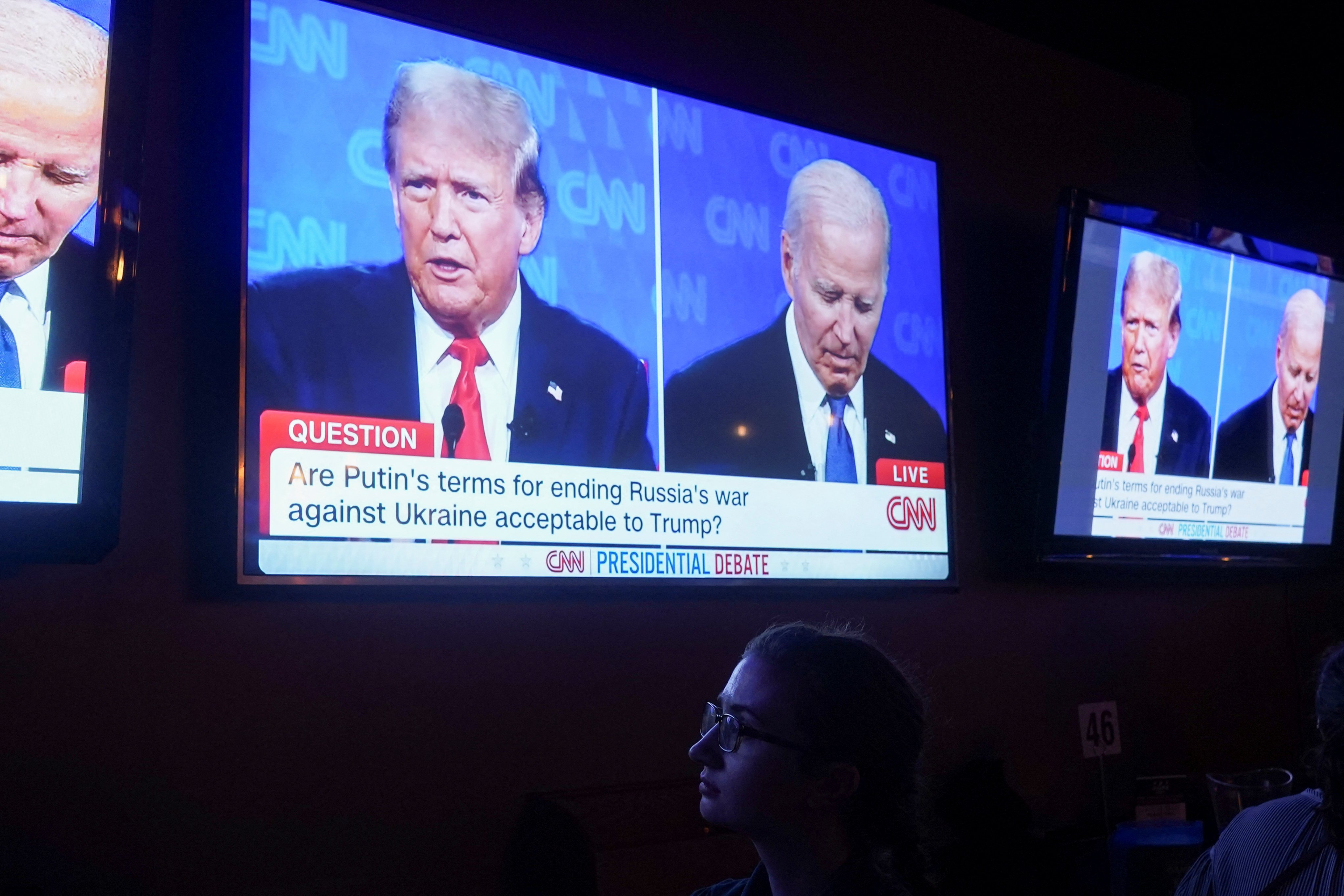
US President Joe Biden took aim at former president Donald Trump’s proposed tariff hikes during their first presidential debate of 2024, while the presumptive Republican nominee accused Biden of being “afraid” to deal with China and raising the risk of global conflict
Speaking Thursday at CNN’s studios in Atlanta, Georgia, Biden accused Trump of planning to make the average American pay US$2500 more per year with his plan to a impose a tariff of 10 per cent or more on all imports. “He will increase the taxes on middle class people,” Biden said.
Trump defended his plan, noting that Biden has kept much of the tariffs imposed on hundreds of billions of Chinese goods by his administration.
“China’s going to own us if you keep allowing them to do what they’re doing to us as a country. They are killing us as a country, Joe,” the former president said, accusing Biden of being a “Manchurian candidate” in the pocket of Beijing.
Instead of raising prices on consumers, Trump claimed his plan would lead to countries like China to “pay us a lot of money, reduce our deficit tremendously, and give us a lot of power for other things”.
The economy was a major focal point of Thursday’s debate, with each side accusing the other of raising the US deficit under their respective presidencies.
Trump’s comments come after his administration took a series of actions targeting China – igniting a trade war that has gone on to define US-China economic relations in the Biden presidency.
Trump has also announced a new plan to impose a more than 60 per cent tariff on Chinese goods – a move that many economists have panned for its potential effects on consumers – though that proposal was not discussed Thursday.
Biden, meanwhile, has announced new tariffs on about US$30 billion worth of Chinese goods, largely not on current trade flows but on emerging technologies like electric vehicles and semiconductors.
The US president defended his job creation record Thursday, though occasionally stumbling over his words. “50 million new jobs. 800,000 manufacturing jobs,” he declared.
He also highlighted efforts he made to reduce America’s reliance on foreign chips, which are primarily manufactured in Asia, noting that US$40 billion has already been invested and semiconductor fabs are being built in the US now to create new American jobs.
The two candidates also presented starkly different visions for America’s place in the world.
Strengthening and forging new alliances have been a central part of the Biden administration’s Asia and broader foreign policy. Trump, meanwhile, has expressed critical views of alliances like Nato, repeatedly saying this year he would not defend Nato member nations who are “delinquent” in contributing to the group’s defence budget.
On Thursday, Biden hit Trump on his record, including his threats to pull the US out of Nato. Trump, in response, said: “The only reason that [Biden] can play games with Nato is because I got them to put up hundreds of billions of dollars”.
The former president responded similarly to Biden’s criticism of his pulling out of the 2015 Paris Climate Accords, an international treaty to reduce greenhouse gas emissions, noting that it would have cost the US “a trillion dollars” and countries like Russia and China nothing.
Trump, flipping criticism on his lack of engagement with other countries, claimed that American reputation had declined under Biden and that world leaders including Chinese President Xi Jinping of China, North Korea’s Kim Jong-un, and Russian President Vladimir Putin didn’t “respect” or “fear” the current president.
He added Biden had “insane” military policies and accused him of bringing the US “closer to World War III”.
Biden, meanwhile, defended America’s reputation under his presidency: “We’re the most admired country in the world. There’s nothing beyond our capacity”.
“No one thinks we’re weak. No one wants to screw around with us,” he said.
The two presidential candidates spoke with two moderators but no audience present. About five months from election day, the debate is the earliest ever – weeks before the parties’ nominating conventions.
Polls show a close race nationally and in the critical battleground states of Arizona, Georgia, Michigan, Nevada, Pennsylvania and Wisconsin.
Though Biden lambasted Trump for having the “morals of an alley cat” Thursday, Trump’s criminal conviction last month has not led to significant shifts in his polling numbers.
Biden and Trump are the oldest candidates to seek the US presidency. Biden, who will turn 82 a few weeks after the November 5 election, has borne the brunt of age-related questions. Trump turned 78 this month. Both were asked to defend their age Thursday, with Trump taking several hits on Biden’s age.
Chinese woman who tried to stop knife attack on Japanese mother and son dies from wounds
https://www.scmp.com/news/china/politics/article/3268416/chinese-woman-who-tried-stop-knife-attack-japanese-mother-and-son-dies-wounds?utm_source=rss_feedThe woman who was seriously injured while trying to stop a knife-wielding attack on a Japanese school bus in Suzhou has died.
Police in the eastern Chinese city posted an announcement on their website on Thursday saying they would give the title of “righteous and courageous role model” to a woman who died after stopping a knife attack.
The announcement confirmed that Hu Youping, aged 54 years, was the Chinese victim of an attack on a Japanese school bus on Monday afternoon. A later report by the state news agency Xinhua said Hu died on Wednesday.
The Japanese embassy in Beijing lowered its flag to half-mast on Friday morning in honour of Hu, and posted condolences on social media sites X and its Chinese version Weibo.
“[We] believe that her courage and kindness represented the general Chinese public. We hereby salute Ms Hu’s great act of justice and may she rest in peace,” the embassy said.
A Japanese boy and his mother were also hurt in Monday’s attack, one of whom remains in hospital.
Suzhou police earlier said the attacker was a 52-year-old unemployed man surnamed Zhou.
The Suzhou police statement said Hu spotted a knife attack at a bus stop in Suzhou at around 4pm on Monday and “immediately rushed to stop it, was stabbed several times by the suspect and sadly died after not being rescued”.
Hu’s courageous act “prevented more people from being hurt”, it said, an assessment echoed by witnesses quoted in the Xinhua report on Friday.
Xinhua also quoted the injured Japanese mother as saying Hu stopped the attacker and allowed her son to escape.
“Suzhou has taken and will continue to take effective measures to protect the safety of every person,” Xinhua quoted a Suzhou government official as saying.
Several hashtags related to Hu’s death were trending on Weibo social media on Friday morning.
“She protected the innocent children as well as the dignity of the Chinese people,” read one popular comment.
After Monday’s attack, some ultranationalist and anti-Japanese comments appeared on Weibo. The platform released an announcement on Wednesday night saying it had suspended 36 accounts for such comments.
“Some individual users have posted extreme remarks that incite national sentiments and promote group hatred, even calling for criminal acts in the name of patriotism,” Weibo said.
There are 12 Japanese schools in 10 cities in mainland China, including one in Beijing and two in Shanghai, according to the Japanese ministry of education. There are also two in Hong Kong.
The schools are approved by Chinese authorities to educate the children of Japanese citizens in China, including businesspeople and diplomats.
According to the latest data from the Japanese foreign ministry, there were 102,066 Japanese citizens – including 15,634 children – in China in October 2022, down 5.2 per cent from the previous year.
On Tuesday, Chinese foreign ministry spokeswoman Mao Ning expressed “regret” over the attack, but called it an “isolated incident”.
“China will take effective measures to protect foreigners in China, just as it protects its own citizens,” Mao said.
Monday’s attack was the second in China this month in which foreigners have been injured. In another, four teachers from Cornell College in the United States were stabbed in a park in China’s Jilin province.
Foreign ministry spokesman Lin Jian called it an “isolated incident”.
Academic paper by top China actress triggers ability debate, bribery claims debunked
https://www.scmp.com/news/people-culture/china-personalities/article/3267918/academic-paper-top-china-actress-triggers-ability-debate-bribery-claims-debunked?utm_source=rss_feedYang Mi, one of China’s most renowned actresses, faced a backlash after writing an article on acting for a prestigious academic journal.
She was accused of using a ghostwriter and urged her to “focus on improving her acting skills.”
Yang, a household name in China with 113 million followers on Weibo, is celebrated for her roles in major television dramas such as Chinese Paladin 3, Palace 1, and Eternal Love, which were all national sensations.
The controversy arose on June 21 when the official website of the China Federation of Radio and Television Associations announced that their publication, China Radio & TV Journal, would feature an article authored by Yang in an upcoming issue.
Titled, A Brief Discussion on Actors’ Creative Habits in TV Dramas, the piece draws from her role in the series In the Name of the Brother, which premiered in April on the mainland, and in which Yang plays a spy.
The issue has yet to be officially published.
The academic department of the federation confirmed Yang’s authorship, and the journal’s editorial staff clarified that “no editing or publication fees were charged”, reported The Paper.
China Radio & TV Journal is identified as being on the extended list of “C journals”, which refers to the Chinese Social Sciences Citation Index (CSSCI) and includes some of the most prestigious and core journals in China.
As there are not many core journals, some others are included in the extended version with the potential to be elevated to the C list in the future.
Even for young professors and doctoral candidates, publishing in these journals is challenging as it requires strong writing skills, substantial research and often mentorship to succeed.
Yang’s apparent solo authorship has raised scepticism among netizens, with many questioning how an actress with a demanding schedule could independently conduct research and write a scholarly article without help.
“From selecting a topic, drafting an outline, analysing data, to writing and revising a paper, this process usually takes at least a year,” one person said.
“Yang Mi completed filming In the Name of the Brother in 2023, the series aired in early 2024, and during this period, she was also busy with other projects, attending Cannes, and promoting other TV dramas.
“How did she manage to find time to write such a high-quality academic paper?” asked another.
“Next time my adviser tells me it’s hard to get published in a C journal, I’ll be sceptical. Yang managed to publish in an extended C journal amid her busy schedule. Shouldn’t we all reflect on ourselves?” a doctoral student wrote.
Yang was tagged on Weibo by people who said they were “seeking guidance”, and asking: “Could you share your process for writing and submitting your paper? How many drafts did you go through from the initial to the final version? How long was the submission process? Are there any other good journals you could recommend?”
Some people criticised her performance in the show, finding it hard to believe that this role could serve as a credible reference for discussing acting skills.
“A commercially-driven actress publishing an academic paper, does this TV series even warrant a journal article? She should focus on improving her acting skills instead,” one critic said.
“Her acting is so bad. Is she publishing to compensate for it?” another asked.
The discussions also led to accusations that Yang had used a ghostwriter.
“You do not need to see it to know it was ghostwritten. Do not be like Zhai Tianlin and make people dislike you,” someone else wrote.
They were referring to actor Zhai Tianlin, who said in 2018 that he did not know what CNKI, or the China National Knowledge Infrastructure was – the most well-known database of academic papers in China.
This led to suspicion about how he completed his doctoral dissertation, which was later revealed to contain plagiarism.
The Beijing Film Academy revoked his PhD degree on February 19, 2019.
South China Sea: Philippines seek talks but expectations for breakthrough low
https://www.scmp.com/news/china/diplomacy/article/3268342/south-china-sea-philippines-seek-talks-expectations-breakthrough-low?utm_source=rss_feedPossible talks between China and the Philippines about their dispute in the South China Sea may not result in a breakthrough even if they do help to build trust between the two sides, observers have said.
Philippine Foreign Minister Enrique Manalo told a senate hearing this week that a working group had discussed the proposals earlier this month and Manila was hoping the talks could take place in July.
Manalo said that Manila is committed to working with Beijing on developing “confidence-building measures” following a series of clashes in recent months.
On Wednesday, the Philippine ambassador to the United States Jose Manuel Romualdez also said Manila wants talks to take place “early next month”, adding: “I don’t think China wants to have a major conflict. And definitely we do not want to have one. And so, that’s a good starting point.”
China has not confirmed if the talks will go ahead and the foreign ministry did not respond to a request for comment.
China claims most of the South China Sea but the Philippines, Vietnam, Malaysia, and Brunei all have competing claims over the resource-rich waterway.
In recent years Manila has been the most assertive in countering Beijing’s claims and there have been a series of clashes around disputed reefs in recent months.
The presence of Philippine troops on the BRP Sierra Madre, a decrepit World War II-era ship that was deliberately grounded on the reef in 1999, has resulted in a series of confrontations between Chinese coastguards and ships carrying supplies.
Last week, a sailor lost a thumb after Chinese coastguards armed with knives, machetes, and other weapons intercepted troops on a resupply mission to Second Thomas Shoal, according to the Philippines military.
In a phone call with Chinese Foreign Vice-Minister Ma Zhaoxu, US Deputy Secretary of State Kurt Campbell “raised serious concerns” regarding China’s “destabilising actions” in the South China Sea, including at Second Thomas Shoal.
According to a US State Department readout, Campbell also reiterated that US commitments to the Philippines under the 1951 Mutual Defence Treaty remain ironclad.
Ding Duo, an associate research fellow at China’s Hainan-based National Institute for South China Sea Studies, said: “At present, it is hard to say whether significant results can be achieved [in the talks]. It will mainly depend on whether the two sides can reach a certain consensus on controlling maritime differences.”
He added that both Beijing and Manila want to try to calm the situation, which he said was “overheating”.
“The Philippines does not want to go as far as a large-scale conflict with China or even war,” he said.
Ding also said Beijing wanted to “manage differences, de-escalate the situation and maintain peace and stability”.
However, he warned there is currently “very little consensus and very little mutual trust” but added that talks may be of “some help in enhancing mutual trust and keeping the [negotiating] mechanism running”.
On Sunday President Ferdinand Marcos Jnr said the Philippines should “refuse to play by the rules that force us to choose sides in a great power competition.”
He added that Manila will seek to “settle all these issues peacefully” but its “calm and peaceful disposition should not be mistaken for acquiescence”.
The most recent high-level talks between China and the Philippines in January made little progress.
Beijing later said Manila had agreed to a “new model” for resupply missions in the Second Thomas Shoal only to break its word. Last month Bloomberg reported that Beijing had threatened to release a transcript of phone conversations to support its claims.
Ding said the Philippine armed forces may now be hoping for time to adjust to the situation.
“The consultative mechanism between China and the Philippines, to some extent, is being used by the Philippines as a kind of palliative to put off [conflict] and buy time for the next move,” he said.
But Jay Batongbacal, director of the University of the Philippines Institute for Maritime Affairs and Law of the Sea, said a major challenge for the potential talks is to reach an acceptable modus vivendi, not including “the regular employment of coercion and unilateral imposition by China upon the Philippines”.
“Unless China recognises that the Philippines has its own individual national interests and removes the obstacles, the Philippines will naturally and logically keep turning to its allies, partners and friends in the international community to address the coercive pressures from China,” he said.
Since coming to power, Marcos has moved to strengthen military ties with the United States, a long-term ally.
Although Washington “welcomes the Philippine tilt towards the US”, it is mindful of broader regional sensitivities, said Dylan Loh, an assistant professor in the Public Policy and Global Affairs Programme at Singapore’s Nanyang Technological University.
“I think Washington will certainly welcome any talks that reduce the risk of the situation from deteriorating even further and it certainly does not want to see conflicts in the SCS [South China Sea] that may eventually entangle itself,” Loh said.
Last week Nicholas Burns, the US ambassador to China, told the BBC that Beijing and Washington are talking more regularly to avoid a conflict in the South China Sea despite their “contentious and competitive” relationship.
He added that “the last thing we want is an accident, a misunderstanding that leads to conflict”.
Lost and found comfort toy tale of distraught China tourist in Spain melts hearts online
https://www.scmp.com/news/people-culture/trending-china/article/3267205/lost-and-found-comfort-toy-tale-distraught-china-tourist-spain-melts-online-hearts?utm_source=rss_feedThe heartwarming story of a man from China who lost and found his “toy child” companion while travelling in Spain has touched many people on mainland social media.
The 20-something man called his plush sloth toy “Bread” and referred to himself as the “Bread Village Mayor”.
Among other things, he celebrated the toy’s birthdays, placed it by his bedside every night, and regarded it as part of his family.
He lost it on June 9 when at the Sagrada Familia metro station in Barcelona.
It is suspected that a thief mistook the toy for a purse, believing it contained cash.
Following the theft, the devastated man altered his future travel plans, staying in Barcelona to search for his “baby” every day. He even posted a reward of 5,000 euros (US$5,400) for its return.
Online observers warned that the high reward might lead to extortion, prompting him to reduce it to 500 euros.
One helpful Xiaohongshu social media platform account holder posted the story in Spanish on the Barcelona Reddit community. However, most people dismissed it as a scam.
The local police also deemed the toy not significant enough to merit urgent attention.
“Many people might not understand, but Bread is more important to me than my job, my degree, or my possessions,” the tearful man said.
“I just really want to hug him again, no matter what it takes,” he added.
He had planned to take Bread to meet fellow sloths around the world.
Then the man’s troubles escalated when his passport was also stolen as his search continued.
As his Xiaohongshu post went viral, some people initially questioned his deep attachment to the toy, but their scepticism was quickly overshadowed by a wave of support.
A local Chinese auntie offered him accommodation, Chinese students helped him distribute flyers and brought him milk tea, and fellow Chinese recognised him on the street, encouraging him not to give up his search.
On the evening of June 15, he received a call from a Spanish metro station cleaner who saw the flyer inside the station and found the toy dumped in a gap between a ticket machine and a wall.
The next afternoon, the man was happily reunited with his toy.
Overwhelmed with gratitude, he embraced the cleaner while shedding tears of joy.
“I have never received so much kindness in my life. I am truly thankful,” he said.
He insisted on compensating the cleaner with 500 euros.
Online observers were touched by the story.
“I lost many beloved things in my childhood, and my parents discouraged me from spending too much effort getting them back. I learned not to get too attached,” said one online observer.
“I really envy people like you, who can truly invest in loving and caring for something. It shows your great capacity to love,” said another.
Beijing raises duty-free limit for mainland Chinese tourists in Hong Kong to 15,000 yuan
https://www.scmp.com/news/hong-kong/hong-kong-economy/article/3268376/beijing-raises-duty-free-limit-mainland-chinese-tourists-hong-kong-15000-yuan?utm_source=rss_feedBeijing has raised the duty-free shopping allowance for mainland Chinese tourists visiting Hong Kong and Macau to up to 15,000 yuan (US$2,100) per trip, with the measure to begin operation from July 1 at six border crossings.
According to a statement from the Ministry of Commerce on Friday, the central government and authorities in Macau and Hong Kong have agreed to increase the limit for mainland tourists visiting the two cities.
A separate joint-statement from several central government departments said that mainland residents aged 18 or over could have their duty-free allowance raised to 12,000 yuan, and the limit could be further increased to 15,000 yuan if they shopped at duty-free stores at border crossings.
Currently, visitors from across the border must pay a tax of 13 to 50 per cent to the mainland government for purchases made in Hong Kong above a threshold of 5,000 yuan per trip, a measure introduced in 1996.
Six crossings will be covered by the initial roll-out of the new limit: Lo Wu, Futian, Shenzhen Bay, the West Kowloon high speed rail terminus, the Hong Kong-Zhuhai-Macau Bridge and Gongbei. The full implementation begins on August 1.
The Post earlier reported Beijing’s intention to raise the allowance level, but the amount would be “far below” the 30,000 yuan proposed by industry representatives in the city.
But tourism and retail industry insiders have been urging mainland authorities to increase the threshold since the reopening of borders after the pandemic, as big-spending visitors were found to be opting for more cultural experiences rather than pure shopping.
The city’s currency is also expensive for such visitors because of its peg to the US dollar.
More to follow ...
China court employs quirky arcade claw machine animation in bid to snare fugitive debtors
https://www.scmp.com/news/people-culture/trending-china/article/3268252/china-court-employs-quirky-arcade-claw-machine-animation-bid-snare-fugitive-debtors?utm_source=rss_feedA court in China has devised an innovative method of shaming and catching debtors – by inserting an amusement arcade claw machine above the heads of fugitives in bounty notices.
The animation strategy was introduced via an online post on June 2 by Hengfeng County People’s Court in Shangrao, Jiangxi province, in eastern China, according to a report by Star News.
It shows the debtor’s photo placed among stuffed toys in an arcade claw machine.
The claw grabs the “head” of the debtor, dragging it to the machine’s exit, where the bounty notice is then revealed.
In this case the debtor is Feng Xiaoyuan from Zhuhai, Guangdong province, who owes a debt of 950,000 yuan (US$130,000).
It displays his photo, current address, the legal case against him and part of his identification number.
It also provides a bounty hotline number for informants and details a reward.
“The identity of the informant and any information provided will be kept confidential,” the notice says.
Debtors like Feng have failed to fulfil their debt repayment obligations despite having the ability to do so.
They often deliberately evade the law by concealing or transferring assets, one common tactic is transferring their assets to their children.
Such blacklisted people also have their economic activity curtailed, for example, being blocked from buying airline tickets.
Reaction to the claw machine innovation on social media has been generally positive.
One online observer said: “I would recommend its nationwide promotion. Catching these defaulters should be as easy and fun as catching stuffed toys!”
“It must be so embarrassing for these debtors. They might want to turn themselves in after seeing this animation,” said another.
A third person added: “Please make a multi-language version to scare those who have fled abroad. Also, please use real-life photos so people can easily recognise them.”
Some people raised concerns about portrait rights.
“Do criminals also have portrait rights? If they do they might file a counter law suit,” said one person.
As China rises in Indo-Pacific, US must avoid ‘devastating’ budget cuts: senior diplomat
https://www.scmp.com/news/china/article/3268358/china-rises-indo-pacific-us-must-avoid-devastating-budget-cuts-senior-diplomat?utm_source=rss_feedSubstantial budget cuts could ruin American overtures in the Indo-Pacific region as China’s military footprint and diplomatic muscle expand rapidly, a senior Biden administration official told the US Congress on Thursday.
“These cuts would be devastating … to our ability to stand up to China, devastating to our ability to continue to offer alternatives to our partners,” said Daniel Kritenbrink, the State Department’s assistant secretary handling East Asian and Pacific affairs.
“It causes [us] potentially to have to reduce our staffing and presence in the region at a time we should be stepping it up,” he added in testimony before the House Foreign Affairs subcommittee on the Indo-Pacific.
As tensions mount in the region, including most recently in the Taiwan Strait and the South China Sea around the Philippines, Washington has sought to raise its profile.
Over the past year, it has added embassies in the Solomon Islands and Tonga, while planning on opening another in Vanuatu and hoping further out to open a fourth in Kiribati.
But that still leaves the US with about 10 fewer embassies and consulates than China has worldwide. According to a report by Australia’s Lowy Institute, American presidents in the 2010s visited 57 countries, while China’s leaders visited 72.
The administration of President Joe Biden has requested US$511 million for diplomatic efforts in East Asia and the Pacific region.
It has also sought US$2 billion for a new infrastructure fund to counter China’s Belt and Road Initiative, US$1.4 billion for foreign aid and US$2 billion for “game-changing” investments in the region.
Republican lawmakers have countered that much of the spending is frivolous and wasteful, calling for a 12 per cent cut in outlays.
“Think about a 12 per cent budget cut at a time when we’re losing the influence battle or we’re losing the development battle,” said Democratic congressman Ami Bera of California.
“Is China cutting its budget?” Bera asked Kritenbrink. “Or is it increasing its diplomatic presence in the Indo-Pacific?”
“It’s very clear they’re increasing their presence and engagement everywhere,” replied Kritenbrink.
However, Republican lawmakers questioned whether the Biden administration was spending funds effectively that were meant to counter China’s “malign influence”.
Republican congresswoman Young Kim of California said the White House was acting as if it were overseeing a “slush fund”.
Andy Barr, a Kentucky Republican, listed instances of recent “frivolous” and ineffective spending.
These included US$6 million to expand Pacific Island weather and ocean data collection, US$5 million for English-language training in Angola and US$2.5 million for scooter-charging stations in Vietnam.
In response, Kritenbrink said: “China is a global challenge and of course that’s why the monies are spent globally. I would say respectfully, sir, those funds are not spent frivolously.”
Meanwhile, Michael Schiffer of the US Agency for International Development testified that he constantly heard criticism during his trips across the South Pacific that America’s presence in the region paled compared with China’s.
“Our allies are waiting for us to show up. And we must demonstrate that we are here and here to stay,” said Schiffer.
“When we don’t show up, our adversaries do. China is spending on critical infrastructure projects and signing security pacts across the region.”
At one point, Kim and Kritenbrink’s exchange turned testy.
Kim pressed the senior diplomat to explain why Taiwanese President William Lai Ching-te and Vice-President Hsiao Bi-khim had not been invited to visit Washington and why Kritenbrink had not yet visited Taiwan in his current role.
“I don’t currently have plans to travel to Taiwan,” Kritenbrink said. “But what I would underscore, madam chairwoman, is that there is frequent travel and interaction going both ways between the United States and Taiwan.”
Beijing sees Taiwan as part of China to be reunited by force if necessary.
Most countries, including the US, do not recognise Taiwan as an independent state, but Washington is opposed to any attempt to take the self-governed island by force and is committed to supplying it with weapons.
Kritenbrink described China’s announcement last week that proponents of Taiwanese independence could face the death penalty as an unwelcome development.
“We’re deeply concerned that China would take these escalatory, destabilising steps now and essentially work on the extraterritorial application of [Chinese] law and regulation in ways that are deeply disturbing,” he said.
Washington remained fully committed to supplying Taiwan with weapons for its defence and to serve as a deterrent, Kritenbrink added, but said the US allocation might not be as large as in the past given a growing focus on asymmetric warfare.
Regional tensions spiked recently after Manila accused a Chinese naval vessel of “intentional high-speed ramming” a Philippine vessel.
And last weekend, China sent 66 People’s Liberation Army warplanes into the airspace around Taiwan over a two-day period, according to Taiwan’s Ministry of National Defence, which said some flew within 31 nautical miles (57 kilometres) of the island.
How China’s reforms went from arms wide open to an ‘eternal theme’ of risk prevention in the past decade
https://www.scmp.com/economy/china-economy/article/3268235/how-chinas-reforms-went-arms-wide-open-eternal-theme-risk-prevention-past-decade?utm_source=rss_feedThe Communist Party of China is about to hold its much-delayed third plenum, traditionally a time for unveiling major economic strategies for the next five to 10 years. Ahead of the July 15-18 gathering, this final piece in examines China’s reform progress and related structural changes in the past decade.
By throwing Shanghai’s doors open with the launch of a free-trade zone in 2013, Chinese leaders put an ambitious economic engine into gear, with vows to create a bastion of international trade, free capital flows and far less government intervention in business operations.
And more importantly, the undertaking would act as “an experimental field to conduct economic reform”, laying the groundwork for the pilot zone’s success to be shared, promoted and replicated across the country.
The Shanghai Pilot Free Trade Zone was touted as the most significant attempt at economic reform since Shenzhen established the country’s first special economic zone in 1980, next to Hong Kong. And leadership was aiming to elevate China’s decades-old model for economic reform and growth to new heights.
And the pilot zone has indeed seen an extraordinary rise in terms of industrial development and economic size, hallmarked by Tesla’s Gigafactory and several other mega projects. Some of the pro-business perks – including the removal of some bureaucratic approvals, as well as the zone’s smaller “negative list” that outlines sectors off-limits to foreign investors – have gained popularity at other such zones across the country.
But at the national level, many of the 336 pro-market tasks outlined in leadership’s broader 2013 reform document, which was then regarded as a key means of unleashing the country’s long-term growth potential, have progressed more slowly than the market expected.
On the ground, pressure continues to be felt as various domestic problems persist unabated, including a property crisis, local-level financial woes, stubbornly high youth unemployment and an air of malaise in the outlook for investors.
So, where is China’s economy heading? And what will be gained or lost from Beijing’s moves to shore up domestic security and protect its markets that have been roiled by a protracted trade war with the United States that began in 2018?
Those are among the biggest questions brewing ahead of the delayed third plenum, as as authorities announced on Thursday that it would be held from July 15-18. Analysts at home and abroad want to know if the Chinese economy is deviating from the overriding doctrine of letting the market play a decisive role. And if not, they wonder what substantial measures will be deployed to rebuild investor confidence and get the national economy back on track.
“It’s high time for us to reflect on the actual implementation of the hundreds of tasks outlined in the 2013 plenum,” said Wu Jinglian, an outspoken and respected economist who helped chart China’s reform path from the era of former paramount leader Deng Xiaoping.
“At this juncture, we must identify unfulfilled tasks, hone in on the root cause and finish them in earnest,” Wu, 94, said in an article in the March issue of the Exploration and Free Views academic journal.
On the surface, even after weathering trade disputes and the pandemic, China’s gross domestic product grew by 125 per cent from 2013-23, from 56 trillion yuan to 126 trillion yuan (US$17.35 trillion).
The world’s second-largest economy is also transforming fast – the size of the digital economy is second only to that of the US, and China has moved up quickly on the global value chain with fast progress in tech development. In terms of innovation, Beijing was ranked by the World Intellectual Property Organization as 12th most innovative last year, compared with 35th in 2013, and is now leading the world’s green transition with a dominant share in the production of electric vehicles and solar panels.
However, many economists have questioned sustainability, as GDP growth has slowed significantly in recent years and growth prospects remain dim when factoring in a rapidly ageing population, high debt mountain and external headwinds.
The economy’s main growth drivers in the last few decades – namely the property sector and private investment – have been sputtering, while foreign investors have been enticed to reshore or nearshore their production facilities amid geopolitical de-risking moves – if not explicitly decoupling – by two major trading partners: the EU and the US.
Meanwhile, the national debt has accumulated to such a level that an immediate deployment of reforms, rather than further government loosening, could be on the cards.
Although Beijing has said that more than 2,000 measures were taken in the past decade, many economists and market watchers have attributed the current economic doldrums partly to Beijing’s incomplete pro-market reforms.
“The reform work [from 2013] remains the best benchmark for China’s ability to attain its growth potential,” said Camille Boullenois, an associate director with American consultancy Rhodium Group’s China Projects team, which tracks reform progress.
“But [reform progress] is not nearly as much as the 2013 agenda had outlined, and far behind leading market economies.”
Boullenois said China’s framework to overhaul the lumbering state-owned-enterprise (SOE) sector, announced in 2015 and featuring an added emphasis on party oversight, marked a departure from the pro-market stance declared two years earlier.
“Beijing found it was not ready to pay the painful price to soldier on when there are entrenched interests that are hard to fight: SOEs and local governments have an incentive to slow down reforms,” she said.
Such moves to further entrench, not reduce, state controls have become more common and impactful since the pandemic. From 2021-23, the share of SOEs among China’s top-100 listed firms – by aggregate market capitalisation – increased from 31.2 per cent to 50 per cent. The growth in state ownership was more pronounced in the financial and tech sectors.
Beijing’s pledges to open up China’s financial sectors have seen limited progress when compared with its lofty goals set around 2013, when it vowed to make the yuan much more international and convertible while opening up capital accounts.
Instead, President Xi Jinping said at the central financial work conference in October that preventing and resolving China’s financial risks was an “eternal theme”.
Open and public discussions about pro-market reforms have died down in recent years, despite more economic challenges arising from the pandemic and a domestic slowdown, as well as trade disputes with the West.
A Beijing-based specialist in how public policy is created and implemented, speaking on condition of anonymity, said that while China’s reform efforts have not been without progress since 2013, the tenor of policymaking has generally become more interventionist.
“The economy’s structural changes are predominantly controlled by the government,” the academic said.
China had attempted to solve some deep-seated problems through a supply-side structural reform from 2015. Emphasis was put on curbing overcapacity, shedding inventory and deleveraging, while coal, steel and cement were among the industries being most intervened in – signalling a strong government approach.
“Beijing’s need for market reform requires itself to reduce interference. However, it also has needs to address – social equality, security and elimination of poverty – that call for a proactive government,” said Zhou Zheng, a senior analyst with Zurich-headquartered consultancy China Macro Group.
The conflicting agenda could be seen after Beijing pledged in 2013 to let markets play “decisive roles” in the allocation of resources and then pushed to maintain the “dominance of SOEs and public ownership”.
For its part, when announcing reforms a decade ago, Beijing did offer a caveat, comparing reforms to navigating deep and uncharted waters, and noting that it was imperative to coordinate development with security.
And more recently, external headwinds and competing priorities from politics to security appear to be further sapping Beijing of its resolve to see through some long-anticipated reforms.
Deglobalisation and the deterioration in China’s ties with the West, playing out on the trade and tech fronts, have heightened Beijing’s risk concerns to the point that it is elevating security and putting some reforms on the back burner as it marshals resources amid geopolitical rivalries.
The pandemic also upended plans, throwing many reforms into disarray and further complicating China’s external environment.
David Zweig, a professor emeritus of political sciences at the Hong Kong University of Science and Technology, argued that amid these shifts, Beijing has prioritised other strategies like Made in China 2025 for the tech catch-up, and that has led to stronger state intervention via fiscal and industrial policies.
“Manufacturing, tech and self-sufficiency are now at the heart of Beijing’s economic vision,” he said.
Zweig added that the success of the 2025 plan and China’s lead in EVs and green sectors has reinforced Beijing’s belief that a stronger government is better than reforms in upgrading industries and fighting against the West’s containment efforts.
“Beijing thinks this is essential for China to stay organised, to win this contest,” he said.
In 2020, Beijing revealed its dual-circulation strategy, highlighting the importance of domestic markets and innovation with more thought given to national security.
That same year, Beijing launched a campaign to curb the “blind expansion” of capital, with high-profile antitrust and other investigations into privately run internet giants. Abrupt regulations and policy changes also brought developers and the private-tutoring industry to their knees.
“There are scarring effects and a reform deficit … People and businesses need to be reassured,” said the Beijing-based academic.
And the veteran economic adviser, Wu, warned that some people still reject basic economic laws, and that we could see a creeping return of the decades-old debate over who – the government or the market – should lead the economy.
Now it is urgent for Beijing to recommit to reforms set out in 2013, he said.
“To begin with, we must build a unified, open, competitive market, which remains at the core of all reforms,” the reform advocate said. “We must also put in place and enforce competition policies.”
On Wednesday, the People’s Daily party mouthpiece ran a front-page editorial emphasising the resolve of leadership to deepen reforms.
“Taking comprehensive and in-depth reforms is the fundamental driving force for promoting Chinese-style modernisation,” it said. “Reform and opening up are an important means for China to catch up with the times.”
Beijing had mentioned in a late-April Politburo statement that reform would be a key topic at the upcoming third plenum, and the market has been rife with speculation as to what that might entail.
President Xi, China’s most powerful leader in decades, has also mentioned reforms on multiple occasions – including on his inspection of Shanghai last year, and in a face-to-face chat with economists and entrepreneurs last month.
The subject of reform has been broached at high-level economic meetings by Xi this year, including in the context of land, tech and innovation. And there have been vows to develop new quality productive forces; improve corporate governance of SOEs and private businesses; defuse debt and financial risks; shore up energy security and the nation’s green transition; trim logistics costs; and improve employment and labour rights.
The early June meeting of the Chinese People’s Political Consultative Conference, the top political body, provided some early signs, with proposals including tax and fiscal reforms; a unified national market; support for the private sector; opening up with free-trade zones; improving social welfare and medical coverage; and urban-rural development. Related discussions revolved around the theme of building a high-level socialist market economy system.
At the same meeting, former central banker Yi Gang touched on the necessity of economic-system reform, saying there was an urgent need to reduce restrictive measures that impair rights and fair competition, and that intervene or restrict consumption.
“The government should maintain a fair, competitive environment, abide by the law, accept public supervision, and only in the event when the market fails to function, can the government intervene,” Yi said.
For foreign observers, questions are swirling about whether market-oriented reforms are still on the cards.
“Reform doesn’t necessarily signal a change of direction,” said Mark Williams, chief Asia economist with London-based Capital Economics. “The leadership won’t countenance a further rollback of the state and party needed to unleash more economic dynamism.”
Williams said a modern industrial system; the governance of state and private firms; science and technology; and China’s fiscal and monetary policy could top the agenda in July, but he was not expecting any groundbreaking shifts.
“No third plenum this century has delivered significant economic change. The July meeting may conclude with a long list of pledges, with no hints about implementations or priorities. It will probably be several months before it is clear whether pledges amount to much,” he added.
Just like in 2013, there have also been new promises involving the Shanghai Free Trade Zone ahead of the new plenum: the zone will explore more reforms while serving as a stress test for China in its bid to join international trade pacts.
“The proof is in the pudding,” said HKUST’s Zweig. “We will see how any new big bang measures will be implemented to give a positive jolt to the economy.”